
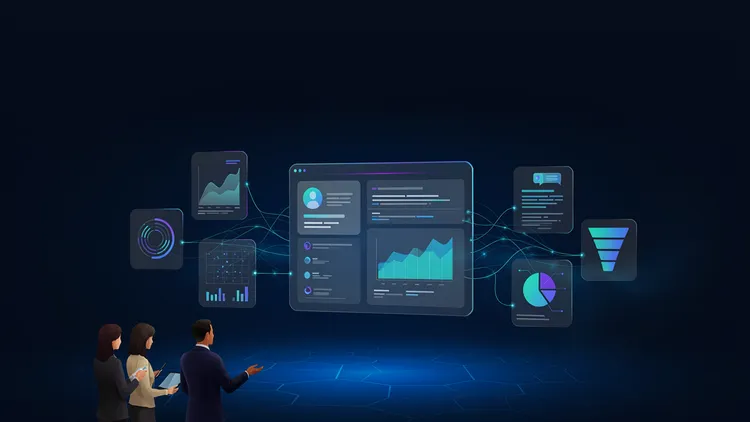
AI Is Changing What CRM Systems Can Do
Customer relationship management is entering a new phase. For years, CRM platforms primarily served as digital repositories for contact details, sales activity, customer interactions, and account histories. Now, artificial intelligence is turning these systems into more active sources of business intelligence.
AI Powered Customer Intelligence is helping companies move beyond simply storing information. Instead, modern CRM platforms can interpret customer behavior, identify patterns, predict likely outcomes, and support faster decisions. As a result, sales and marketing teams can spend less time searching through data and more time acting on meaningful insights.
This shift is becoming increasingly important as businesses manage larger volumes of customer information across websites, applications, email, social platforms, support channels, and digital transactions.
Why Customer Intelligence Is Moving Into CRM
Traditionally, customer intelligence often existed across separate analytics platforms and business applications. Consequently, teams had to collect information from different sources before they could understand what was happening.
However, AI is changing that process. CRM systems can increasingly connect customer history with behavioral signals and predictive models within the same environment. Therefore, employees can receive relevant insights while they are already working with customer records.
For example, an AI enabled CRM could recognize that a customer has become more active, identify a potential buying signal, and recommend a suitable follow up. Similarly, it could detect declining engagement and alert an account team before the relationship becomes difficult to recover.
This makes AI Powered Customer Intelligence more practical because insights are delivered closer to the moment when action is required.
Smarter Sales Decisions Through Predictive Insights
Sales teams are among the biggest beneficiaries of this transformation. Rather than relying exclusively on historical reports, sales professionals can use AI to understand which opportunities deserve immediate attention.
Predictive scoring can evaluate engagement patterns, previous interactions, purchasing behavior, and other signals. Consequently, sales representatives can prioritize accounts with stronger potential while reducing time spent on low probability opportunities.
At the same time, AI can support more personalized communication. By analyzing previous conversations and customer preferences, CRM platforms can help sales teams understand what matters most to individual prospects.
These developments are closely connected to broader Sales strategies and research, where personalization, timing, and data driven decision making continue to shape competitive sales environments.
Marketing Becomes More Contextual
Marketing teams are also gaining new opportunities as CRM intelligence becomes more sophisticated. Instead of treating customer databases as static lists, businesses can use AI to identify changing interests and engagement patterns.
For instance, a CRM system may recognize when a customer is showing stronger interest in a particular service. Subsequently, marketing teams can adjust messaging, campaign timing, or content recommendations based on that behavior.
This creates a closer connection between customer data and marketing execution. Moreover, it supports more relevant experiences because campaigns can respond to actual customer activity rather than relying only on broad audience categories.
The development also reflects wider Marketing trends analysis, particularly the growing importance of personalization, automation, predictive analytics, and first party customer data.
Customer Experience Gains Greater Importance
The value of intelligent CRM systems extends beyond sales and marketing. Customer service teams can also benefit from a more complete understanding of customer relationships.
When relevant information is available in one place, support representatives can identify previous issues, recent purchases, communication history, and potential concerns more quickly. As a result, customers may receive faster and more informed assistance.
AI Powered Customer Intelligence can also help identify recurring problems. If similar complaints appear across a large customer base, businesses can recognize emerging issues sooner and take corrective action.
Furthermore, this creates an opportunity to move from reactive support toward proactive customer care.
The Business Impact Goes Beyond CRM
The influence of intelligent CRM technology is spreading across the wider organization. Executives can use customer insights to understand market behavior, while finance teams can connect customer activity with revenue patterns and business forecasts.
Likewise, HR teams can observe changing workforce requirements as organizations adopt more AI driven customer operations. These developments connect CRM innovation with broader Technology insights, IT industry news, HR trends and insights, and Finance industry updates.
As a result, CRM is increasingly becoming part of a larger business intelligence ecosystem rather than functioning as an isolated sales tool.
Data Quality and Trust Remain Critical
Despite the potential, intelligent CRM systems are only as reliable as the information they use. Poor data quality, duplicated records, incomplete profiles, and outdated information can weaken AI generated recommendations.
Therefore, businesses need strong data governance alongside advanced technology. Privacy and transparency are equally important. Customers should understand how their information is being used, while organizations must establish clear controls around sensitive data.
Human oversight also remains essential. AI can identify patterns and suggest actions, but employees still need to evaluate context and make responsible decisions.
What Businesses Should Prepare For
The next stage of CRM development will likely focus on making intelligence increasingly proactive. Instead of waiting for employees to request reports, systems may continuously identify opportunities, risks, and customer needs.
For businesses, the priority should not simply be adopting another AI feature. Instead, organizations should determine which customer decisions can genuinely benefit from automation and predictive intelligence.
They should also focus on clean data, employee training, responsible AI practices, and measurable business outcomes. In addition, integrating sales, marketing, service, and finance data can create a stronger foundation for meaningful customer insights.
Practical Insights for Business Leaders
AI Powered Customer Intelligence is most valuable when it leads to a clear business action. Companies should begin by identifying repetitive decisions where better customer information could improve speed, accuracy, or personalization.
Next, teams should measure outcomes rather than focusing only on technology adoption. Improved conversion rates, stronger retention, faster service, and better customer engagement provide more meaningful evidence of success.
Above all, organizations should treat AI as an intelligence layer that strengthens human decision making. When technology and employee expertise work together, CRM systems can become significantly more useful, responsive, and strategically important.
For more Technology insights, IT industry news, HR trends and insights, Finance industry updates, Sales strategies and research, and Marketing trends analysis, stay connected with InfoProWeekly. Reach out to InfoProWeekly to explore more expert perspectives on technology and the evolving digital business landscape.
Connect with InfoProWeekly today and stay informed about the innovations shaping tomorrow’s organizations.