Meta Brings Muse Into the Small Business Market
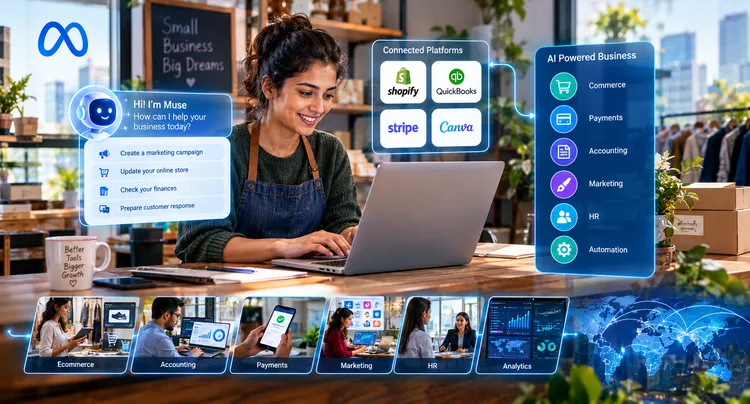
Meta is expanding its AI agent Muse to support small businesses with a broader set of business tools and integrations. The move gives entrepreneurs access to AI assistance across areas such as commerce, accounting, payments and marketing.
The expansion comes shortly after Meta launched Muse as a personal AI agent designed to perform tasks rather than simply respond to questions. Now, the company is extending that approach toward business users as it looks for new ways to make AI useful across everyday operations.
For small companies, this shift could make AI more practical. Instead of using separate tools for different tasks, business owners may increasingly rely on intelligent systems that connect several parts of their workflow.
New Connections Could Simplify Business Operations
Meta is adding connections with platforms including Shopify, QuickBooks, Stripe and Canva. These integrations are designed to help small businesses manage activities related to online stores, accounting, payments and creative work.
For example, a business owner could benefit from an AI system that understands information from an online store while also working with payment and financial tools. Connecting these systems can reduce the need to move information manually between different applications.
Furthermore, the integration with creative platforms could help businesses prepare marketing materials more efficiently. This could be particularly useful for smaller companies where one person often handles sales, marketing, customer service and administration.
AI Could Change How Small Businesses Find Customers
Customer acquisition is another important part of the expansion. Meta says its business focused AI efforts are intended to help companies grow and reach customers.
That direction connects closely with Meta’s enormous advertising ecosystem. Small businesses already use platforms such as Facebook and Instagram to promote products and services. Adding intelligent agents could eventually connect advertising activity with other parts of the customer journey.
Consequently, business owners may have more opportunities to use AI for research, campaign preparation, customer communication and follow up activities. This could influence future sales strategies and research as companies look for faster ways to understand customer demand.
Muse Reflects a Broader Shift Toward AI Agents
The development also shows how AI is moving beyond simple chatbot experiences. Meta introduced Muse as a system that can perform tasks, work through a browser and continue working toward longer term goals. It can also request approval before completing sensitive actions such as sending emails or making purchases.
This agent based approach is becoming an important part of the wider technology market. Instead of asking an AI system for information and completing the work manually, users can increasingly ask an agent to perform multiple steps.
Meta has also announced plans to bring Muse to AI glasses and expand its network of connectors. The company has described connectors as an important part of making the agent useful across different services.
Small Businesses Could Gain More Automation
Small companies often operate with limited staff and limited time. Therefore, automation can have a meaningful effect when it removes repetitive administrative work.
An AI agent connected to commerce, payment and accounting systems could potentially help organize information and prepare tasks for review. However, businesses should still maintain human oversight for financial decisions, customer communications and other sensitive activities.
This is especially important because connected AI systems can gain access to valuable business information. Permissions, audit records and secure authentication will therefore become increasingly important as agents become more capable.
The Impact Could Reach Finance and HR
The expansion also has implications beyond sales and marketing. Finance teams could benefit from connected financial information, while HR teams may eventually use AI agents for administrative workflows and employee support.
These developments fit into broader HR trends and insights around workplace automation and changing employee responsibilities. At the same time, finance industry updates increasingly focus on how intelligent automation can improve efficiency without weakening controls.
For IT teams, the challenge will be connecting these tools safely. Strong identity management, access controls, data protection and monitoring will become essential parts of the implementation process.
Marketing Teams May Need New Strategies
Marketing professionals may also need to rethink how campaigns are created and managed. AI agents can potentially connect customer information, creative tools and commerce platforms, creating a more connected marketing workflow.
As a result, marketing trends analysis will increasingly focus on how AI influences customer discovery, content creation, advertising and conversion. Human creativity will remain important because businesses still need distinctive ideas, brand positioning and customer understanding.
At the same time, technology insights will become increasingly important for marketing professionals who need to understand how AI systems interact with their existing platforms.
Meta Is Building a Larger Business AI Strategy
The small business expansion arrives alongside Meta’s broader enterprise AI push. On September 28, Meta announced its Meta Enterprise Platform, which will bring technologies including Muse, Meta Business Agent, Muse API and Muse Code to businesses and developers.
This suggests that Meta is looking beyond consumer AI applications. The company is developing a wider ecosystem where AI agents can support individuals, small businesses and larger organizations.
The strategy could create new opportunities for software developers, technology providers and businesses that want to build AI based workflows around Meta’s platforms.
Valuable Insights for Small Business Leaders
Small businesses should view the expansion as part of a larger shift toward connected AI workflows. The biggest opportunity may not come from using an AI chatbot for isolated tasks. Instead, greater value could emerge when AI connects sales, marketing, finance, commerce and customer operations.
Businesses should begin by identifying repetitive processes that consume employee time. They can then evaluate where AI assistance could reduce manual work without removing necessary human review.
Security should remain a priority. Companies should understand what information an AI agent can access, which actions it can perform and how those actions are recorded.
For employees, continuous learning will also matter. Teams that understand AI tools, data protection and workflow automation will be better prepared for changing responsibilities across technology, finance, sales, HR and marketing.InfoProWeekly delivers practical technology insights and IT industry news to help business professionals understand fast moving digital changes.
Reach out to InfoProWeekly for deeper perspectives on technology, business strategy and emerging industry trends.