AI Is Reshaping the Final Quarter
The final quarter is one of the most important periods for global advertisers. Holiday shopping, seasonal promotions and year end spending create intense competition for consumer attention. In 2026, however, brands are entering this period with a major change in the advertising environment.
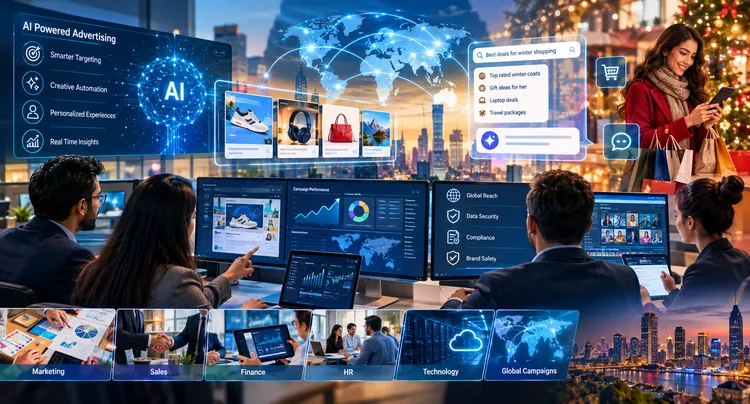
Artificial intelligence is becoming part of campaign planning, creative production, audience targeting and performance measurement. As a result, Q4 advertising campaigns are becoming more automated while marketers gain new ways to understand customers.
The change is particularly visible in search and shopping. Google and Microsoft are both highlighting how AI is influencing discovery, comparison and purchase decisions during the 2026 holiday season. Microsoft says nearly three in four consumers plan to use AI tools during holiday shopping for activities such as researching products, comparing options and finding deals.
Search Is Becoming More Conversational
Traditional search advertising relied heavily on keywords and short queries. That behavior is changing as consumers increasingly ask detailed questions through conversational AI experiences.
Google is introducing new advertising formats for its AI powered Search experience, using Gemini to help connect advertising with more conversational product discovery. The company says its new approach is designed to help consumers research products and services based on more complex needs.
Consequently, brands need to think beyond individual search terms. Their content and advertising need to answer broader questions about products, pricing, benefits, comparisons and customer needs.
Creative Production Is Getting Faster
AI is also changing how advertising creative gets produced. Instead of waiting weeks for every variation of an image, video or advertisement, marketing teams can use generative systems to create and test multiple versions much faster.
Google says advertisers created nearly 70 million Gemini generated creative assets in AI Max and Performance Max during Q4 of the previous year. The company is also expanding tools that use generative AI for image and video creation.
This does not mean every advertisement should look machine generated. Rather, AI can give creative teams more options while people remain responsible for brand identity, storytelling and final approval.
Targeting Is Becoming More Intelligent
Audience targeting is another area undergoing rapid change. AI systems can analyze signals from customer behavior and use those signals to identify people who may be more likely to engage or purchase.
Google has expanded AI Max for Search campaigns and says the full feature set can produce an average seven percent increase in conversions or conversion value at a similar cost per acquisition or return on advertising spend compared with search term matching alone.
For global brands, this can make campaign optimization more responsive. Instead of relying only on manually defined audiences, advertisers can increasingly allow intelligent systems to discover relevant opportunities.
Indian Festive Shopping Shows the Shift
India provides a strong example of how AI is entering seasonal advertising. Google reports that shoppers used generative AI chatbots an average of 7.5 times during their Navratri and Diwali shopping journey in 2026.
The same research found that 51 percent of shoppers who used AI during their journey said it helped them make decisions, while 38 percent said it reduced decision making time.
Therefore, brands targeting Indian consumers during the festive period need to consider AI discovery alongside traditional search, social media and ecommerce channels.
Marketing Measurement Is Changing Too
AI is not only influencing how advertisements are created and delivered. It is also changing how marketers evaluate results.
Campaign teams can increasingly analyze customer signals across multiple channels and identify patterns that would be difficult to detect manually. McKinsey reports that three quarters of surveyed advertising leaders expect AI to increase total media spending, while one third expect it to produce at least a 10 percent increase in return on advertising spend.
However, these findings come from a survey of 182 United States based advertising and marketing leaders. They should therefore be treated as industry sentiment rather than a guarantee for every advertiser.
Human Creativity Still Matters
Despite rapid automation, successful advertising still depends on human judgment. AI can generate variations and analyze information, but it does not automatically understand every cultural reference, brand relationship or emotional response.
This becomes particularly important for global brands. A campaign that works in one country may not connect with consumers elsewhere because expectations, language and cultural context differ.
Marketing teams therefore need to combine automation with strong creative direction. That balance can help brands move faster without losing authenticity.
Sales and Marketing Teams Are Becoming More Connected
The increasing use of AI is also bringing advertising closer to sales. Campaign data can provide insights into customer interests, product demand and purchase intent.
Sales strategies and research can use these signals to understand which audiences are responding to specific offers. Meanwhile, Marketing trends analysis can help teams identify changes in customer behavior before they become obvious across the wider market.
This connection can make Q4 campaigns more closely aligned with actual business outcomes rather than focusing only on impressions or clicks.
Technology and Workforce Skills Are Changing
AI powered advertising requires more than marketing knowledge. Teams increasingly need data literacy, automation skills and an understanding of how AI systems make targeting and creative decisions.
Technology insights and IT industry news are therefore becoming relevant to marketing leaders. HR teams also need to consider these changes when planning training and recruitment, making HR trends and insights part of the broader advertising transformation.
Finance teams have a similar role because advertising budgets need careful monitoring as automated systems influence spending decisions. Finance industry updates can help businesses understand the wider economic conditions affecting consumer demand and marketing investment.
Valuable Insights for Global Brands
The biggest change in Q4 advertising is not simply that AI can create advertisements faster. It is that artificial intelligence is becoming connected to discovery, targeting, creative development, measurement and customer decision making.
Global brands can benefit from testing AI powered tools while maintaining clear human oversight. They should also measure business outcomes rather than relying entirely on automated platform recommendations.
Most importantly, advertisers should prepare for consumers to discover products through traditional search, social platforms and conversational AI at the same time. Brands that understand this changing journey can build more flexible campaigns and respond more effectively as customer behavior evolves.
Stay informed about the technology and marketing changes shaping global advertising with practical insights from InfoProWeekly.Reach out to InfoProWeekly for timely research and perspectives on AI, marketing, technology and the future of digital business.