
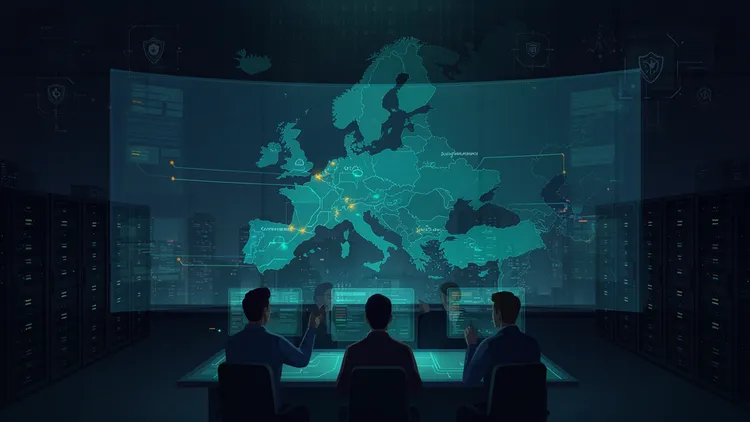
Europe Faces a Cybersecurity Information Gap
Cyberattacks are becoming more complex, frequent and difficult to contain. At the same time, European countries are working to strengthen cooperation and improve their ability to respond to incidents.
However, a new assessment from the European Court of Auditors has highlighted an important weakness. Member states are not consistently sharing enough information about cyber incidents with European partners.
The auditors said poor information sharing is undermining efforts to combat cyberattacks across the European Union. They also pointed to national security rules and differences between countries as barriers to faster cooperation.
The issue matters because a cyberattack in one country can quickly affect businesses, infrastructure and public services in several others.
Why Data Sharing Matters
Cybersecurity depends heavily on timely information.
When one organization discovers a new attack technique, sharing details can help other organizations protect themselves before the same method is used against them. Information about malware, vulnerabilities and attack patterns can provide valuable early warnings.
However, if countries keep incident information within national systems, other members may not know that a threat is spreading.
Consequently, European cyber defenses can become less effective even when individual countries have strong security capabilities.
Auditors Highlight Cross Border Challenges
The European Court of Auditors reviewed how the EU is responding to cybersecurity incidents and identified weaknesses in cooperation.
According to reporting on the findings, the auditors highlighted a ransomware incident involving an aviation technology provider in September 2025. The attack disrupted airport operations in several European cities, including London, Brussels, Berlin and Dublin. The affected countries did not notify the EU cybersecurity agency or other member states about the incident.
The example illustrates why rapid information exchange matters. An incident affecting several countries requires more than an individual national response.
National Rules Can Complicate Cooperation
One challenge involves national security legislation.
Countries have their own rules governing sensitive information. These rules can make it difficult to determine what information can be shared and with whom.
As a result, security agencies may hesitate to distribute information about incidents that could affect other countries.
The auditors identified this tension as one of the factors limiting effective cooperation. The problem is therefore not simply a lack of technology. Legal and organizational differences can also slow the flow of important information.
Reporting Gaps Make Threats Harder to Measure
Reliable data is also important for understanding the scale of cybersecurity threats.
The auditors noted that no EU country has reported a large scale cybersecurity incident since 2016, even though the official definition covers attacks affecting at least two member states.
That does not necessarily mean large cross border incidents are not occurring. Instead, the reporting gap can make it harder for European institutions to build a complete picture of the threat environment.
Better information could help policymakers, security agencies and businesses understand where vulnerabilities are increasing.
Cybersecurity Investment Needs Better Coordination
The European Union is investing significant resources in cybersecurity.
Reporting on the auditors findings said the bloc has allocated about 1.4 billion euros to cybersecurity within its current budget. However, the auditors concluded that greater spending and stronger cooperation structures do not automatically produce effective results when information remains fragmented.
Therefore, investment needs to be supported by practical coordination.
Technology insights increasingly show that cybersecurity depends on connected systems. The same principle applies to institutions. Security teams need mechanisms that allow relevant information to move quickly and safely.
Businesses Could Feel the Impact
The data sharing problem is not limited to governments.
European businesses operate across multiple countries and often depend on shared cloud platforms, suppliers, payment systems and technology providers. A cyberattack affecting one organization can therefore create risks for partners in other markets.
For example, a compromised technology provider could expose several customers at the same time.
IT industry news continues to highlight how interconnected modern business infrastructure has become. Consequently, companies need to understand both their own security posture and the risks created by external partners.
Cybersecurity Teams Need Better Information
Security professionals depend on accurate information when investigating incidents.
If threat intelligence arrives late, analysts may spend more time determining whether an attack is isolated or part of a wider campaign.
Faster information sharing can help teams compare incidents, recognize common attack methods and improve defensive measures.
However, information sharing must also protect sensitive data. Organizations need clear rules about classification, access and secure communication.
This balance between transparency and security will remain important as European cybersecurity cooperation develops.
Employees Are Part of the Security Network
People also play an important role in cybersecurity.
Employees may be the first to notice suspicious emails, unusual account activity or unexpected system behavior. Therefore, organizations need training that helps workers report potential incidents quickly.
HR trends and insights increasingly connect employee training with broader technology risk. Cybersecurity awareness should not be treated as a one time exercise.
Instead, companies can build regular training and reporting processes into everyday operations.
Cyber Risk Can Affect Business Functions
Cyber incidents can affect nearly every business department.
Finance teams may face payment disruption or fraud risks. Sales teams can lose access to customer systems. Marketing teams may experience website or advertising platform interruptions.
Finance industry updates, sales strategies and research, and marketing trends analysis are therefore increasingly connected with cybersecurity planning.
A security incident can quickly become a business continuity problem.
Europe Needs Faster Cyber Coordination
The auditors findings highlight a broader challenge for the EU. Cybersecurity cooperation requires more than shared technology. It also requires compatible rules, reliable reporting and trust between organizations.
The European Court of Auditors has emphasized that effective cooperation depends on countries and institutions working together. The ECA also maintains cooperation structures with national supreme audit institutions across the EU.
Improving incident reporting could help create a clearer picture of emerging threats and support faster responses.
Valuable Insights for Businesses
The situation offers an important lesson for organizations of every size. Cybersecurity should not stop at protecting individual systems.
Businesses should also understand how they share incident information with suppliers, partners and relevant authorities. Clear reporting procedures can reduce delays when an attack occurs.
At the same time, organizations should review how sensitive security information is classified and protected during communication.
Better data sharing cannot prevent every cyberattack. Nevertheless, faster and more reliable information can help organizations recognize threats earlier and coordinate their response more effectively. Stay informed about cybersecurity, technology and business developments with InfoProWeekly. Reach out to InfoProWeekly for practical insights into the trends shaping digital security and modern business.