
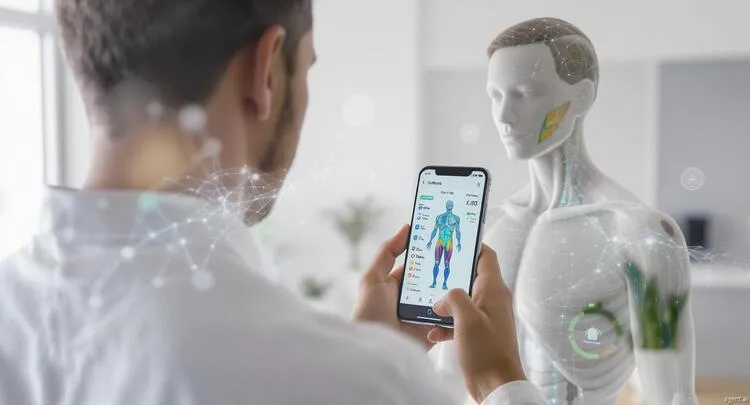
Body Mass Index has served as a simple measure of weight related health for decades. However, BMI does not show how much body fat a person carries or where that fat is stored.
That limitation has encouraged researchers to explore more detailed ways to assess cardiometabolic health. One promising approach combines artificial intelligence with smartphone imagery.
Researchers are now exploring whether ordinary smartphone photographs can provide useful information about body composition and metabolic health. This approach could eventually complement traditional measurements and give people a broader picture of their health.
How Smartphone Images Could Reveal More
The idea is relatively simple. Instead of relying only on height and weight, an AI model examines photographs taken from different views.
Researchers can train these systems to recognize visual patterns linked to body composition. The models may estimate factors such as overall body fat and fat distribution around different areas of the body.
These measurements could provide information that BMI cannot capture. Two people can have the same BMI while having very different levels and distributions of body fat.
As a result, image based assessment could offer an additional layer of information for future health screening.
Understanding Cardiometabolic Risk
Cardiometabolic health covers several factors connected to heart health and metabolic function. Body composition plays an important role because the location and amount of stored fat can influence health outcomes.
Visceral fat around internal organs has received particular attention from researchers. It differs from the fat stored directly beneath the skin and can have stronger links with metabolic problems.
Therefore, a technology that can estimate body fat distribution could potentially help researchers and healthcare professionals understand risk more effectively.
Still, smartphone imagery should not become a substitute for professional medical evaluation. Researchers need more evidence before these systems can support routine clinical decisions.
AI Is Turning Smartphones Into Health Tools
Smartphones already contain powerful cameras, sensors, processors, and internet connections. These capabilities make them attractive platforms for digital health applications.
Artificial intelligence adds another layer of capability. Instead of simply storing a photograph, an AI model can analyze visual patterns and estimate specific characteristics.
For example, future applications could potentially combine smartphone images with information from wearable devices, health records, or other measurements. This could create a broader view of an individual’s health.
Moreover, AI could make some forms of health assessment more convenient. People might eventually complete certain measurements at home instead of visiting a specialized facility for every assessment.
Accessibility Could Change Health Screening
Traditional body composition testing can require specialized equipment and trained professionals. Such services may not be available to everyone, particularly in areas with limited healthcare resources.
Smartphones offer a different possibility. Many people already carry a capable camera in their pocket, making image based assessment potentially easier to access.
However, convenience alone does not guarantee usefulness. The technology must produce reliable results across different environments and populations.
Lighting, camera quality, distance, posture, clothing, and image angle can all affect the information available to an AI system. Developers must therefore design robust methods that account for these differences.
Diverse Data Matters
AI health systems need broad and representative training data. A model may perform well during development but produce less reliable results when researchers apply it to a different population.
Age, body shape, skin tone, sex, ethnicity, fitness level, and body fat distribution can vary significantly between groups. These differences can affect how an AI system interprets images.
Consequently, researchers need to test such technologies across diverse populations before making broad claims about their performance.
This issue extends beyond digital health. Technology insights across the AI industry increasingly highlight the importance of representative data and careful model validation.
Privacy Must Remain a Priority
Smartphone health applications also create important privacy concerns. A body image is highly personal, and AI systems may extract additional health information from it.
Users should know how companies collect, store, process, and protect these images. They should also understand whether an application sends photographs to a remote server or processes them directly on the device.
Furthermore, companies need strong security measures to protect sensitive information from unauthorized access.
Trust will play a major role in digital health adoption. People are unlikely to use these technologies widely if they do not feel confident about how their information is handled.
Clinical Validation Comes First
Promising research does not automatically make a technology suitable for medical use. Researchers need to compare AI estimates with established clinical measurements and evaluate how accurately the systems identify meaningful health patterns.
Long term studies can provide additional evidence. Researchers also need to understand how well these tools perform when people capture images outside controlled research environments.
For this reason, smartphone based health assessment should currently be viewed as an emerging research area rather than a replacement for established clinical testing.
What This Means for Digital Health
The development of AI based smartphone assessment reflects a larger transformation in healthcare technology. Cameras, wearable devices, mobile applications, and machine learning systems are creating new ways to collect and interpret health information.
The potential impact extends across the technology industry. IT industry news increasingly covers the convergence of AI, mobile computing, healthcare platforms, and data analytics.
Meanwhile, finance industry updates may increasingly focus on investment in digital health companies developing scalable screening technologies.
The opportunity is significant, but responsible development will require strong evidence, privacy protections, clinical expertise, and transparent communication.
Beyond BMI With Smarter Health Assessment
BMI remains useful as a simple population level measurement, but it cannot describe every aspect of body composition. Smartphone imagery could eventually provide additional information by estimating characteristics that traditional weight and height measurements overlook.
The real opportunity lies in combining different sources of information. AI could analyze smartphone images while other systems contribute activity, heart rate, sleep, or laboratory data.
Such an approach could provide a more detailed picture than any single measurement. Nevertheless, researchers must continue testing these systems before healthcare providers can rely on them for clinical decisions.
What Readers Should Know
The most important lesson is that AI may turn everyday devices into useful health measurement tools. However, promising technology still needs rigorous validation before people should treat its results as medical advice.
Consumers should be cautious about applications that make strong health claims without explaining how their models work or presenting credible evidence. Privacy policies also deserve careful attention before users upload personal images.
For businesses, researchers, and technology developers, the opportunity is equally clear. Successful digital health products will need to combine useful technology with scientific evidence, responsible data practices, and user trust.
Actionable Insights From the Research
The practical lesson is that future health technology may rely increasingly on combinations of measurements rather than a single number. AI can help transform everyday devices into useful sources of additional information, but accuracy, transparency, privacy, and clinical validation must remain central. For more Technology insights, IT industry news, HR trends and insights, Finance industry updates, Sales strategies and research, and Marketing trends analysis, connect with InfoProWeekly.
Follow InfoProWeekly for thoughtful coverage of emerging AI, technology, business, and digital health developments.