
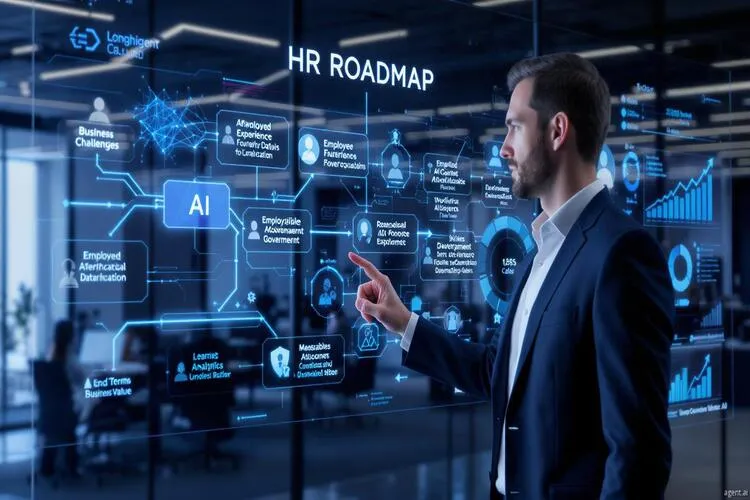
Artificial intelligence is quickly becoming part of the modern workplace. Human resources teams are using AI to improve recruitment, analyze workforce data, personalize employee experiences, automate repetitive processes, and support strategic decision making. However, adopting AI without a clear direction can create unnecessary costs, fragmented systems, and uncertainty among employees.
A well designed AI Roadmap for HR gives organizations a practical path from experimentation to measurable results. Rather than introducing technology simply because it is available, HR leaders can identify meaningful business problems, prioritize valuable opportunities, and establish appropriate governance.
For organizations following Technology insights and IT industry news, this shift represents an important development in how technology and workforce strategy are becoming increasingly connected.
Start With Business Problems
An effective AI strategy should begin with business needs rather than technology. HR leaders should first identify processes that consume significant time, create recurring administrative work, or limit the ability of teams to make informed decisions.
Recruitment screening, employee support, workforce planning, learning recommendations, and HR reporting can all present potential opportunities. Nevertheless, not every process requires AI. The strongest roadmap focuses on areas where intelligent automation or analysis can produce a meaningful improvement.
Consequently, HR teams can avoid investing in technology without a clear purpose and instead concentrate resources on measurable outcomes.
Identify High Value AI Opportunities
Once key challenges are understood, HR leaders can evaluate where AI could make the greatest difference. A useful opportunity should have a clear business objective, accessible data, manageable risk, and a realistic path toward implementation.
For example, an organization experiencing a high volume of employee questions could explore an AI powered HR assistant that provides answers to common policy and benefits questions. Meanwhile, workforce analytics could help leaders identify patterns related to hiring, retention, skills, or workforce capacity.
This approach allows an AI Roadmap for HR to develop around genuine organizational needs instead of following short lived technology trends.
Establish Clear Success Measures
AI projects need measurable objectives. Without defined outcomes, it can be difficult to determine whether an initiative is creating genuine value.
HR leaders can connect AI projects to improvements such as reduced administrative time, faster recruitment processes, improved employee engagement, better workforce planning, or lower operational costs. Furthermore, financial measures can help executives understand the broader impact of AI investments.
Finance industry updates often emphasize the importance of measurable performance, and HR technology should receive the same level of financial discipline. An AI initiative should demonstrate how its expected benefits connect to wider business priorities.
Build a Strong Data Foundation
AI depends heavily on reliable data. Inconsistent employee records, outdated information, disconnected systems, and unclear ownership can reduce the effectiveness of AI applications.
Therefore, HR organizations should review their existing data infrastructure before scaling AI initiatives. Data quality, accessibility, security, privacy, and governance should all be considered as part of the planning process.
In addition, organizations should determine which information an AI system actually needs. Limiting unnecessary access can reduce security risks while making governance easier to manage.
Keep Employees at the Center
Technology adoption succeeds when employees understand how it supports their work. AI should not be positioned only as a cost reduction tool. Instead, HR leaders should explain how intelligent systems can remove repetitive tasks, provide faster access to information, and give employees more time for higher value activities.
Transparency is particularly important when AI influences recruitment, performance management, workforce planning, or employee development. People should understand when AI is being used and where human judgment remains part of the process.
Similarly, HR trends and insights increasingly highlight the importance of employee trust, skills development, and responsible technology adoption.
Create Responsible AI Governance
HR applications can involve highly sensitive information, making responsible governance essential. Organizations should establish clear expectations around privacy, security, fairness, transparency, and human oversight.
AI systems should also be monitored after deployment. Their performance can change as data, business conditions, and employee behavior evolve. Regular reviews can therefore help identify inaccurate recommendations, unexpected outcomes, or emerging risks.
Moreover, HR and technology leaders should work together to establish clear accountability for AI systems rather than treating governance as an exclusively technical responsibility.
Develop Skills Across the HR Team
An AI roadmap is only as effective as the people responsible for implementing it. HR professionals need enough understanding of AI to evaluate tools, interpret outputs, identify risks, and communicate effectively with employees.
Training does not necessarily mean turning HR professionals into technology specialists. Instead, it should help teams understand how AI works at a practical level and how it can support specific HR responsibilities.
Consequently, organizations can build confidence while reducing resistance to new technologies.
Connect AI With the Wider Business
HR should avoid developing AI initiatives in isolation. Workforce technology can influence finance, sales, marketing, operations, and IT, so cross functional collaboration can uncover additional opportunities.
For instance, workforce analytics can support Sales strategies and research by helping organizations understand skills and capacity across revenue teams. Marketing teams can also benefit from workforce insights when planning talent requirements for future campaigns.
Marketing trends analysis and IT industry news can provide additional context about emerging capabilities, but the roadmap should always reflect the organization’s own priorities.
Scale What Works
Not every AI experiment will deliver the expected results. That is normal. A successful roadmap allows organizations to test promising ideas, measure outcomes, learn from failures, and expand initiatives that demonstrate meaningful value.
Starting with manageable projects can provide valuable lessons before larger investments are made. Over time, successful applications can become part of a broader HR technology ecosystem.
As a result, AI adoption becomes a continuous improvement process rather than a single transformation project.
Valuable Insights for HR Leaders
The most effective AI Roadmap for HR is not necessarily the one with the largest number of AI tools. It is the one that connects technology with clear workforce priorities, measurable business outcomes, responsible governance, and employee needs.
HR leaders should therefore begin with problems worth solving, validate opportunities through controlled experiments, measure results, and expand only when evidence supports further investment. At the same time, strong data practices and human oversight should remain central to every stage.
By taking this approach, organizations can move beyond AI experimentation and create practical systems that improve HR operations while contributing to broader business performance.
For more Technology insights, IT industry news, HR trends and insights, Finance industry updates, Sales strategies and research, and Marketing trends analysis, stay connected with InfoProWeekly. Reach out to InfoProWeekly for expert perspectives on AI, workforce transformation, and emerging business technology.
Connect with our team to explore practical insights that can help your organization turn technology investments into measurable value.