The digital marketing landscape is entering another major period of transformation. Advances in artificial intelligence, changing search behavior, evolving social platforms, and rising customer expectations are reshaping how brands attract and retain audiences. As a result, businesses need to look beyond traditional campaigns and understand where digital engagement is heading.
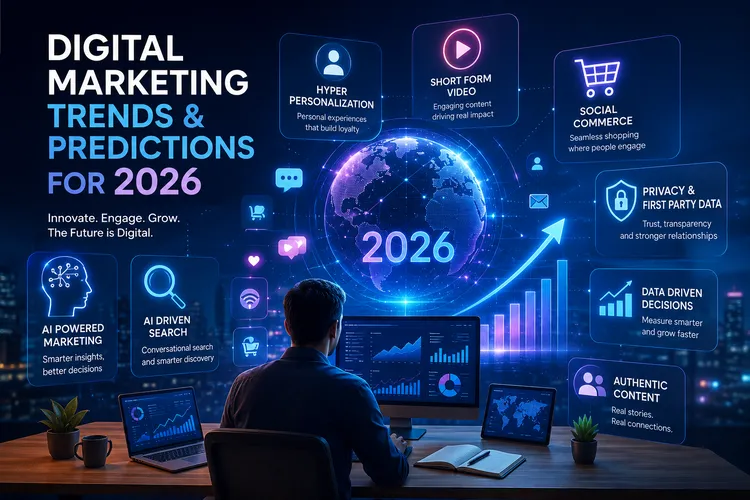
The most important Digital Marketing Trends in 2026 will focus on intelligent automation, personalized experiences, useful content, and stronger connections between technology and human creativity. Meanwhile, marketers will need to balance innovation with trust as consumers become more selective about the information and advertising they encounter online.
For organizations following Technology insights and IT industry news, these developments offer valuable clues about how marketing teams can prepare for the next stage of digital growth.
Artificial Intelligence Becomes a Marketing Partner
Artificial intelligence is expected to become more deeply integrated into everyday marketing operations during 2026. Rather than simply generating content, AI systems will increasingly support audience research, campaign planning, customer segmentation, creative development, and performance analysis.
However, successful brands will not rely entirely on automated content. Human judgment will remain essential for defining brand identity, understanding cultural context, and creating meaningful stories. Therefore, the strongest marketing strategies will combine AI efficiency with human creativity.
Generative AI can also help marketing teams analyze large amounts of customer information and identify patterns that might otherwise be difficult to detect. Consequently, businesses can make faster decisions while creating campaigns that are more closely aligned with audience behavior.
Search Is Becoming More Conversational
Search behavior is changing rapidly as consumers use conversational AI tools and advanced search features to discover information. Traditional search engine optimization remains important, but marketers increasingly need to create content that provides clear answers and genuine value.
In 2026, content designed around specific user questions, practical explanations, original research, and trustworthy expertise is likely to become even more valuable. Moreover, brands will need to consider how their content appears across traditional search engines, AI powered discovery platforms, social networks, and other digital environments.
This shift means search visibility will depend on relevance and credibility rather than simply repeating keywords throughout a page.
Personalization Moves Beyond Basic Recommendations
Consumers increasingly expect brands to understand their interests and provide relevant experiences. Consequently, personalization will remain one of the most influential Digital Marketing Trends in 2026.
Modern marketing platforms can use behavioral signals, purchase history, engagement patterns, and contextual information to create more relevant customer journeys. Instead of showing identical messages to everyone, businesses can deliver content that reflects where an individual is within the buying process.
Nevertheless, personalization must be handled responsibly. Customers want relevance, but they also want transparency and control over their data. Therefore, organizations that combine personalization with responsible data practices can build stronger long term relationships.
Short Form Video Continues to Influence Attention
Video will remain central to digital communication as audiences continue to consume short, visually engaging content across social platforms. Brands are likely to use video not only for awareness but also for education, product demonstrations, customer stories, and direct engagement.
Meanwhile, improvements in AI assisted video creation could allow smaller marketing teams to produce more content without significantly increasing production costs. Even so, originality and authenticity will remain important because audiences can quickly recognize content that feels repetitive or overly promotional.
Social Commerce Becomes More Integrated
The relationship between social media and ecommerce is becoming increasingly connected. Consumers can discover products, research brands, interact with creators, and complete purchases within increasingly integrated digital experiences.
As a result, businesses will focus more heavily on reducing the distance between discovery and conversion. Social platforms will become not only communication channels but also important parts of the customer journey.
This development will also influence Sales strategies and research because marketing and sales teams will need to work more closely together. Shared customer insights can help businesses create smoother experiences from initial awareness through final purchase.
First Party Data Gains Greater Importance
Data strategy will become increasingly important as privacy expectations continue to influence digital advertising. Businesses will place greater emphasis on information collected directly through websites, applications, memberships, purchases, and customer interactions.
First party data can help organizations understand their audiences while reducing dependence on external data sources. However, collecting information responsibly will be critical. Clear consent practices, useful customer experiences, and transparent communication can make data collection more sustainable.
Finance industry updates will also remain relevant here because marketing investments will face greater pressure to demonstrate measurable returns. Strong data infrastructure can help organizations connect campaign activity with business outcomes more effectively.
Authentic Content Will Matter More
Although AI generated content will become more common, audiences will continue to value originality and human perspective. Brands that publish useful research, expert opinions, customer experiences, and distinctive viewpoints can stand out in an increasingly crowded information environment.
Similarly, HR trends and insights show why employer branding and authentic communication are becoming important parts of the broader marketing ecosystem. Organizations must communicate consistently with customers, employees, candidates, and partners.
Therefore, authenticity will not simply be a creative preference. It will become an important component of brand credibility.
Marketing Teams Become More Data Driven
Marketing departments will increasingly combine creative thinking with analytical decision making. Campaign performance, customer behavior, conversion patterns, and audience engagement can provide valuable evidence for improving future strategies.
Marketing trends analysis will consequently become more important for organizations seeking sustainable growth. Instead of relying only on assumptions, teams can use real time information to identify what works and adjust campaigns accordingly.
At the same time, marketers should avoid becoming overly dependent on metrics that do not reflect genuine business value. Engagement is useful, but revenue, customer retention, brand loyalty, and lifetime value often provide a more complete picture.
Valuable Insights for Marketers in 2026
The most practical approach for businesses is to prepare for change without chasing every new platform or technology. Organizations should first understand their customers, strengthen their data foundations, improve content quality, and identify where automation can genuinely save time or improve results.
The Digital Marketing Trends emerging in 2026 suggest that successful marketing will depend on a combination of intelligent technology, meaningful content, responsible data use, and strong customer experiences. Brands that continuously test their strategies while remaining focused on customer needs will be better positioned to adapt.
For more Technology insights, IT industry news, HR trends and insights, Finance industry updates, Sales strategies and research, and Marketing trends analysis, stay connected with InfoProWeekly. Reach out to InfoProWeekly for informed perspectives on the technologies and strategies shaping modern business.
Connect with our team to discover practical insights that can help your organization navigate the evolving digital landscape.