AI Skills Are Changing the Global Workforce
Artificial intelligence is changing how businesses operate, how employees work, and which capabilities organizations value most. As companies introduce AI into everyday workflows, a growing difference is emerging between workers who can effectively use these technologies and those who have limited access or training.
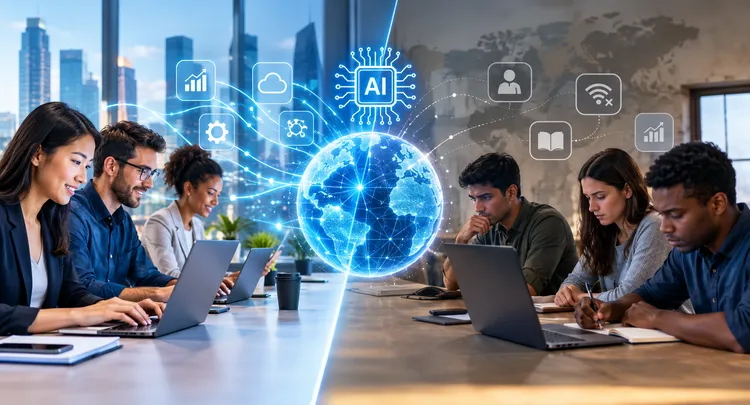
This divide is contributing to what can be described as a two speed global workforce. On one side are employees who are gaining access to AI tools, developing new capabilities, and using automation to complete work more efficiently. On the other side are workers who may have fewer opportunities to learn these technologies or whose organizations are adopting AI more slowly.
Consequently, AI is influencing not only individual productivity but also the wider structure of the global labor market.
Why AI Adoption Is Moving at Different Speeds
AI adoption does not happen equally across industries, companies, or countries. Large organizations with strong technology infrastructure can often experiment with advanced AI systems more quickly. Meanwhile, smaller businesses may face budget limitations, skills shortages, or concerns about implementation.
Geography also plays an important role. Workers in technology focused economies may have greater exposure to generative AI, automation platforms, and digital training programs. However, employees in regions with weaker digital infrastructure may encounter fewer opportunities to develop relevant capabilities.
As a result, the difference is becoming less about whether AI exists and more about who can effectively use it.
These developments are increasingly visible across Technology insights and IT industry news, where AI adoption continues to influence business operations and workforce planning.
AI Skills Can Increase Workplace Productivity
Employees who understand how to work with AI can potentially complete certain tasks faster. Writing, research, data analysis, document processing, software development, customer support, and administrative activities can all benefit from intelligent tools.
However, productivity gains do not simply come from having access to an AI application. Employees need to understand how to ask useful questions, evaluate generated information, identify errors, and integrate AI outputs into existing workflows.
Therefore, digital literacy is becoming increasingly important. The ability to work alongside intelligent systems can complement traditional professional expertise rather than completely replace it.
For example, a financial analyst who understands both financial modeling and AI assisted analysis may be able to investigate large datasets more efficiently. Similarly, a marketing professional can combine industry knowledge with AI tools to accelerate research and content development.
The Growing Divide Between Workers
The emerging workforce divide is not necessarily between technical and nontechnical employees. Instead, it increasingly reflects differences in access, training, confidence, and organizational support.
An employee may have an AI tool available but still avoid using it because they do not understand its capabilities or limitations. Conversely, another employee may integrate AI into daily work and gradually develop new productivity habits.
Over time, these differences can compound. Workers who use AI regularly may gain more experience, while those without training may find it increasingly difficult to catch up.
This makes continuous learning particularly important for employers and employees alike.
HR Faces a New Workforce Challenge
Human resources teams are increasingly responsible for helping organizations prepare employees for technological change. Rather than treating AI as purely an IT investment, businesses need to consider the workforce implications of adoption.
Training programs can help employees understand how AI should be used responsibly and where human judgment remains necessary. At the same time, companies can identify roles where automation may change responsibilities and provide employees with opportunities to develop relevant capabilities.
Consequently, HR trends and insights are becoming closely connected with technology strategy. Workforce development is no longer only about traditional professional training. It increasingly involves helping people adapt to rapidly changing digital tools.
Education and Reskilling Become More Important
Education systems and professional training providers also have an important role to play. Traditional qualifications may not fully prepare workers for environments where AI is integrated into everyday tasks.
Reskilling can help employees move into emerging responsibilities, while upskilling can strengthen the capabilities of people already working in a particular profession.
For instance, an accountant does not necessarily need to become an AI engineer. However, understanding automated reporting, data analysis, AI assisted forecasting, and technology governance could become increasingly valuable.
Similarly, sales professionals can combine customer relationship expertise with AI supported research and forecasting. This creates a natural connection between AI adoption and Sales strategies and research.
Businesses Must Avoid Creating an Access Gap
Organizations can unintentionally create a workforce divide when AI tools are provided only to selected employees without broader training or communication.
Therefore, companies should think carefully about who receives access, how employees are trained, and how productivity improvements are measured. Transparent policies can also help employees understand how AI is expected to support their work.
At the same time, leadership should recognize that not every task should be automated. Human judgment remains important when decisions involve customers, employees, financial risk, creativity, ethics, or complex business relationships.
This balance is particularly important when AI becomes embedded across multiple departments.
AI Is Reshaping Finance and Marketing Too
The impact extends beyond technology departments. Finance teams can use AI for forecasting, reporting, anomaly detection, and financial analysis. Consequently, Finance industry updates increasingly include discussions about automation, data quality, governance, and changing finance roles.
Marketing teams are also adapting. AI can accelerate audience research, content development, campaign analysis, and personalization. However, marketers still need strategic judgment to understand customers and protect brand credibility.
Therefore, Marketing trends analysis increasingly requires both creative thinking and technological awareness.
Building a More Inclusive AI Workforce
The two speed workforce does not have to become a permanent divide. Companies can reduce the gap by making training accessible, creating practical learning opportunities, and encouraging employees to experiment with AI within appropriate boundaries.
Managers can also identify repetitive tasks that employees could improve through automation and then provide guidance on how to use relevant tools. In addition, organizations can recognize employees who share useful AI practices with colleagues.
Ultimately, the goal should not be to create a workforce where everyone has identical technical abilities. Instead, businesses can focus on ensuring that employees have reasonable opportunities to develop the capabilities needed for their changing roles.
Practical Insights for the Future of Work
The most important lesson is that AI transformation is also a people transformation. Organizations that invest only in software may miss the larger opportunity to develop employees who can use technology effectively.
Employees can begin by identifying repetitive parts of their daily work and learning how AI can assist with those activities. At the same time, they should develop stronger skills in verification, critical thinking, communication, and domain expertise.
For businesses, measuring training participation and tool adoption can provide useful signals. However, the bigger question is whether employees are becoming more capable and whether technology is improving meaningful business outcomes.
As AI continues to develop, the gap between workers may depend increasingly on access to learning rather than access to technology alone.
Stay Informed With InfoProWeekly Keep up with changing technology, workforce developments, finance, marketing, sales, and business trends through the latest insights from InfoProWeekly.
Visit InfoProWeekly to discover practical perspectives that help professionals understand the forces shaping modern business.