
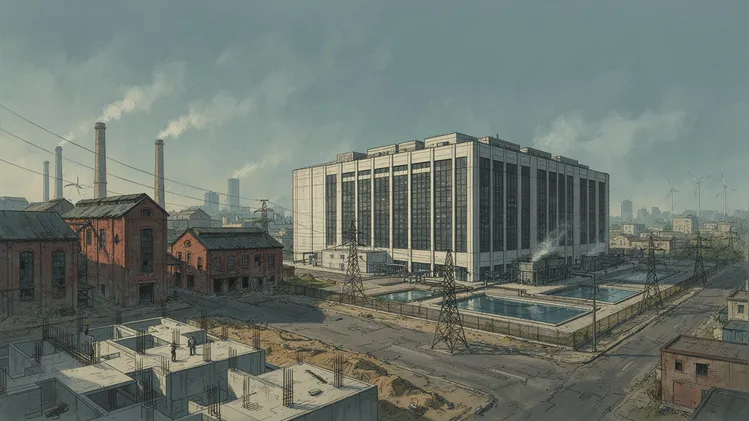
The rapid expansion of artificial intelligence is changing more than software and digital services. It is also changing the physical landscape of cities. Across the world, large data centers are being developed in places that already have a history of manufacturing, energy production, warehouses, factories and other heavy industries.
This shift is creating a new chapter for industrial cities. Sites that once supported traditional manufacturing can now become infrastructure for cloud computing and artificial intelligence. The United States Environmental Protection Agency has specifically identified brownfield locations with existing infrastructure and industrial zoning as potential candidates for data center redevelopment.
However, the transformation is not without challenges. AI infrastructure requires enormous amounts of electricity, cooling capacity, connectivity and land. Consequently, cities with industrial histories are once again being asked to support resource intensive economic activity.
Why Industrial Locations Are Attractive for AI Infrastructure
Former industrial areas can offer several advantages for data center developers. Large parcels of land, existing utility connections, transportation networks and industrial zoning can reduce some of the obstacles involved in developing new infrastructure.
Furthermore, redevelopment can give underused industrial property a new economic purpose. According to the EPA, thoughtful brownfield redevelopment can potentially bring jobs and tax revenue while supporting environmental cleanup and community investment.
This creates an interesting connection between old and new economies. A location once designed around factories can now support servers, artificial intelligence workloads and digital services used across the world.
Power Is Becoming the Central Challenge
The scale of AI computing makes electricity one of the most important factors in data center development. The International Energy Agency expects global electricity demand to grow strongly through 2030, with data centers among the factors contributing to that increase.
As a result, cities must consider whether existing grids can support new facilities without affecting reliability or increasing pressure on other users.
The issue is particularly important because AI workloads can require high density computing infrastructure. Developers are therefore searching for locations where large amounts of reliable power can be secured quickly.
Recent industry research also identifies power availability as a major constraint on continued data center expansion.
Water Adds Another Layer of Pressure
Electricity is only part of the infrastructure equation. Cooling systems can also require significant water resources, depending on the technology used.
This is especially important in cities where industrial activity has already placed pressure on natural resources. In India, for example, researchers and industry observers have raised concerns about data center development in water stressed regions.
Therefore, modern facilities are increasingly exploring technologies such as closed loop cooling, liquid cooling and other approaches designed to reduce water consumption. The choice of cooling technology can become just as important as the availability of land or electricity.
Industrial Cities Face a Familiar Question
The arrival of AI infrastructure creates a question that many industrial cities have faced before. How much economic activity should a community accept in exchange for infrastructure demands and environmental pressures?
The difference today is that the factories are being replaced by highly automated computing facilities. Data centers can have a much smaller permanent workforce than traditional industrial plants, even though their electricity requirements can be substantial.
Consequently, cities need to evaluate economic benefits through more than direct employment. Construction activity, tax revenue, local infrastructure investment and broader technology ecosystems can also influence the potential value of a project.
At the same time, communities may reasonably focus on electricity prices, water availability, noise, land use and long term environmental effects.
India Is Becoming an Important Example
India provides a particularly useful example of how AI infrastructure is changing urban development. Mumbai and Chennai remain major data center markets, while developers are increasingly examining locations beyond established metropolitan clusters because of land and power requirements.
Mumbai is already seeing substantial data center investment as cloud computing, financial services and AI increase demand for digital infrastructure. Meanwhile, Chennai is positioning itself around its connectivity, technology ecosystem and infrastructure advantages.
These developments demonstrate how digital infrastructure is becoming part of broader urban planning. Power networks, water systems, fiber connectivity and industrial land are increasingly connected to the technology economy.
Communities Want a Larger Role
As development accelerates, community participation is becoming increasingly important. Cities around the world are debating how data center projects should be planned and what responsibilities developers should have toward local communities.
In June 2026, C40 Cities announced a Global Urban Data Centres Pact involving mayors from cities across multiple continents. The initiative highlighted concerns around energy, water, land use and community impacts associated with rapidly expanding digital infrastructure.
Similarly, recent proposals in New York have focused on requiring significant community investment from new data center developments.
These developments indicate that infrastructure planning is becoming an important part of the AI economy rather than an issue considered after construction decisions are already made.
What This Means for Technology and Business
The AI data center boom is creating opportunities across several industries. Construction companies, energy providers, cooling technology firms, network operators and infrastructure investors are all becoming part of the expanding digital ecosystem.
For businesses, this trend connects directly with technology insights and IT industry news because computing infrastructure increasingly influences the availability and cost of AI services.
It also has implications for finance industry updates because data center projects require substantial capital investment and long term infrastructure planning. Meanwhile, sales strategies and research are changing as technology companies sell increasingly infrastructure intensive AI services to enterprises.
Marketing trends analysis is also evolving because organizations now need to communicate how AI adoption affects sustainability, reliability, customer experience and corporate responsibility.
Preparing Cities for the Next Phase of AI
The most important lesson is that AI infrastructure should be considered as part of city planning rather than as an isolated technology project.
Cities can examine available industrial land, grid capacity, water resources, transportation networks and fiber connectivity before approving major developments. Developers can also consider energy efficiency, renewable power, advanced cooling and transparent resource reporting from the beginning.
For organizations operating around these projects, HR trends and insights will also matter because the industry needs specialized skills spanning construction, energy, engineering, cybersecurity, networking and data center operations.
Valuable Insights for Businesses and City Leaders
The AI data center boom is turning former industrial locations into critical components of the digital economy. However, successful development depends on more than finding cheap land or available buildings.
The strongest long term opportunities will likely come from locations where power, water, connectivity, skilled workers, environmental planning and community interests can be considered together.
For businesses, the changing infrastructure landscape is a reminder that AI growth depends on physical resources as much as algorithms and software. For cities, it presents an opportunity to reuse industrial spaces while creating clear expectations around infrastructure, sustainability and community value.
Stay informed about the technology, business and infrastructure changes shaping the modern economy with insights from InfoProWeekly.
Connect with InfoProWeekly for practical perspectives that help organizations understand emerging trends and identify meaningful opportunities.