
Large language models have changed how businesses interact with artificial intelligence. They can generate content, summarize information, write software, analyze documents and answer complex questions. However, enterprise AI adoption involves a much larger challenge than simply connecting employees to an advanced language model.
Businesses increasingly want AI systems that can perform complete tasks rather than only generate responses. An enterprise assistant may need to understand a request, access company information, use software tools, make decisions within defined boundaries and complete several steps before delivering an outcome.
That is where AI agent logic becomes increasingly important. Instead of treating an LLM as the entire solution, organizations can use it as one component inside a broader system capable of planning and executing work.
Why LLMs Alone Are Not Enough
An LLM is highly capable at processing language and generating responses, but most business processes involve more than language. An employee asking an AI system to investigate a customer issue may require access to a CRM, order database, support platform and internal documentation.
Consequently, the system needs logic that determines which tool to use, what information to retrieve, what action should happen next and when human approval is required.
This distinction is becoming increasingly important as organizations move from experimental chatbots toward AI systems that interact with real business processes. Enterprise AI adoption therefore depends not only on model quality but also on how effectively models are connected to reliable tools, data and operational rules.
What AI Agent Logic Actually Does
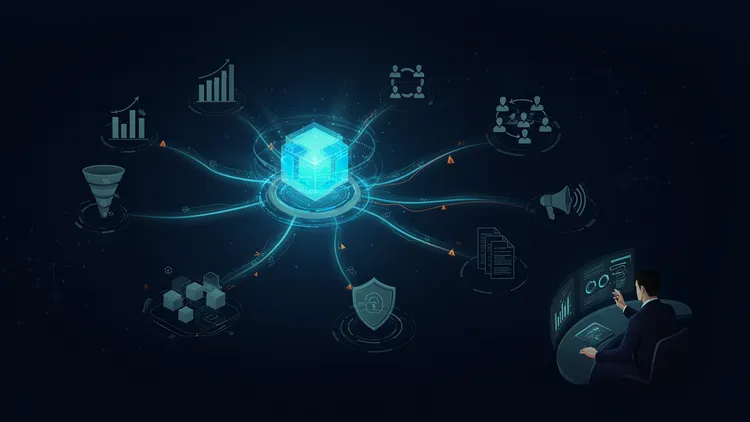
AI agent logic provides the structure around a language model. It can help an AI system interpret a goal, break a complex request into smaller tasks, select appropriate tools and evaluate the results before continuing.
For example, imagine an employee asks an AI assistant to prepare a customer account review. The system could retrieve customer information, examine recent support activity, summarize open issues and prepare a report. If the task requires sending information externally, the system could pause and request human approval.
In this approach, the language model provides reasoning and communication capabilities while the surrounding architecture manages permissions, workflows, tools and business rules.
Enterprise AI Needs More Than Better Models
AI development has historically focused heavily on model performance. Larger context windows, stronger reasoning and improved accuracy can certainly expand what AI systems are capable of doing.
Nevertheless, businesses must also solve operational challenges. An enterprise system needs predictable behavior, access controls, observability, data governance and clear accountability.
For that reason, enterprise AI adoption is increasingly becoming an engineering problem as much as a model selection problem. Organizations need architectures that can connect AI capabilities with existing enterprise software without creating uncontrolled access to sensitive systems.
These technology insights are especially relevant as IT industry news continues to highlight the rapid expansion of AI agents across enterprise environments.
Connecting Agents to Business Systems
The practical value of an AI agent often comes from its ability to interact with existing software. APIs can connect agents to customer relationship management platforms, enterprise resource planning systems, ticketing tools, databases and communication platforms.
However, every connection introduces potential security and reliability concerns. An agent that can read information is different from one that can modify records or initiate transactions.
Therefore, organizations need clearly defined permissions. Tool access should follow the principle of least privilege, while important actions can require human confirmation.
This approach allows businesses to experiment with automation while maintaining greater control over consequential decisions.
Data Quality Remains Critical
Even an advanced agent can produce poor outcomes when it operates on incomplete or unreliable business information. Enterprise AI adoption therefore depends heavily on data quality.
Companies need consistent sources of truth, clear data ownership and reliable access mechanisms. Internal documents should also be organized so that AI systems can retrieve relevant information without unnecessarily exposing unrelated or confidential material.
Furthermore, organizations should monitor how agents use retrieved information. Strong retrieval and validation processes can reduce the risk of unsupported answers and incorrect actions.
Measuring AI Agent Performance
Traditional AI evaluation often focuses on whether a model produces a correct response. Agent based systems require broader measurements.
Businesses may need to evaluate whether an agent completed the intended workflow, selected appropriate tools, followed authorization rules and recovered correctly when something went wrong.
For instance, an agent handling a support workflow should not receive a high performance assessment simply because its written response sounds professional. The organization also needs to know whether it accessed the correct customer record, followed company policies and updated the appropriate system.
This shift from response quality to task performance could become one of the defining changes in enterprise AI development.
The Business Impact Across Industries
The growing importance of agent logic reaches far beyond technology departments. Finance industry updates increasingly involve AI applications for research, customer support, compliance and operational workflows, although sensitive financial decisions require strong governance.
Similarly, sales strategies and research can benefit from agents that organize prospect information, summarize interactions and prepare account insights. Marketing teams can use AI systems to coordinate research, content workflows and campaign analysis.
HR trends and insights are also being influenced by enterprise AI as organizations explore assistants for employee support, knowledge management and administrative processes. Across these functions, the central challenge remains the same. AI needs to operate within clearly defined organizational boundaries.
Building a More Reliable Agent Architecture
Businesses exploring AI agents should begin with specific workflows rather than attempting to automate entire departments. A narrowly defined process makes it easier to measure results, identify risks and establish appropriate permissions.
Moreover, organizations can separate reasoning from execution. The AI model can propose an action while deterministic software validates whether that action is allowed.
This architecture creates an important safety layer. It also makes systems easier to audit because business rules do not need to depend entirely on model behavior.
What Comes Next for Enterprise AI
The next phase of enterprise AI is likely to involve increasingly capable systems that combine language models, business data, software tools and workflow logic. The goal is not simply to make AI produce better answers. It is to make AI useful within real operational environments.
At the same time, organizations will need to balance automation with human oversight. Some workflows can be fully automated, while others should retain approval steps because they involve financial commitments, sensitive information or significant business consequences.
Valuable Insights for Enterprise Leaders
The central lesson is that successful enterprise AI adoption requires more than choosing a powerful LLM. Organizations need reliable data, controlled tool access, workflow logic, monitoring and clear governance.
Businesses can begin by identifying repetitive processes where AI can assist without creating excessive risk. From there, teams can introduce agents gradually, measure task completion and strengthen controls as capabilities expand.
Ultimately, the organizations that gain lasting value from AI may be those that treat intelligent agents as carefully engineered business systems rather than simply as conversational interfaces. Stay informed about emerging AI developments and practical business technology with insights from InfoProWeekly.
Connect with InfoProWeekly to explore technology trends and strategies shaping the next generation of enterprise innovation.