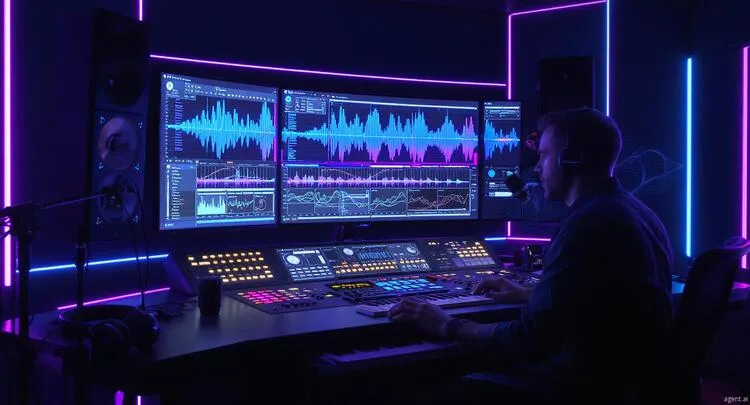
Artificial intelligence is rapidly changing how people create, edit and experience music. What once required years of musical training, studio equipment and complex production software can increasingly be explored through simple creative instructions.
Google is continuing this transformation with the launch of Lyria 3.5 in Google Flow Music. The latest development focuses on improving several important aspects of AI generated music, including musicality, lyrics, vocals and creative control.
Rather than treating music generation as a simple text to audio process, the technology aims to give creators more influence over the final result. Consequently, the update could make AI music creation more useful for musicians, content creators, marketers and other professionals.
Better Musicality for More Natural Results
One of the biggest challenges facing AI music systems has been creating compositions that feel coherent and expressive. Generating individual sounds is relatively straightforward, but producing a track with convincing structure, rhythm and musical progression is considerably more difficult.
The new capabilities are designed to improve the overall musical experience. Better understanding of musical patterns can help generated tracks sound more intentional and consistent.
As a result, creators may have greater freedom to experiment with different genres, moods and arrangements without needing to manually control every production detail.
This development is particularly relevant to Technology insights and IT industry news because generative AI is expanding beyond traditional text and image applications into increasingly sophisticated creative workflows.
Lyrics Become More Important
Lyrics are another area where AI generated music has historically faced challenges. A song can have impressive instrumentation while still feeling unnatural if its words lack rhythm, structure or emotional consistency.
The latest improvements aim to make lyrics work more effectively alongside the music. Better alignment between words, melody and vocal delivery can create a more unified listening experience.
Furthermore, stronger lyrical generation could help creators develop early concepts, explore songwriting ideas and experiment with different storytelling approaches.
For professional musicians, this does not necessarily mean replacing traditional songwriting. Instead, AI can become another creative tool for brainstorming and experimentation.
More Expressive AI Vocals
Vocals often determine how emotionally convincing a song feels. Small changes in timing, tone and expression can significantly influence how listeners respond.
Google’s latest music technology focuses on improving vocal quality and musical integration. Consequently, generated voices can potentially feel more connected to the rhythm and emotional character of a composition.
This progress could be valuable for creators producing demonstrations, background music, digital content and experimental projects. At the same time, it raises important questions about originality, ownership and responsible use of synthetic voices.
These questions will likely become increasingly important as AI generated audio becomes more sophisticated.
Greater Creative Control
Creative control may ultimately be one of the most important improvements. Earlier generations of AI music tools could produce impressive results, but users sometimes had limited influence over specific musical details.
More control allows creators to guide the direction of a track rather than simply accepting whatever the system generates.
Therefore, AI music platforms are gradually moving toward collaborative creative environments. The technology provides generation capabilities while the human creator determines the desired direction.
This approach can make the creative process more interactive and potentially more useful for professionals who need consistent results.
Implications for Content Creators
The expansion of AI music generation could have a significant impact on digital content. Video creators, advertisers, podcasters and social media professionals often need music that matches a specific mood or format.
Previously, finding suitable music could involve licensing libraries, professional composers or extensive editing. AI tools could make early stage experimentation considerably faster.
Nevertheless, businesses still need to consider licensing, attribution and commercial usage requirements before incorporating generated music into campaigns.
Marketing teams may particularly benefit from this technology as personalized audio becomes part of broader digital experiences. Marketing trends analysis will likely pay greater attention to how generative audio influences branding and audience engagement.
AI Music Could Change Creative Workflows
The broader significance of this development extends beyond music generation itself. AI is increasingly becoming part of creative workflows across industries.
Designers can use generative tools for visual concepts. Writers can use AI for brainstorming. Developers can use AI for code assistance. Similarly, musicians can use generative systems to explore ideas that might otherwise take considerable time.
However, human creativity remains important. The strongest results are often achieved when people use AI as a collaborative tool rather than allowing automation to determine every creative decision.
Business Opportunities Around AI Generated Music
As AI music technology improves, new commercial opportunities may emerge. Businesses could use customized audio for advertisements, games, applications, virtual experiences and branded content.
This could also create new services around music editing, AI assisted production and creative consulting. Finance industry updates may become relevant as companies evaluate the commercial potential of these emerging markets and determine where investment opportunities exist.
Meanwhile, Sales strategies and research could influence how AI music platforms position their products for professional creators and businesses.
What Creators Should Consider
Creators interested in AI music should focus on experimentation while maintaining clear creative direction. Instead of generating large quantities of music without purpose, users can benefit from defining the mood, audience and intended use before beginning the process.
It is also important to review the platform’s rules regarding commercial usage, ownership and content rights. As AI generated media becomes more common, understanding these conditions will be just as important as understanding the technology itself.
For organizations, the opportunity is equally significant. Businesses can explore AI music for content production while ensuring that creative quality and legal considerations remain part of the workflow.
Insights for the Future of AI Music
The arrival of Google Lyria 3.5 highlights how quickly generative audio is evolving. Improvements in musicality, lyrics, vocals and creative control could make AI music increasingly practical for everyday creative work.
At the same time, the technology demonstrates that better generation is only one part of the equation. Human direction, originality, responsible usage and clear creative objectives will remain essential. For more Technology insights, IT industry news and analysis of emerging AI developments, connect with InfoProWeekly for informed coverage of the technologies shaping the future.
Reach out to InfoProWeekly for practical insights into artificial intelligence, digital creativity and emerging business opportunities. Stay informed and discover how new technology can influence the way industries create and grow.