
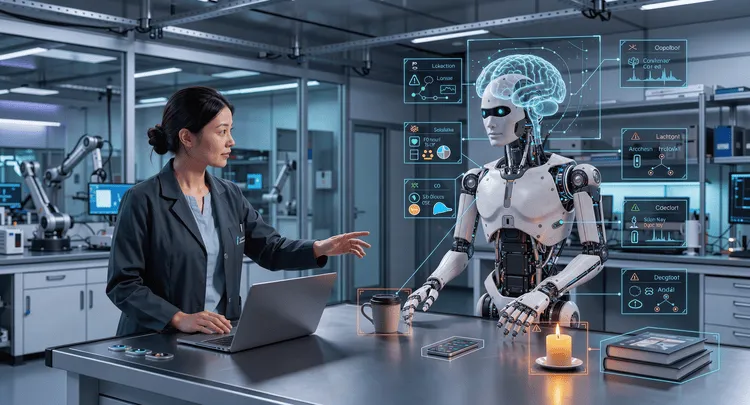
Robots are becoming increasingly capable of performing physical tasks, but understanding what humans actually mean remains a significant challenge. Traditional robotic systems generally depend on specific instructions, leaving little room for interpreting context or recognizing unstated expectations.
A new AI assisted learning platform developed by researchers at the Massachusetts Institute of Technology (MIT) and New York University (NYU) aims to address this limitation. Called FLEX, the system helps robots understand the broader meaning behind everyday human commands rather than simply following their literal wording.
This development represents an important step in artificial intelligence and robotics. Moreover, it offers fresh Technology insights into how machines could become more adaptable, intuitive, and useful in everyday environments.
What Is the FLEX AI Learning Platform?
FLEX stands for Flexible Feature Editing Pipeline. It is a system designed to improve robot motion planning by helping machines interpret natural language instructions and identify the underlying intentions behind them.
The research team, led by MIT assistant professor Andreea Bobu, developed the approach to make human and robot interactions more natural.
For example, imagine asking a robotic assistant to carry a cup of coffee across a table. If you tell it not to spill coffee on your laptop, a conventional robot might simply avoid that particular laptop.
However, FLEX takes the instruction further. By recognizing the broader relationship between liquids and electronic devices, it can also avoid nearby objects such as smartphones without requiring another explicit instruction.
Consequently, the robot can make more informed decisions based on context rather than relying exclusively on predefined rules.
How FLEX Helps Robots Understand Human Intent
The platform follows a three stage process called Add, Generalize, and Mask. Each stage contributes to helping robots understand their surroundings and adjust their movements.
Add Stage Identifies Important Objects
Initially, the robot identifies objects mentioned in a person’s instructions and adds them to a list of features that matter for the task.
For instance, when someone asks a robot not to drop a bowling ball near a coffee mug, the system identifies the mug as an object that should be avoided.
This provides the robot with a clear starting point for adjusting its movement.
Generalize Stage Applies Common Sense
The Generalize stage introduces a more advanced capability through a large language model. In the researchers’ demonstration, the system uses GPT-4o to identify relationships between objects and infer broader categories.
Instead of remembering only that a particular mug should be protected, the robot can recognize that fragile objects generally require careful handling.
Similarly, an instruction to avoid spilling coffee on a laptop can lead the robot to avoid other electronic devices.
This capability reduces the need for users to describe every possible obstacle or restriction individually.
Mask Stage Removes Irrelevant Information
The final stage uses computer vision to examine the surrounding environment and identify objects that are no longer present.
If an object disappears from the environment, the system removes its associated feature from the robot’s active list.
This is important because constantly adding new restrictions could eventually create an unnecessarily complicated feature list.
Together, these three stages allow the system to update its understanding while keeping the robot’s motion planning relevant to its current surroundings.
What Researchers Discovered Through Robot Simulations
The research team evaluated FLEX through simulated robotic tasks involving serving coffee, moving a candle, and carrying a bowling ball.
During these experiments, volunteers provided natural language instructions to a virtual robotic arm.
When instructed to avoid spilling coffee on a laptop, the robot also avoided nearby electronics. Similarly, instructions about keeping a candle away from paper encouraged the system to avoid flammable materials.
In another scenario, a warning about dropping a bowling ball on a mug helped the robot recognize the broader importance of avoiding fragile objects.
According to the MIT research announcement, the complete three stage process takes approximately five seconds.
These demonstrations highlight how language models can support more flexible decision making in robotic systems. However, it is important to recognize that the reported experiments were conducted in simulations. Real world household performance still requires further evaluation.
Why This Development Matters for the Future of Robotics
One of the biggest challenges in robotics is making machines useful to people without requiring technical knowledge or complicated instructions.
FLEX moves towards addressing this challenge by allowing people to communicate with robots using ordinary conversational language.
For household environments, this could eventually make robotic assistants more practical. A user might simply explain what needs protection rather than manually defining every obstacle.
Furthermore, assistive robots could potentially benefit from this approach when helping older adults or individuals who need support with everyday activities.
For businesses, these developments also offer valuable Technology insights into the future of intelligent automation. Manufacturing, logistics, healthcare, and customer service are among the industries where more adaptable robotic systems could create new opportunities.
These changes may also influence HR trends and insights as organizations reconsider workforce requirements and human machine collaboration. Similarly, Finance industry updates, Sales strategies and research, and Marketing trends analysis increasingly reflect the wider business implications of artificial intelligence and automation.
Challenges That Researchers Still Need to Address
Although FLEX demonstrates promising capabilities, several challenges remain before similar systems can become widely available.
Understanding human language does not always guarantee correct interpretation. Different people may use the same words to communicate different expectations, depending on their environment and personal preferences.
Additionally, language models can sometimes make incorrect generalizations. A robot that interprets an instruction too broadly could avoid objects unnecessarily or make an unsuitable movement decision.
Safety is another important consideration. Robots operating around people, electronic devices, and fragile household objects must make reliable decisions even when their surroundings change unexpectedly.
Therefore, further real world testing, improved contextual understanding, and stronger safety mechanisms will be essential.
Practical Insights Into the Future of AI Powered Robotics
FLEX highlights an important shift in robotics research. The next generation of intelligent machines will need more than the ability to execute instructions. They will also need to understand context, recognize relationships, and adapt their decisions to changing environments.
For technology developers, this creates opportunities to explore language models, computer vision, and motion planning as connected components of intelligent systems.
Businesses interested in robotic automation should also pay attention to how these capabilities mature. Instead of evaluating robots only by speed and task completion, organizations should consider their ability to understand human preferences and operate safely around people.
Ultimately, making robots easier to communicate with could be just as important as improving their physical capabilities.
Stay Updated With InfoProWeekly
Explore the latest developments in artificial intelligence, robotics, and emerging technologies with InfoProWeekly. Discover research driven insights that help professionals understand the innovations shaping tomorrow’s industries. Visit InfoProWeekly for the latest technology insights, industry developments, and expert perspectives on the future of innovation.