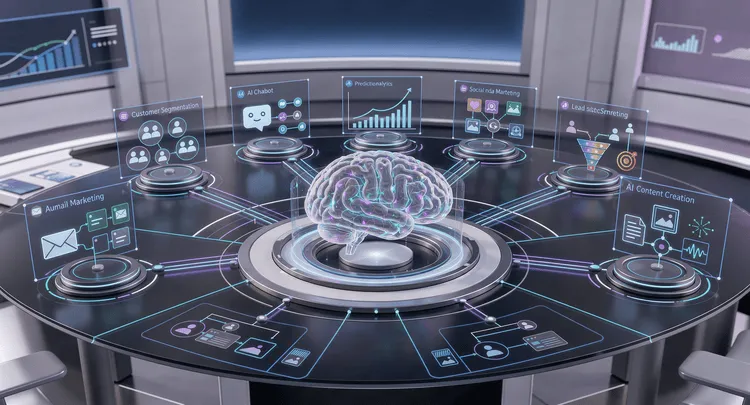
Marketing is evolving rapidly as businesses look for smarter ways to attract customers, improve engagement, and increase conversions. Traditional marketing methods often require significant time, manual effort, and continuous monitoring. However, artificial intelligence is changing how organizations plan, execute, and measure their campaigns.
AI in marketing automation enables businesses to analyze customer behavior, personalize communication, predict market trends, and streamline repetitive activities. Consequently, marketing teams can focus more on creative strategies while technology handles time-consuming tasks.
From personalized email campaigns to intelligent customer segmentation, AI is creating new opportunities across industries. Understanding these applications also provides valuable Technology insights into the changing digital landscape and emerging marketing trends analysis.
How AI Is Transforming Marketing Automation
AI combines machine learning, predictive analytics, natural language processing, and customer data to improve marketing decisions. Rather than relying entirely on predefined rules, modern systems can identify patterns, learn from customer interactions, and adjust campaigns accordingly.
Moreover, businesses can respond to customer needs more effectively because automated systems continuously evaluate engagement and performance. This creates a more connected marketing experience across websites, social media, email, and other digital channels.
AI Powered Email Marketing Personalization
Email marketing remains an important channel for building customer relationships. However, sending identical messages to every subscriber rarely produces the best results.
AI powered automation analyzes browsing activity, previous purchases, engagement history, and customer preferences to recommend relevant content. For example, an online retailer can automatically send personalized product recommendations based on a customer’s previous purchases.
Furthermore, AI can identify suitable sending times, suggest subject lines, and optimize email content. As a result, businesses can improve campaign relevance without manually creating separate messages for every customer.
Intelligent Customer Segmentation
Understanding different customer groups is essential for successful marketing. Traditionally, marketers segmented audiences using basic information such as age, location, and purchasing history.
AI takes this process further by identifying behavioral patterns and similarities between customers. For instance, a financial services company can identify individuals interested in investment products based on their website interactions and content preferences.
Additionally, predictive segmentation helps businesses recognize potential customers who are more likely to engage with specific campaigns. These capabilities support better targeting and more informed Finance industry updates by highlighting changing customer interests and purchasing behavior.
AI Chatbots for Customer Engagement
Customers increasingly expect immediate responses when interacting with businesses. AI powered chatbots help organizations meet this expectation by providing automated assistance across websites, messaging platforms, and social media.
These systems can answer frequently asked questions, recommend products, collect customer information, and guide visitors through purchasing decisions.
More importantly, conversational AI can understand customer questions and provide contextually relevant responses. When a conversation requires human assistance, the chatbot can transfer the interaction to an appropriate representative.
Consequently, sales and support teams can manage inquiries more efficiently while maintaining a consistent customer experience.
Predictive Analytics for Smarter Campaigns
Successful marketing depends on understanding what customers might do next. Predictive analytics uses historical information, customer behavior, and machine learning models to estimate future outcomes.
For example, an eCommerce business can predict which customers may stop purchasing and automatically launch targeted retention campaigns. Similarly, marketing teams can estimate campaign performance and identify audiences with stronger conversion potential.
In addition, predictive insights help organizations allocate advertising budgets more effectively. This approach connects marketing trends analysis with practical business decisions, allowing companies to improve campaign planning through data.
AI Powered Social Media Marketing
Managing multiple social media platforms requires continuous content planning, monitoring, and performance evaluation. AI automation simplifies these activities by helping marketers identify popular topics, analyze audience sentiment, and schedule content.
For example, AI tools can examine engagement patterns to determine which content formats generate stronger audience responses. They can also suggest captions, generate creative variations, and identify emerging conversations relevant to a brand.
Meanwhile, automated social listening helps businesses understand customer opinions and respond to potential concerns. These capabilities are particularly valuable for organizations following IT industry news and changing digital communication trends.
Automated Lead Scoring and Sales Optimization
Generating leads is only one part of the marketing process. Businesses must also identify which prospects are most likely to become paying customers.
AI powered lead scoring evaluates factors such as website visits, email interactions, content downloads, and previous engagement. Based on these signals, automation platforms assign scores that help sales teams prioritize promising opportunities.
For example, a prospect who repeatedly visits pricing pages and downloads product guides may receive a higher priority than someone who has only subscribed to a newsletter.
As a result, marketing and sales departments can coordinate their activities more effectively. These applications also support evolving Sales strategies and research by helping teams focus on qualified opportunities rather than spending equal time on every lead.
AI for Content Creation and Optimization
Producing relevant content consistently is challenging for marketing departments. AI writing and optimization tools can assist with researching topics, generating initial drafts, identifying relevant keywords, and improving existing content.
For instance, an organization can use AI to develop different versions of landing page headlines and evaluate which variation attracts more engagement.
However, automated content should not replace human expertise. Editors still need to verify facts, maintain brand consistency, and ensure that content provides genuine value to readers.
Similarly, HR teams can apply related automation capabilities to recruitment communication and employer branding, making this technology relevant to emerging HR trends and insights.
Practical Insights for Businesses Adopting AI Marketing Automation
Implementing AI successfully requires more than purchasing an automation platform. Businesses should first identify repetitive marketing activities that consume significant time or produce inconsistent results.
Next, organizations should establish clear objectives, maintain reliable customer data, and select tools that integrate with their existing marketing systems.
Equally important, companies should regularly evaluate campaign performance through engagement, conversion rates, customer retention, and return on investment.
Although AI can improve efficiency, human supervision remains essential. The strongest marketing strategies combine automated intelligence with creative thinking, ethical data practices, and a clear understanding of customer expectations.
As technology continues to evolve, businesses that adopt AI thoughtfully will be better positioned to respond to changing customer behavior and competitive market conditions.
Stay Ahead with InfoProWeekly
Explore the latest technology developments, marketing innovations, and industry insights with InfoProWeekly. Our expert driven content helps professionals understand emerging trends and make informed business decisions. Visit InfoProWeekly to discover valuable perspectives, practical knowledge, and insights shaping the future of business and technology.