AI Is Creating a New Identity Challenge
Artificial intelligence is moving from answering questions to taking actions.
Modern AI systems can browse websites, access applications, retrieve information and complete tasks with limited human involvement. As a result, companies face a new security question. How do you know exactly which system performed an action?
This question becomes more important as businesses connect intelligent software to customer databases, cloud platforms, financial systems and internal applications.
NIST is already examining how existing identity standards can apply to software agents. Its 2026 concept paper highlights identification, authorization, auditing and accountability as important areas for agentic systems.
Why Traditional User Accounts Are Not Enough
Traditional identity systems mainly separate people from applications.
A human employee has an account. A software application has credentials. A server has a machine identity.
An AI agent creates a different situation.
It can make decisions, select tools and perform multiple actions during a single task. It may also act on behalf of a person while operating independently.
Therefore, simply giving an agent the same permissions as its user can create unnecessary risk.
Microsoft now describes agent identities as a specialized identity model designed for autonomous AI systems. The company says these identities provide unique identification and authentication capabilities for agents operating in enterprise environments.
What a Digital Identity Could Provide
A dedicated identity gives an autonomous system a clear security boundary.
Instead of asking only which employee initiated a task, security teams can also determine which agent performed each action.
That distinction improves visibility.
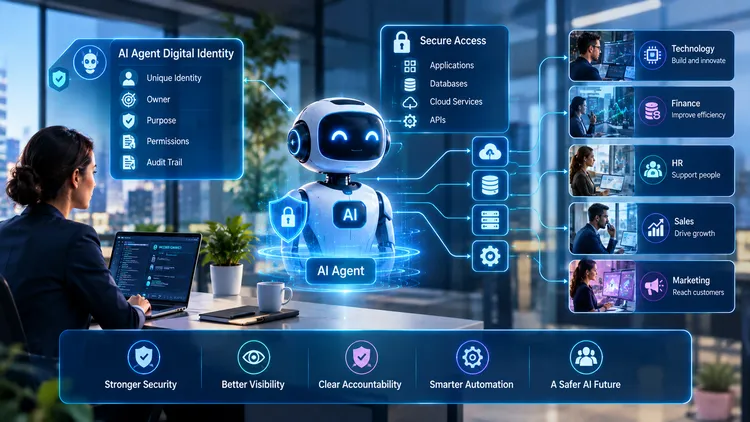
An identity could connect an agent with its owner, purpose, permissions and approved systems. It could also help organizations record activity and quickly revoke access when something goes wrong.
Consequently, identity can become a central control layer for autonomous software.
Permissions Need to Match the Task
Not every AI system needs access to every business resource.
A marketing research agent may need access to public websites and campaign data. It should not automatically receive access to payroll records or confidential financial documents.
Likewise, a customer service agent may need customer account information. It may not need permission to change payment details.
This is where identity and authorization work together.
Microsoft’s agent identity framework focuses on authentication and authorization designed specifically for agents. Google Cloud has also introduced capabilities around agent identity, access management and runtime protection for enterprise AI.
Identity Can Improve AI Accountability
Accountability becomes harder when several autonomous systems work together.
Imagine a customer service agent asking another agent to retrieve an account record. That second system then calls a third service to update information.
Without clear identities, tracing the complete chain can become difficult.
With dedicated identities, organizations can record which system initiated an action and which system actually performed it.
This creates a clearer audit trail for security teams and business managers.
Researchers are also studying this problem. A 2026 IEEE publication describes identity challenges involving temporary agents, delegated authority and interactions across different trust boundaries.
Security Teams Need Better Visibility
The growth of autonomous systems changes the work of cybersecurity teams.
Security professionals need to know which agents exist, what permissions they hold and where they can operate.
They also need to detect unusual behavior.
For example, an agent that normally reads customer information may suddenly attempt to access administrative settings. That change should trigger attention.
Identity controls can help security teams connect access activity with a specific autonomous system.
This approach fits with the wider shift toward zero trust security, where access decisions depend on identity, context and authorization rather than simple network location.
AI Identity Will Matter Across Business Functions
The impact will extend beyond IT departments.
Finance teams may use autonomous systems for reporting, reconciliation and transaction workflows. Therefore, finance industry updates will increasingly include questions about machine access and approval controls.
Sales teams can use agents for lead research, customer follow ups and CRM updates. Strong identity controls can help companies determine which actions were performed automatically.
Marketing teams face similar concerns when AI systems access campaign platforms, customer data and analytics tools. Marketing trends analysis will increasingly involve questions about automated access and data protection.
HR teams also have a role to play. HR trends and insights may increasingly include new responsibilities around employee use of autonomous software, training and access policies.
Agent Identity Could Support Safer Automation
Identity does not solve every AI security problem.
An authenticated agent can still make a poor decision. It can also misuse an approved permission or respond incorrectly to manipulated information.
However, identity creates an important foundation.
Companies can combine identity with limited permissions, continuous monitoring, approval workflows and clear ownership.
NIST has specifically highlighted the need to understand how identity and authorization practices can reduce risks associated with agents accessing data, tools and applications.
New Standards Are Taking Shape
The technology industry is already working on ways to formalize agent authentication.
An Internet Engineering Task Force draft published in 2026 proposes an Agent Identity Protocol that would give agents unique identifiers and cryptographic keys for signing actions. Another draft focuses on authentication and authorization practices for interactions between AI agents.
These efforts show that agent identity is moving beyond theory.
Organizations are beginning to treat autonomous software as a distinct category of digital actor.
The Business Case for Digital Identity
Companies adopting autonomous AI should think about identity before expanding access.
Every deployed system should have a clearly defined owner, purpose and permission boundary.
Organizations should also maintain an inventory of active agents. Unused or experimental agents should not retain access indefinitely.
Furthermore, businesses should connect identity records with monitoring and audit systems. This can make investigations faster when an automated action produces an unexpected result.
These practices can support technology insights and IT industry news discussions about safer AI adoption while helping businesses prepare for more autonomous workflows.
Valuable Insights for Businesses
The rise of autonomous AI means companies are gaining a new category of digital worker.
The key difference is speed and autonomy. An automated system can perform actions continuously and across several applications without waiting for a person to approve every step.
That makes identity increasingly important.
Businesses should know which systems are acting, who owns them, what they can access and why they have those permissions.
A strong identity foundation can also support better governance as AI systems become more connected to sales, finance, HR, marketing and technology workflows.
For businesses exploring autonomous AI, identity should therefore become part of the architecture from the beginning rather than an afterthought.
For more technology insights, IT industry news and practical analysis of AI developments, connect with InfoProWeekly. Stay informed about emerging AI security, business technology and digital transformation trends with InfoProWeekly.