
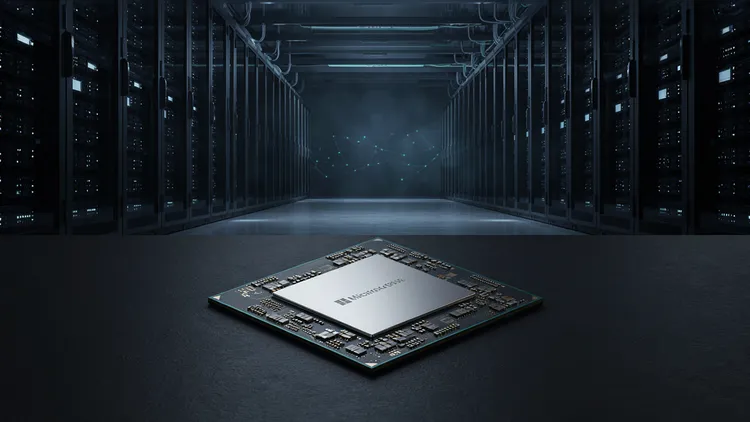
Microsoft’s AI Chip Strategy Focuses on Computing Efficiency
Artificial intelligence is transforming businesses, but running advanced AI models requires enormous computing power. As organizations adopt generative AI, AI assistants, and automated workflows, technology companies are looking for ways to improve performance while controlling infrastructure expenses. Microsoft’s Maia 300 AI chip fits into this broader push toward more efficient AI computing.
The development of specialized processors reflects a significant shift in the technology industry. Rather than relying entirely on third party hardware, cloud providers are developing custom chips designed for their own workloads. Consequently, they can work toward improving computing efficiency, managing infrastructure costs, and delivering AI services at scale.
For Microsoft, this strategy supports its expanding cloud and AI ecosystem. However, the practical impact of a new processor depends on its performance, availability, energy requirements, and ability to operate alongside existing infrastructure.
Why Custom AI Chips Matter for Data Centers
Traditional processors are designed to support a broad range of computing tasks. In contrast, AI accelerators focus on workloads such as model training and inference, which involve large volumes of mathematical calculations.
Specialized hardware can help cloud providers allocate computing resources more efficiently. For example, inference chips can accelerate the process of generating responses from trained AI models. As businesses integrate AI into customer support, software development, analytics, and marketing, efficient inference becomes increasingly important.
Furthermore, custom silicon gives cloud providers greater control over hardware design and system integration. When processors, networking, memory, and software are designed to work together, providers can optimize performance across the entire computing environment.
This matters because operating an AI data center involves more than purchasing chips. Electricity, cooling, networking equipment, maintenance, and infrastructure utilization all contribute to the overall cost of delivering AI services.
How Maia 300 Could Help Reduce Computing Expenses
The central attraction of a specialized AI processor is its potential to deliver more useful computing work with fewer resources. Microsoft’s Maia 300 AI chip is associated with this broader objective of improving AI infrastructure efficiency.
If the hardware delivers better performance per watt, Microsoft could potentially run more AI workloads within the same power budget. Similarly, improved utilization could help reduce the cost of serving individual AI requests.
Nevertheless, lower operating costs are not automatic. Actual savings depend on workload characteristics, software optimization, processor availability, and the total cost of deploying the hardware. Businesses should therefore distinguish between the potential advantages of custom silicon and independently verified performance results.
In addition, hardware efficiency can influence how cloud providers price their services. Although customers may benefit from improved infrastructure economics over time, pricing also depends on competition, demand, operating expenses, and commercial strategy.
What the Chip Strategy Means for Enterprise AI
Enterprises increasingly depend on AI for document processing, research, customer engagement, software development, and business intelligence. However, deploying these applications at scale requires predictable performance and manageable operating expenses.
More efficient AI infrastructure could make it easier for companies to expand their use of intelligent applications. For example, customer service teams could process more interactions, while analysts could use AI tools to examine larger volumes of information.
Moreover, organizations could evaluate a wider range of AI use cases if computing costs become more manageable. This could influence marketing trends analysis, sales strategies and research, and internal automation initiatives.
At the same time, enterprises should consider data protection, application reliability, integration requirements, and vendor dependence before committing to a particular cloud ecosystem. Hardware improvements alone cannot guarantee a successful AI implementation.
Connections to Finance, HR, and Marketing
Developments in AI infrastructure extend beyond the IT department. Finance teams can use more efficient AI services to support document analysis, forecasting, and financial reporting. As a result, finance industry updates increasingly intersect with discussions about automation, cloud spending, and digital transformation.
Similarly, HR teams can explore AI powered tools for employee support, recruitment administration, and workforce analytics. However, organizations must establish appropriate privacy protections and human oversight. These considerations are particularly important when reviewing HR trends and insights involving employee data.
Marketing departments can also benefit from scalable AI services. Content analysis, campaign personalization, customer segmentation, and research may become easier to integrate into everyday workflows. Nevertheless, organizations must evaluate the quality of AI outputs rather than assuming that faster computing automatically produces better decisions.
These developments make Technology insights and IT industry news relevant to decision makers across multiple departments. Understanding infrastructure changes can help businesses make more informed technology investments.
Competition in the AI Hardware Market
The market for AI computing includes established processor manufacturers, cloud providers, and companies developing specialized accelerators. Each participant is competing to deliver an attractive balance of performance, efficiency, software compatibility, and availability.
Custom chips can help cloud companies differentiate their services and reduce reliance on external hardware suppliers. However, established hardware ecosystems offer mature software support and broad compatibility, which remain important advantages.
Therefore, the success of a custom processor depends on more than its technical specifications. Developers need familiar tools, organizations need reliable deployment options, and businesses need confidence that applications will perform consistently.
Over time, competition among hardware providers could encourage further innovation in energy efficiency, AI infrastructure design, and cloud service delivery.
What Businesses Should Evaluate Next
Companies considering expanded AI adoption should focus on measurable outcomes rather than product announcements alone. Before investing in new AI infrastructure, decision makers should examine the cost per task, response speed, reliability, security, and integration effort.
They should also compare different deployment options, including managed cloud services and existing computing infrastructure. A specialized accelerator may deliver substantial benefits for one workload while providing limited advantages for another.
Additionally, businesses should monitor verified performance benchmarks, commercial availability, and changes in cloud pricing. These indicators provide a clearer picture of whether improvements in processor design translate into practical business value.
Practical Insights for Technology Decision Makers
The wider lesson is that AI infrastructure efficiency is becoming a business priority rather than a purely technical concern. As AI adoption expands, organizations need to understand the relationship between computing performance, energy consumption, infrastructure spending, and measurable business outcomes.
Start by identifying repetitive or resource intensive tasks where AI can deliver clear value. Next, establish a baseline for current costs and performance. Finally, test AI solutions against those measurements before expanding deployment.
This approach helps organizations make evidence based decisions while avoiding unnecessary spending. Although custom processors may improve the economics of AI, the strongest results come from combining suitable hardware with optimized software, effective governance, and clearly defined business goals.
Stay Ahead With InfoProWeekly
Explore the latest technology developments, business innovations, and industry research to understand how emerging AI infrastructure could shape your organization’s future. Visit InfoProWeekly for practical insights that help you evaluate new opportunities, make informed decisions, and navigate an increasingly AI driven business landscape.