Space Weather Is Becoming a Satellite Operations Priority
Modern society depends on satellites for communication, navigation, weather forecasting, broadcasting, Earth observation and many other services. However, these systems operate in an environment that can change dramatically when the Sun becomes active.
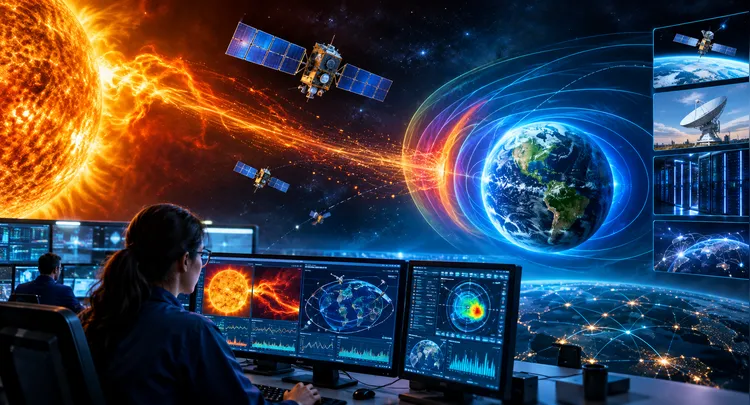
Space weather monitoring is therefore becoming an increasingly important part of satellite operations. Solar flares, coronal mass ejections and energetic particles can interfere with spacecraft systems and affect technologies on Earth. ESA notes that space weather can reduce satellite communications, performance, reliability and operational lifetime.
As satellite networks become larger and more commercially important, understanding these risks is becoming essential for operators.
Why Solar Activity Can Threaten Satellites
The Sun constantly releases energy and charged particles into space. Most of the time, Earth’s magnetic field and atmosphere provide substantial protection. During major solar events, however, that protection can be challenged by intense radiation and streams of charged particles.
For satellites, the effects can include communication disruptions, radiation exposure, charging events and increased atmospheric drag. These conditions can interfere with spacecraft electronics and orbital operations.
A significant example occurred in February 2022 when a geomagnetic storm contributed to the loss of 38 of 49 newly deployed Starlink satellites after increased atmospheric drag prevented them from reaching their intended operational orbits. ESA highlighted the event as an example of how space weather can affect modern satellite infrastructure.
Monitoring the Sun Can Provide Valuable Warning Time
The biggest advantage of monitoring space weather is preparation.
When satellites can detect changes in solar wind, magnetic fields and solar eruptions early enough, operators may have time to adjust spacecraft operations. Depending on the situation, they can modify mission activities, protect sensitive systems or prepare ground teams for possible disruptions.
NOAA’s SOLAR 1 satellite is designed specifically for continuous space weather observation from the Sun Earth Lagrange point. Its position gives researchers an early view of solar activity before disturbances reach Earth.
The satellite began operational service in June 2026 and provides continuous observations of the solar wind and coronal mass ejections.
Modern Satellites Need Faster Space Weather Data
Speed matters when dealing with rapidly developing solar events.
NOAA says SOLAR 1 can provide coronal mass ejection imagery to forecasters within about 30 minutes of acquisition, compared with some older sources that can take several hours. Faster information can give satellite operators more time to respond to changing conditions.
Meanwhile, NOAA’s GOES satellite series continues to provide solar imaging and space weather observations alongside its weather monitoring capabilities. The program is designed to improve warnings for solar flares, energetic particles and geomagnetic storms.
Consequently, space weather forecasting is becoming more closely connected with everyday satellite operations.
Satellite Networks Are Becoming More Vulnerable to Disruption
The number of satellites in orbit continues to grow, while businesses increasingly depend on space based infrastructure.
Communication constellations, navigation systems, Earth observation networks and commercial data services all depend on spacecraft remaining operational. A significant disruption could therefore affect multiple industries simultaneously.
Space weather can also influence navigation signals and communications on Earth. ESA notes that disturbances can affect satellite navigation services and industries such as aviation, transportation and shipping.
Therefore, monitoring solar conditions is not simply a scientific activity. It is increasingly part of infrastructure risk management.
AI Could Improve Space Weather Forecasting
Artificial intelligence is also beginning to contribute to space weather research.
NASA reported in August 2026 that researchers developed a machine learning model capable of predicting the emergence of active regions on the Sun up to 12 hours before they appear. Such approaches could eventually support earlier identification of conditions that may produce significant solar activity.
This creates an interesting connection between space science and technology insights. Better models, faster computing and larger observation datasets could improve the ability of researchers to identify patterns that are difficult to detect manually.
However, AI predictions still need scientific validation and reliable observations. Human experts remain essential when forecasts could affect spacecraft and critical infrastructure.
Space Weather Monitoring Supports More Than Satellites
The benefits extend beyond spacecraft operators.
Solar storms can influence power grids, communications and navigation systems on Earth. NOAA says space weather information helps protect critical infrastructure, economic interests and national security.
For technology companies, this creates another reason to consider space weather when designing resilient digital infrastructure. Telecommunications providers, navigation dependent businesses and organizations using satellite connectivity may need contingency plans for periods of elevated solar activity.
This issue can also become relevant to finance industry updates because financial institutions depend on reliable communication and timing systems. Similarly, sales strategies and research increasingly rely on connected digital infrastructure that may depend indirectly on satellite services.
Businesses Will Need Better Space Risk Awareness
Space weather is often viewed as a specialized concern for aerospace companies. Yet its effects can reach much further.
Marketing systems, cloud services, financial platforms, logistics operations and enterprise communication networks can depend on reliable connectivity. If satellite navigation or communication services experience disruption, businesses may face operational challenges.
HR trends and insights could also be influenced as organizations develop continuity plans for employees working with satellite dependent systems. At the same time, IT industry news will increasingly need to track space infrastructure because digital resilience is no longer limited to terrestrial networks.
Space Weather Monitoring Will Become More Continuous
Future satellite operations are likely to depend on a combination of continuous observation, forecasting and automated response.
NOAA’s Space Weather Follow On program is designed to maintain continuity of critical space weather observations while expanding monitoring capabilities through new spacecraft and instruments.
This approach is important because space weather does not follow business hours. Solar activity can change quickly, and satellite operators may need timely information regardless of location or time.
As a result, continuous monitoring can become part of the standard operational infrastructure supporting modern spacecraft.
The Next Generation of Satellite Protection
Satellite technology is becoming more sophisticated, but greater capability also creates greater exposure to environmental risks.
Future spacecraft will likely combine stronger radiation protection, improved system redundancy, better forecasting and automated operational safeguards. At the same time, more accurate observations from dedicated space weather missions could help operators make better decisions before solar disturbances become disruptive.
The objective is not to prevent solar storms. That is impossible. Instead, the goal is to understand them earlier and reduce their consequences.
Valuable Insights for Businesses and Technology Leaders
Companies that depend on satellite connectivity should treat space weather as part of broader technology resilience planning. Understanding which business systems rely on satellite communication, navigation or timing can help organizations prepare for potential disruptions.
Satellite operators should continue investing in real time monitoring, predictive models and operational procedures that can respond quickly to solar activity. Meanwhile, technology teams can explore how AI and automation can support faster analysis while keeping human experts involved in critical decisions.
For businesses, the larger lesson is clear. Space infrastructure has become part of the digital economy, and protecting that infrastructure increasingly depends on knowing what is happening on the Sun. Stay informed with practical technology insights, IT industry news and emerging space technology analysis from InfoProWeekly.
Reach out to InfoProWeekly for timely perspectives on technology, finance, marketing and the systems shaping the modern digital economy.