Robotics is moving beyond machines that simply repeat programmed movements. Modern robots are increasingly expected to understand their surroundings, respond to changing conditions and perform tasks that require coordination between perception, reasoning and physical movement.
Gemini Robotics 2 represents this shift toward more capable robotic intelligence. The technology aims to help robots understand their environments and coordinate their entire bodies while interacting with objects and people.
This development could influence how robots operate across manufacturing, logistics, healthcare, research and other industries.
What Whole Body Intelligence Means
Traditional robots often perform specific movements within carefully controlled environments. Whole body intelligence takes a broader approach.
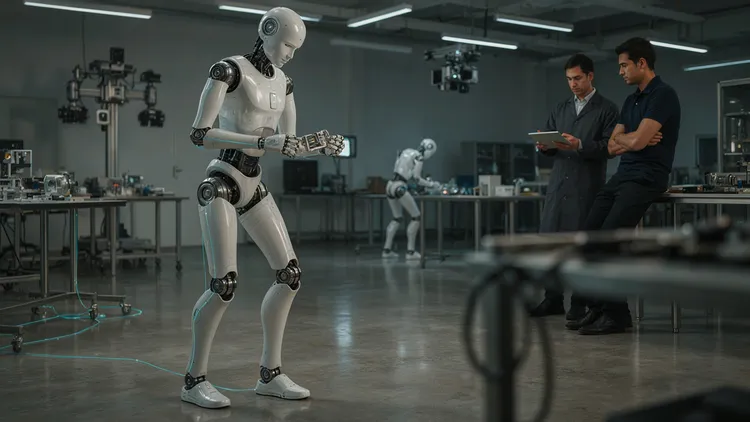
Instead of treating each movement as an isolated command, an intelligent robot can coordinate its arms, hands, body position and interaction with its surroundings.
For example, completing a physical task may require a robot to recognize an object, determine how to grasp it, move its body into the correct position and adjust its actions when the environment changes.
Consequently, whole body intelligence can make robots more adaptable to real world situations.
Combining Vision With Reasoning
A major challenge in robotics is connecting what a machine sees with what it should do next.
Advanced AI models can help robots interpret visual information and connect it with instructions and environmental context. This allows robotic systems to move closer to understanding tasks rather than simply executing predefined commands.
Technology insights from developments in embodied AI show how perception and reasoning are becoming increasingly connected with physical action.
Robots Need More Than Physical Strength
A capable robot is not simply a machine with powerful motors. It needs to understand objects, spaces and instructions.
A robot working in a warehouse, for instance, may encounter objects positioned differently every time. An intelligent system needs to recognize these differences and adjust its movements accordingly.
Gemini Robotics 2 highlights the growing importance of combining artificial intelligence with physical control.
Learning From Real World Environments
Real environments are unpredictable. Objects can move, surfaces can change and humans can interact with robots unexpectedly.
AI powered robotic systems need to respond to these situations without requiring engineers to manually program every possible scenario.
This creates an important opportunity for machine learning. Robots can potentially become more capable by learning from demonstrations, simulations and real world interactions.
The long term goal is to create systems that can generalize their abilities across different tasks.
Potential Applications Across Industries
Advanced robotics could have applications across numerous industries. Manufacturing companies may use intelligent robots for assembly and inspection, while logistics organizations could deploy them for sorting and handling goods.
Healthcare could also benefit from robotic systems capable of assisting with carefully controlled physical tasks.
As robotics becomes more adaptable, organizations may find opportunities to automate activities that were previously difficult to perform with conventional machines.
The Business Impact of Intelligent Robots
The adoption of advanced robotics could influence productivity and operational costs. Businesses may be able to automate repetitive physical tasks while allowing employees to focus on activities requiring judgment, creativity and interpersonal skills.
Finance industry updates are relevant here because organizations need to evaluate the investment required for robotic infrastructure against expected productivity gains.
The economic value of robotics will depend not only on technical capability but also on reliability, maintenance requirements and the cost of deployment.
Robotics and the Future Workforce
As robots become more intelligent, workplace roles may change. Employees could increasingly work alongside machines rather than simply supervise automated equipment.
HR trends and insights will become important as organizations determine how workers can develop skills for robot enabled environments.
Training in robotics, AI supervision, maintenance and human machine collaboration could become increasingly valuable.
The objective should be to use automation to enhance human capabilities while managing workforce disruption responsibly.
Safety and Human Interaction
Robots operating around people require strong safety mechanisms. Physical intelligence must include an understanding of movement, proximity and potential hazards.
A robot that can reason about tasks but cannot safely respond to unexpected human movement would not be suitable for many real world environments.
Therefore, safety testing, monitoring and controlled deployment remain essential as intelligent robots become more capable.
The Role of Software in Robotics
Modern robotics is increasingly becoming a software challenge as much as a hardware challenge.
Powerful AI models can provide perception and reasoning capabilities, while robotic control systems translate those capabilities into physical actions.
IT industry news increasingly reflects this convergence between software engineering, artificial intelligence and robotics.
This shift could encourage technology companies to build broader platforms that connect AI models with physical machines.
Opportunities for Developers
More capable robotic intelligence could also create opportunities for developers and researchers.
Software professionals may build applications that allow robots to perform specialized tasks, while researchers can explore new approaches to learning, perception and physical reasoning.
The growing robotics ecosystem could therefore create demand for skills spanning AI, software engineering, computer vision, mechanical systems and human machine interaction.
Marketing and Customer Expectations
Marketing trends analysis may also become relevant as robotics enters consumer facing environments.
Companies introducing robots will need to explain their benefits clearly and address customer concerns about safety, privacy and reliability.
Similarly, Sales strategies and research can help businesses identify industries where intelligent robotics can solve genuine operational problems rather than being adopted simply because the technology is new.
Challenges Ahead
Despite rapid progress, intelligent robotics still faces significant challenges. Robots must operate reliably in complex environments and respond appropriately to unexpected situations.
Hardware limitations, energy consumption, training requirements and safety considerations can also affect commercial adoption.
Furthermore, organizations need to establish clear rules around data collection and the use of AI systems in physical environments.
A Shift Toward Embodied AI
Gemini Robotics 2 reflects a larger movement toward embodied artificial intelligence, where intelligent systems interact directly with the physical world.
Instead of limiting AI to screens and software applications, embodied systems bring machine intelligence into factories, warehouses, laboratories and potentially homes.
This could become an important stage in the evolution of artificial intelligence as models gain stronger connections between perception, reasoning and physical action.
Actionable Insights for Businesses
Organizations considering robotics should begin with specific operational challenges rather than focusing solely on the latest AI capabilities. Tasks involving repetitive physical activity, predictable workflows and measurable outcomes may offer practical starting points.
Businesses should also evaluate safety, workforce training and long term operating costs before deployment.
The most valuable robotics strategies will likely combine intelligent automation with human supervision. As robotic systems become more capable, companies that prepare their infrastructure and workforce early may be better positioned to benefit from the next generation of physical AI.
Stay Informed With InfoProWeekly
For more Technology insights, IT industry news, HR trends and insights, Finance industry updates, Sales strategies and research and Marketing trends analysis, connect with InfoProWeekly for practical coverage of AI, robotics and emerging business technology. Reach out to InfoProWeekly to explore the latest developments shaping artificial intelligence, intelligent automation and the future of enterprise technology.