AI Powered Robotics Enters a New Industrial Phase
Robotics has been part of industrial production for decades. However, traditional robots usually depend on carefully programmed instructions and controlled environments. New advances in artificial intelligence are changing that model.
AI powered robotics is moving closer to real world industrial automation as machines become better at sensing their surroundings, understanding tasks and adapting to changing conditions. The International Federation of Robotics says artificial intelligence is increasingly improving robot autonomy, adaptability and interaction with people.
Consequently, factories are beginning to explore robots that can perform more flexible tasks instead of repeating only one precisely defined movement.
Robots Are Becoming More Adaptable
Traditional industrial automation works particularly well when production conditions remain predictable. Yet modern factories often handle changing products, materials and workflows.
Artificial intelligence can help robots respond to these variations. Computer vision allows machines to identify objects and environments, while advanced software can help them adjust movements and make decisions based on incoming information.
For example, a robot working in a warehouse could recognize different packages and determine how to handle them. Similarly, a manufacturing robot could adjust its movements when the position of a component changes.
This greater flexibility could make automation useful in areas where conventional robotics has previously been difficult to deploy.
Physical AI Connects Software With Machines
A major development in robotics is the growing connection between artificial intelligence and physical machines. The International Federation of Robotics describes this direction as Physical AI, where robots can learn through simulation and experience before operating in real environments.
This approach can reduce dependence on manually programming every possible situation. Instead, AI systems can process information from sensors, cameras and other sources to help robots respond to their surroundings.
As a result, the relationship between software and industrial equipment is becoming much closer. Information technology and operational technology are increasingly connected, allowing data from physical operations to influence digital decision making.
Manufacturing Is a Major Testing Ground
Manufacturing remains one of the most important areas for advanced robotics. Companies are looking for ways to improve productivity, quality and operational flexibility while managing labor shortages and changing customer demand.
The International Federation of Robotics reports that the global market value of industrial robot installations reached 16.7 billion dollars, highlighting the continued importance of automation investment.
Automotive production remains an important adopter, while electronics, pharmaceuticals, logistics and other industries are also exploring more intelligent robotic systems.
Therefore, AI powered robotics could become an important part of the next generation of smart factories.
Humanoid Robots Are Getting Attention
Humanoid robots have attracted significant attention because their body structure can allow them to operate in spaces designed for people. However, their commercial use remains relatively limited.
The International Federation of Robotics reported that around 7,000 humanoid robots were sold globally for industrial and professional service applications in 2025. At the same time, the organization noted that humanoids still represent a very small share of the overall robot population.
This distinction is important. Demonstrations can show impressive capabilities, but industrial customers need reliability, efficiency, safety and consistent performance.
Therefore, the next stage of robotics will depend less on impressive demonstrations and more on measurable performance in real workplaces.
Real World Automation Still Has Difficult Challenges
AI powered robotics is advancing, but several challenges remain. Robots must operate safely around people, handle unexpected situations and perform tasks consistently.
Fine motor control is another difficult area. A robot may successfully complete a task in a controlled environment but struggle when objects have different shapes, weights or positions.
Recent reporting on industrial humanoid development has highlighted limitations involving dexterity, adaptability and reliability.
Furthermore, companies must consider cybersecurity. Connected robots can exchange information with cloud platforms and enterprise systems, creating additional points that organizations need to protect.
AI Could Change the Role of Industrial Workers
The growth of robotics does not necessarily mean that human workers disappear from industrial environments. Instead, jobs can change as machines take over repetitive or physically demanding activities.
Workers may increasingly supervise robotic systems, manage exceptions, analyze production data and maintain automated equipment. This creates new demand for technical knowledge, problem solving and machine supervision.
These developments connect with HR trends and insights because organizations will need to rethink training and workforce development. Employees may need opportunities to learn robotics, AI systems, data analysis and digital operations.
Business Functions Will Feel the Impact
The effects of intelligent automation extend beyond factory floors. Finance teams may monitor investment and operational efficiency. Sales teams can use automation data when developing sales strategies and research. Marketing teams can study how automation changes production capacity and customer expectations.
Meanwhile, technology teams will manage the systems connecting robots with enterprise software, cloud infrastructure and operational networks.
These developments also contribute to wider technology insights, IT industry news, finance industry updates and marketing trends analysis because industrial automation is becoming part of broader digital transformation.
The Future Could Be More Collaborative
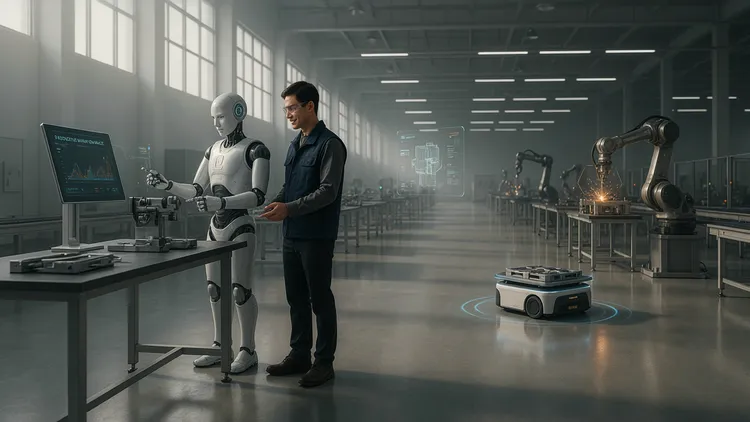
The most practical future may involve humans and robots working together rather than machines operating completely independently.
Robots can handle repetitive movements, inspection and physically demanding work. People can provide judgment, creativity, supervision and problem solving when situations become unpredictable.
The International Federation of Robotics describes human and robot collaboration as an important part of addressing labor shortages while creating opportunities for workers to develop new skills.
As a result, successful automation may depend as much on workforce preparation as on robotics technology itself.
Valuable Insights for Businesses
Businesses evaluating advanced robotics should focus on practical outcomes rather than technology hype. A useful starting point is identifying repetitive processes where greater flexibility could create measurable value.
Companies should also evaluate safety, cybersecurity, maintenance, training and integration with existing systems before expanding deployment.
Most importantly, organizations need to treat robotics as part of a wider transformation strategy. The strongest opportunities may emerge when intelligent machines, skilled employees and connected business systems work together.
AI powered robotics is moving from controlled demonstrations toward more practical industrial applications. However, its long term impact will depend on whether these systems can deliver reliable performance, reasonable costs and safe collaboration in everyday working environments. For more technology insights and IT industry news, connect with InfoProWeekly for practical coverage of emerging robotics and automation trends.
Stay informed about AI, workforce transformation and the technologies shaping the future of industrial business.