

The New Era of Digital Discovery
Artificial intelligence is reshaping how people discover information online, pushing brands to rethink their digital content strategies. AI powered search experiences increasingly provide direct answers, summaries, and recommendations, changing how users interact with websites and search results.
For businesses, this shift creates new opportunities to reach audiences while introducing fresh challenges for search engine optimization and content visibility. Instead of focusing exclusively on traditional search rankings, marketing teams must now consider how their content can help AI systems generate accurate, relevant answers.
Consequently, brands are investing greater attention in original research, clear explanations, authoritative information, and content that directly addresses customer questions.
The Shift From Traditional Search to AI Answers
Traditional search engines generally present a list of links that users explore to find information. AI search experiences can combine information from multiple sources to produce conversational responses, summaries, and suggested follow up questions.
Google has expanded AI Overviews and introduced AI Mode, while other platforms have developed conversational search experiences. OpenAI has also integrated web search into ChatGPT, allowing users to ask questions and receive answers supported by online sources.
These developments represent a significant change in information discovery. Users can increasingly research products, compare services, and explore complex topics without visiting several websites individually.
However, AI generated answers still rely on information available from online sources. As a result, publishing accurate, useful, and clearly structured content remains important for brands seeking visibility.
Why Content Strategy Is Changing
AI search is encouraging marketing professionals to reconsider what makes digital content valuable. Publishing large volumes of generic articles may not provide the same competitive advantage when AI systems can summarize widely available information.
Brands are therefore placing greater emphasis on original insights, specialist knowledge, first hand experience, and reliable evidence.
Important developments include
- Greater investment in original research and proprietary data
- More direct answers to specific customer questions
- Clearer content structures with descriptive headings
- Stronger emphasis on subject expertise and factual accuracy
- Increased attention to brand mentions and visibility beyond conventional search results
Moreover, businesses must create content that serves real customer needs rather than simply repeating keywords. This approach can support both traditional search performance and discovery through AI powered platforms.
Research Highlights Show the Traffic Challenge
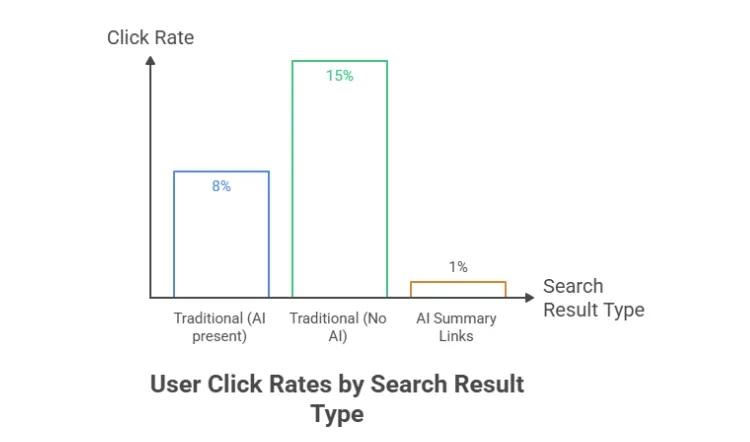
Evidence suggests that AI summaries can influence how often users visit external websites. A July 2025 analysis by Pew Research Center examined 68,879 Google searches conducted during March 2025.
The study found that users clicked a traditional search result in 8% of visits when an AI summary appeared, compared with 15% when no summary appeared. Clicks on links within the AI summaries themselves occurred in just 1% of visits.
These findings highlight a challenge for publishers and marketing teams. Even when a brand provides useful information, users may receive enough detail from an AI generated response without visiting the original website.
However, these figures reflect observed browsing behaviour in the United States during a specific period. They do not establish that every website or industry will experience the same impact.
What Google Says About AI Search Optimization
Google’s guidance emphasizes that established SEO practices remain relevant to its AI search experiences. Its documentation recommends publishing helpful, reliable, people first content rather than relying on special optimization tricks.
Google also advises website owners to ensure that important information remains accessible to search crawlers, that internal links help users discover related pages, and that structured data accurately reflects visible content.
Furthermore, Google’s AI search experiences can draw on multiple related searches to develop answers. This creates opportunities for pages that explain specific subtopics clearly and provide useful evidence.
For brands, the implication is straightforward. Content should demonstrate genuine expertise, answer questions accurately, and offer information that readers cannot easily find in dozens of nearly identical articles.
How AI Search Affects B2B Marketing
The shift has implications for B2B marketing, where purchasing decisions often involve lengthy research and multiple stakeholders.
Business buyers may use AI search to compare software platforms, investigate service providers, understand industry challenges, and shortlist potential suppliers before contacting sales teams.
Consequently, marketing professionals need content that supports different stages of the buying journey.
- Lead generation can benefit from detailed product comparisons, practical guides, and industry research that address specific buyer questions.
- Account based marketing can use expert content tailored to the challenges faced by particular industries and target accounts.
- Demand generation can focus on building brand recognition and trust before buyers are ready to make contact.
- Sales and marketing alignment can improve when both teams use consistent, evidence based explanations of products, services, and customer outcomes.
Moreover, businesses should evaluate whether AI search visibility contributes to qualified enquiries, pipeline growth, and customer acquisition rather than judging performance exclusively by website traffic.
The Role of Original Research and Expert Content
As AI systems make common information easier to access, original material may become a stronger competitive advantage.
Brands can differentiate themselves through customer case studies, proprietary research, expert interviews, product demonstrations, and carefully documented industry analysis. These formats provide specific evidence and perspectives that generic summaries may not offer.
Meanwhile, content teams can use AI tools to research topics, organize information, and improve editorial efficiency. However, automated drafts still require human verification to prevent unsupported claims, outdated details, and misleading interpretations.
Technology providers and publishers must also consider transparency, attribution, and content quality. Publishing more articles is not necessarily an effective strategy if those articles provide little original value.
What Businesses Should Know
Businesses should adapt their content strategies without abandoning the SEO foundations that continue to support discoverability.
First, identify the questions customers ask throughout their buying journey. Create focused pages that answer those questions with accurate information, useful examples, and clear explanations.
Second, strengthen technical SEO. Ensure important pages can be crawled and indexed, improve internal linking, and maintain a clear website structure. Businesses seeking visibility in ChatGPT search should also check that their site permits access by OpenAI’s OAI SearchBot where appropriate.
Third, measure performance more broadly. Alongside rankings and organic traffic, monitor qualified leads, branded searches, conversions, referral sources, and the business outcomes associated with content.
Finally, review content regularly. Update outdated information, verify statistics, identify gaps in expertise, and prioritize material that genuinely helps customers make informed decisions.
Conclusion
AI search is changing how audiences discover brands and how businesses compete for digital attention. The strongest strategies will combine established SEO practices with original insights, trustworthy information, and a clear understanding of customer needs. InfoProWeekly.com will continue covering the developments shaping digital marketing, content strategy, and marketing technology.
Explore more industry news, business insights, and digital marketing developments at InfoProWeekly.com.