Marketing teams have more data than ever. They can track clicks, views, leads, sales, customer actions and campaign results across many platforms. Yet, finding useful answers from that data remains difficult.
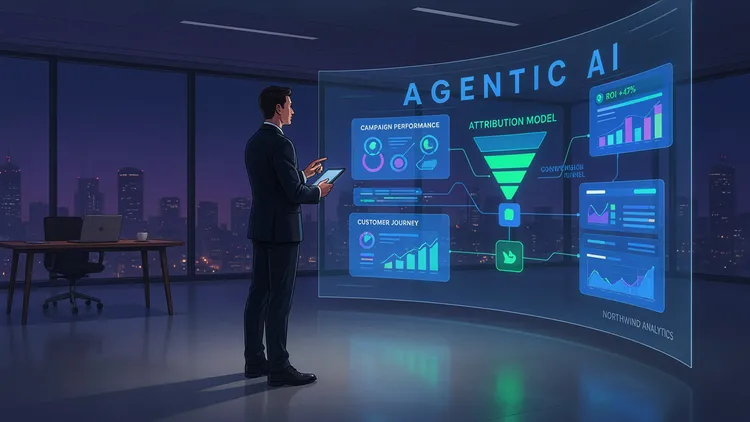
Now, agentic AI is changing how marketers work with this information. Instead of simply showing reports, AI systems can study data, identify patterns and help teams decide what to do next.
Google has already added agentic features to Google Ads and Google Analytics. Its Ask Advisor tools can analyze marketing data and provide insights, visualizations and recommendations.
As a result, marketing analytics is moving from simple reporting toward faster decision making.
What Agentic AI Means for Marketing
Traditional AI tools often respond to a specific request. Agentic AI can take a broader role. It can examine information, connect different signals and suggest actions based on a defined goal.
For example, a marketing team may ask why sales dropped during a particular week. An agent can review traffic, campaigns, conversions and other available data. It can then highlight changes that may explain the result.
Therefore, marketers spend less time searching through dashboards. Instead, they can focus more on understanding the business impact.
Marketing Measurement Is Becoming More Complex
Customer journeys have become harder to track. People move between search, social media, websites, email, apps and offline interactions before making a purchase.
At the same time, privacy rules and changes in tracking technology have reduced some of the signals marketers once relied on.
The IAB reported in its 2026 State of Data report that privacy changes, signal loss and fragmented data environments are putting pressure on traditional marketing measurement.
Consequently, marketers need stronger ways to connect different signals and understand what really drives business results.
From Reports to Real Time Decisions
Traditional analytics often answers a simple question. What happened?
Agentic systems can move the conversation toward another question. What should we do next?
That change is important. Forrester reported in July 2026 that 49 percent of B2C marketing decision makers surveyed still felt that analytics findings did not translate into action.
Agentic AI can help close this gap. It can bring insights closer to the moment when marketers need to make a decision.
For instance, an AI system could notice that a campaign is losing efficiency. It could compare recent results with earlier periods and highlight possible reasons. A marketer could then investigate the issue before the campaign wastes more budget.
Attribution Is Also Changing
Attribution has long been a difficult part of marketing analytics. Customers rarely follow one simple path before buying.
A person might discover a brand through a video, search for it later, read reviews and finally purchase through a website. Giving full credit to one channel can therefore create an incomplete picture.
Agentic AI can help marketers compare different measurement models and signals. However, it should not replace sound measurement methods.
The IAB says marketers are exploring AI across attribution, incrementality testing and marketing mix modeling.
Therefore, AI works best when it supports strong measurement rather than replacing it.
Google Is Bringing Agents Into Analytics
Google is one of the clearest examples of this shift. Its Ask Advisor experience in Google Analytics uses Gemini models to analyze account data and provide insights.
The tool can answer questions about performance and create visualizations based on analytics data. It can also identify opportunities and provide recommendations.
Google has also introduced new measurement tools that combine first party data, multiple signals and causal measurement. Its September 2026 updates focus on helping marketers move from reporting toward faster performance decisions.
This shows how analytics platforms are becoming more active participants in the marketing process.
AI Is Changing What Marketers Measure
The rise of AI may also change the metrics that matter.
Traditional marketing reports often focus on clicks, impressions, sessions and conversions. These metrics remain useful. However, AI driven customer journeys can create new forms of interaction.
The IAB’s 2026 measurement discussions point to signals such as inclusion in AI responses, citation share and agent access as areas that marketers may need to understand.
This creates a new measurement challenge. A customer may discover a brand through an AI assistant without following a traditional search journey.
Therefore, marketing teams need to understand both traditional traffic and emerging AI driven discovery.
The Impact on Marketing Teams
Marketing professionals will spend less time collecting data when AI agents handle more routine analysis.
However, this does not reduce the need for human skills. Marketers still need to understand customers, evaluate recommendations and make strategic decisions.
This connects with HR trends and insights because companies will need employees who can combine marketing knowledge with data and AI skills.
Similarly, technology insights and IT industry news increasingly focus on how AI systems connect with business data. Marketing teams will need closer cooperation with technology and data teams as these systems become more advanced.
Sales and Finance Will Use the Same Data
Better marketing measurement can also support other business teams.
Sales teams can use campaign insights to understand which sources produce stronger leads. This can improve sales strategies and research by connecting marketing activity with customer outcomes.
Finance teams can also use clearer marketing data when reviewing budgets and returns. Finance industry updates increasingly focus on proving the value of technology and marketing investments.
As a result, marketing analytics is becoming a shared business resource rather than a tool used only by marketing departments.
Marketing Needs Better Data Foundations
Agentic AI can only provide useful answers when it has access to reliable data.
Poor tracking can create misleading results. Missing customer information can also produce incomplete recommendations.
Therefore, businesses should improve their data foundation before giving AI more responsibility. They need clear tracking rules, consistent definitions and reliable first party data.
Google has also emphasized the importance of a strong data foundation, multiple signals and causal proof for measurement in the AI era.
Without these foundations, faster analysis may simply produce faster mistakes.
The Future of Marketing Analytics
The next stage of marketing analytics will focus more on action. AI agents may continuously monitor campaigns, identify changes and bring important findings to marketers.
However, human oversight will remain important. Marketers need to decide whether an AI recommendation fits the brand, audience and business goal.
In addition, companies will need clear controls around data access and automated actions.
Marketing trends analysis will therefore move beyond campaign reporting. It will increasingly focus on how data, AI and human judgment work together.
Valuable Insights for Marketing Leaders
Businesses should begin by identifying the marketing questions that take the most time to answer. These questions can become useful starting points for AI assisted analytics.
Next, teams should connect reliable data sources and define the metrics that matter most. They should also test AI recommendations against real business outcomes.
Most importantly, marketers should not measure success by how many AI tools they use. The real value comes from making better decisions faster while keeping people responsible for important choices.
Agentic AI can make marketing measurement more active, useful and responsive. However, strong data, sound measurement methods and human judgment will remain the foundation of reliable marketing decisions.
For more practical technology insights and marketing analysis, connect with InfoProWeekly for timely coverage of AI and digital business trends. Reach out to InfoProWeekly to stay informed about the technologies changing marketing and the future of business analytics.