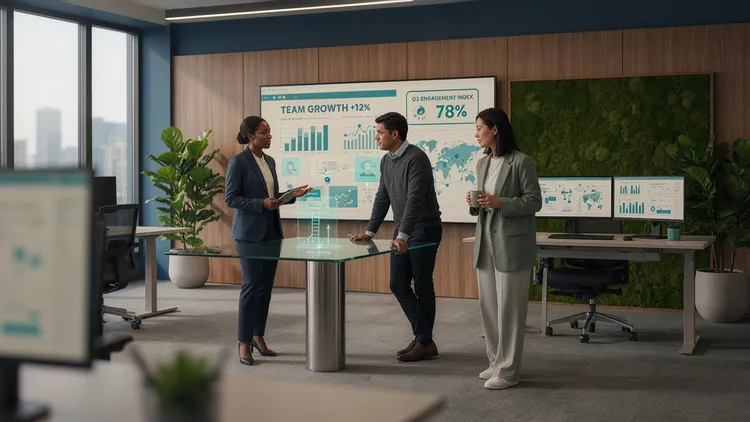

Businesses generate enormous amounts of information through employees, customers, applicants, workplace systems and digital interactions. When this information is organized responsibly, it can reveal patterns that support better business decisions.
People data refers to information that helps organizations understand workforce behavior, skills, engagement, customer preferences and broader human factors. Rather than relying only on assumptions, leaders can use relevant data to understand what is happening across their organization.
Consequently, people data and business insights are becoming increasingly important for companies looking to improve productivity, employee experience and long term growth.
Turning Information Into Business Insights
Collecting information is only the first step. The real value comes from transforming raw information into useful insights that leaders can act upon.
For example, workforce data can reveal which skills are becoming difficult to find, where employee turnover is increasing or which training programs are producing better outcomes. Similarly, customer information can help companies understand purchasing behavior and identify changing expectations.
Furthermore, combining information from different departments can provide a broader view of business performance. This allows leaders to make decisions based on evidence rather than isolated observations.
Technology Is Transforming People Analytics
Advances in artificial intelligence, cloud computing and data analytics are changing how organizations process information. Modern platforms can analyze large datasets quickly and identify patterns that may be difficult to detect manually.
Technology insights show that businesses are increasingly using intelligent systems for workforce planning, recruitment, customer analysis and operational decision making.
Meanwhile, IT industry news continues to highlight developments in artificial intelligence and enterprise analytics. As these technologies become more accessible, even smaller organizations can use sophisticated analytical tools to support business planning.
Better Workforce Planning Through Data
Employees are one of the most important assets of any organization. However, managing a workforce effectively requires more than simply tracking headcount.
Organizations can use workforce information to understand skill availability, employee movement, productivity patterns and training requirements. This can help leaders plan recruitment and development more effectively.
HR trends and insights increasingly emphasize skills based workforce planning. Companies can identify existing capabilities before hiring externally and create development programs that help employees prepare for future responsibilities.
As a result, data driven workforce planning can support both organizational growth and employee development.
Improving Employee Experience
Employee experience can have a direct effect on productivity, engagement and retention. Data can help organizations understand where employees are facing difficulties and which workplace practices are creating positive outcomes.
For instance, organizations can analyze employee feedback, participation in development programs and workplace engagement patterns. These insights can help HR teams identify areas that require attention.
However, businesses should avoid treating employees simply as data points. Human judgment and direct communication remain essential when interpreting workplace information.
Understanding Customers More Effectively
People data is equally valuable outside the workplace. Customer behavior provides important signals about product preferences, purchasing decisions and changing expectations.
Businesses can analyze customer interactions across websites, applications, sales conversations and support channels to develop a more complete understanding of their audiences.
Consequently, sales strategies and research can become more targeted. Sales teams can understand customer needs more clearly, while marketing teams can create messages that are more relevant to specific audiences.
Supporting Smarter Marketing Decisions
Marketing decisions increasingly depend on understanding people. Customer data can reveal which content attracts attention, which channels generate engagement and where customers move through the purchasing journey.
Marketing trends analysis can help organizations identify emerging audience behaviors and adapt campaigns accordingly. However, personalization should always be balanced with transparency and responsible data practices.
When customers understand how their information is being used and receive genuine value in return, businesses can build stronger relationships and greater trust.
Financial Decisions Can Benefit From Human Insights
Financial performance is influenced by human behavior. Consumer confidence, employee costs, purchasing patterns and customer retention can all affect revenue and profitability.
Finance industry updates increasingly demonstrate how organizations use analytics to understand these factors. By connecting financial information with relevant people and customer insights, businesses can develop a more complete view of performance.
For example, declining sales may not simply indicate a pricing problem. Customer feedback could reveal changing preferences, while workforce information could identify service issues contributing to lower satisfaction.
Privacy and Responsible Data Use
The growing importance of people data also creates significant responsibility. Organizations must protect sensitive information and establish clear policies around collection, storage and access.
Employees and customers should understand how their information is being used. Businesses should also ensure that analytical systems do not create unfair outcomes or rely on incomplete information.
Trust is particularly important because people are more likely to engage with organizations that demonstrate responsible data practices.
Creating a Data Driven Culture
Technology alone cannot create effective decision making. Organizations also need a culture where employees understand how to interpret information and use insights responsibly.
Leaders can encourage teams to question assumptions, compare evidence and measure outcomes. Over time, this approach can make data a natural part of everyday decision making rather than something reserved for specialist teams.
Moreover, employees with strong analytical and communication skills can help translate complex information into practical business actions.
The Future of People Data and Business Insights
As artificial intelligence and analytics continue to evolve, organizations will gain access to increasingly sophisticated ways of understanding human behavior. The most successful companies are likely to combine technological capabilities with human judgment.
People data and business insights can help organizations identify opportunities, anticipate challenges and make better decisions across workforce management, customer engagement, finance and marketing.
Nevertheless, the objective should not be collecting the largest possible amount of information. The priority should be identifying reliable information that answers meaningful business questions and supports measurable improvements.
Actionable Insights for Business Leaders
Organizations should begin by identifying the decisions that have the greatest impact on employees, customers and business performance. From there, they can determine which information is genuinely useful for improving those decisions.
Businesses should also invest in data quality, employee training and responsible governance. When reliable information is combined with experienced human judgment, organizations can respond faster to changing market conditions while reducing unnecessary guesswork.
Ultimately, the strongest advantage comes from turning information into action. Companies that understand their people, customers and workforce can build strategies that are more responsive, relevant and sustainable.
Stay Informed With InfoProWeekly For more Technology insights, IT industry news, HR trends and insights, Finance industry updates and Marketing trends analysis, connect with InfoProWeekly for practical perspectives on business and technology trends.
Reach out to InfoProWeekly to discover insights that can help your organization make smarter decisions and build sustainable growth.