
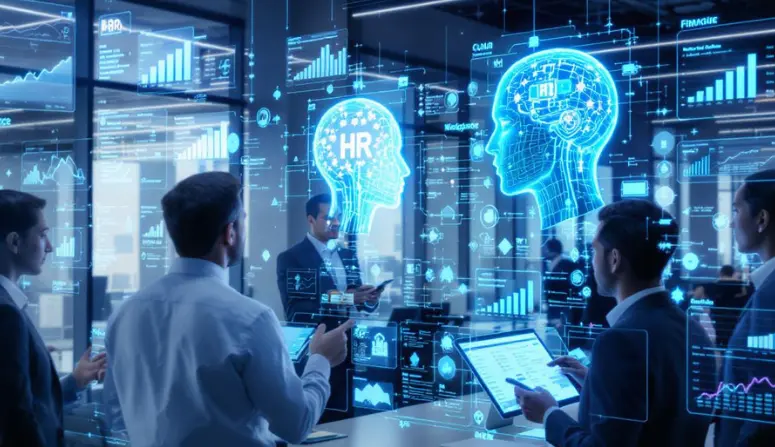
Artificial intelligence is changing the way organizations manage people, budgets, and long term growth. In recent years, companies have started moving beyond isolated departments and toward more connected strategies. As a result, HR leaders and finance executives are now working closer than ever before. This shift is helping businesses make faster decisions, improve workforce planning, and achieve stronger business outcomes.
How AI links HR and finance to business results has become one of the most important discussions across modern enterprises. Companies are no longer relying only on instinct or historical reports. Instead, they are using intelligent systems to connect employee performance, hiring patterns, operational costs, and revenue growth into one complete picture. Consequently, organizations gain clearer visibility into how people related decisions directly influence profitability and long term success.
AI Creates a Stronger Connection Between Workforce and Revenue
For years, HR teams focused mainly on recruitment, employee engagement, and retention while finance departments concentrated on budgets and forecasting. However, artificial intelligence is helping bridge that gap in a practical and measurable way.
AI driven platforms can now analyze employee productivity, turnover risks, payroll expenses, and performance metrics together. Because of this, companies can understand whether their workforce investments are truly delivering value. Moreover, executives can identify which teams generate the highest returns and where improvements are needed.
This transformation is becoming a major topic in Technology insights and HR trends and insights because businesses want more accurate ways to align talent strategies with financial performance. At the same time, finance leaders appreciate having deeper workforce visibility that supports smarter budgeting decisions.
Smarter Hiring Decisions Improve Financial Outcomes
Recruitment has traditionally been expensive and time consuming. Nevertheless, AI tools are making the process faster and far more efficient. Intelligent recruitment systems can evaluate candidate data, predict hiring success, and identify individuals who are likely to stay longer within the organization.
As companies continue exploring how AI links HR and finance to business results, hiring efficiency has become a major advantage. Reducing turnover saves money while improving team stability. Furthermore, businesses can avoid unnecessary recruitment costs and minimize productivity losses caused by frequent employee departures.
This growing reliance on predictive hiring technology is often highlighted in IT industry news because companies are increasingly investing in data driven talent acquisition strategies. Meanwhile, HR professionals are discovering that better hiring decisions contribute directly to healthier financial performance.
Workforce Planning Becomes More Accurate
One of the biggest challenges businesses face is predicting future workforce needs. Economic conditions change rapidly, and companies must adapt without overspending or understaffing critical departments. Fortunately, AI provides a more accurate approach to workforce planning.
Advanced analytics systems can study historical trends, employee performance, market demand, and business growth patterns to forecast staffing requirements. As a result, organizations can allocate resources more effectively and avoid reactive decision making.
Additionally, finance teams gain stronger confidence in budget planning because staffing forecasts become more reliable. This is why discussions surrounding how AI links HR and finance to business results continue gaining attention across Marketing trends analysis and Sales strategies and research communities. Businesses understand that workforce efficiency directly impacts customer experience and revenue growth.
Employee Experience Now Influences Profitability
Modern organizations are increasingly recognizing that employee satisfaction has a measurable effect on business performance. AI powered engagement tools can analyze feedback, communication trends, and workplace sentiment in real time. Consequently, companies can identify issues before they become larger problems.
When employees feel supported and valued, productivity often improves. In addition, stronger engagement reduces absenteeism and turnover rates. These outcomes positively influence operational costs and overall profitability.
Many Finance industry updates now focus on the financial impact of employee wellbeing because workforce stability plays a critical role in long term business success. Likewise, HR leaders are using AI to create personalized employee experiences that support retention and performance goals simultaneously.
Real Time Data Helps Leaders Make Faster Decisions
Businesses today operate in highly competitive environments where delays can lead to missed opportunities. Therefore, companies need real time access to accurate information. AI powered dashboards now allow HR and finance teams to monitor workforce trends, labor costs, and productivity metrics instantly.
This connected approach improves collaboration between departments. Instead of waiting for monthly reports, executives can react quickly to changing conditions. Moreover, organizations can adjust hiring plans, compensation strategies, and operational investments based on live business data.
As conversations around how AI links HR and finance to business results continue expanding, many organizations are discovering that speed and visibility are becoming major competitive advantages. Faster decision making often leads to better resource management and stronger business performance overall.
AI Supports Long Term Business Strategy
Artificial intelligence is not only improving daily operations. More importantly, it is helping organizations build sustainable long term strategies. Companies can now use predictive models to estimate future workforce costs, identify leadership gaps, and prepare for market shifts before they happen.
This forward thinking approach allows HR and finance teams to become strategic partners rather than separate operational units. Consequently, businesses can align talent development with revenue goals more effectively.
Industry experts featured in Technology insights frequently emphasize that organizations adopting AI driven workforce intelligence are positioning themselves for stronger resilience and future growth. At the same time, HR trends and insights continue showing that companies investing in intelligent workforce planning often outperform competitors in both productivity and profitability.
Valuable Insights for Businesses Exploring AI Integration
Organizations looking to strengthen the relationship between HR and finance should begin with data transparency and cross departmental collaboration. AI systems perform best when businesses combine workforce metrics with financial data in one centralized environment. Furthermore, leadership teams should focus on measurable goals such as retention improvement, productivity growth, and smarter budget allocation.
Companies should also invest in employee training to ensure teams understand how AI tools support decision making rather than replace human expertise. In many cases, businesses achieve better outcomes when technology enhances collaboration between departments instead of creating additional complexity.
Most importantly, organizations should regularly evaluate how workforce initiatives contribute to revenue growth, operational efficiency, and customer satisfaction. This balanced approach allows businesses to gain meaningful value from AI while supporting both employee success and financial stability.
InfoProWeekly delivers trusted coverage on emerging business innovation, digital transformation, and enterprise technology strategies.