
Audio Wearables Are Becoming More Intelligent
Earbuds and headphones have traditionally focused on delivering music and making calls. However, that role is beginning to change as artificial intelligence moves directly into smaller personal devices.
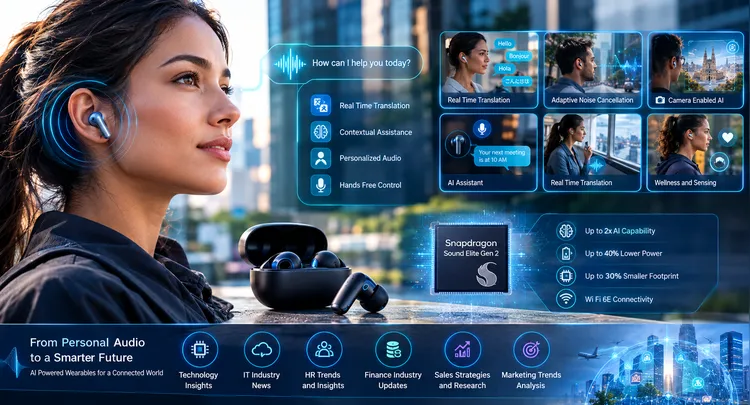
Qualcomm has introduced Snapdragon Sound Elite Gen 2, a new audio platform designed to combine premium sound with on device intelligence, cloud connected services and low power connectivity. The company says the platform is designed for a new generation of intelligent audio wearables that can understand context, provide assistance and adapt to users throughout the day.
As a result, earbuds could increasingly become personal computing devices rather than simple audio accessories.
Qualcomm Brings Personal AI Into Earbuds
The central idea behind the new platform is personal AI that can operate through natural voice interactions. Instead of reaching for a smartphone every time they need information, users could interact with an assistant directly through their earbuds.
Qualcomm says the platform can support experiences such as real time translation, contextual assistance and personalized hearing. It is also designed to support multimodal experiences that combine audio, vision and AI.
Therefore, the next generation of audio devices could become more useful during everyday activities such as commuting, working, traveling and exercising.
More AI Processing Can Happen on the Device
One of the important changes is the amount of intelligence that can be processed directly on the wearable. Qualcomm says Snapdragon Sound Elite Gen 2 provides up to twice the AI capability of its previous generation platform while also targeting up to 40 percent lower power consumption and a platform footprint that is up to 30 percent smaller. These figures are Qualcomm comparisons based on its own testing.
That combination matters because small wearables have strict limits around battery capacity, heat and physical space.
Consequently, more processing can happen locally without requiring every interaction to depend entirely on a smartphone or remote server.
Sound Can Adapt to the Listener
Artificial intelligence is also changing the way audio itself works. Qualcomm says its new platform can continuously adapt audio experiences according to the listener, device and surrounding environment.
The technology includes its fifth generation adaptive active noise cancellation, AI enhanced voice processing and advanced microphone architectures. The company says these features are designed to improve noise cancellation, speech capture and voice clarity.
For users, this could mean headphones that respond more naturally when they move between a quiet room, a crowded office, a busy street or an airplane.
Micro Power Wi Fi Expands What Earbuds Can Do
Another important part of the platform is integrated micro power Wi Fi 6E. Qualcomm says this allows audio wearables to maintain direct cloud connectivity while consuming much less power than conventional approaches.
This is significant because cloud connectivity can expand what a small device can accomplish. Instead of relying entirely on a connected smartphone, future earbuds could communicate directly with online services and AI assistants.
Qualcomm also says its Snapdragon Sound Apps and Agents approach can provide access to AI assistants, services and content that can continue evolving after the hardware reaches consumers.
Camera Enabled Audio Devices Could Open New Possibilities
The platform is not limited to traditional earbuds. Qualcomm says Snapdragon Sound Elite Gen 2 supports earbuds, headphones, open ear designs, hybrid products, camera enabled earbuds and audio glasses.
Camera enabled devices could add visual context to voice interactions. For example, a wearable could potentially understand what a user is looking at while also processing spoken questions.
Qualcomm says some emerging designs are intended to gather environmental context rather than simply capture photographs. This points toward a broader category of multimodal personal computing.
Privacy Will Become More Important
Greater intelligence in wearable devices also creates important privacy questions. Microphones, cameras and sensors can collect information about the user and their surroundings.
On device processing may help reduce the need to send every piece of information to the cloud. Qualcomm has positioned local intelligence as part of its approach to personal AI, although the overall privacy experience will also depend on software design, permissions and how individual device manufacturers implement the platform.
Therefore, manufacturers will need to explain clearly what their devices collect, where information is processed and when cloud services are involved.
Businesses Could Benefit From Smarter Audio
The impact of intelligent audio will extend beyond entertainment. Employees could use wearable assistants for translation, communication, information retrieval and hands free workflows.
For technology teams, this creates new opportunities around connected applications and personal computing. It also adds another dimension to technology insights and IT industry news as AI moves into smaller devices.
Human resources teams may also need to consider how wearable assistants influence workplace productivity, employee training and acceptable technology use. These developments connect with wider HR trends and insights as companies adapt to increasingly AI enabled workplaces.
Marketing and Sales Could Gain New Interfaces
The growth of intelligent wearables could also influence how brands communicate with customers. Voice based interactions may become another channel through which people discover products, receive recommendations and interact with digital services.
This creates potential connections with marketing trends analysis because brands may eventually need to think beyond screens and traditional search interfaces.
Sales teams could similarly benefit from hands free information access during meetings, travel or customer interactions. Sales strategies and research may increasingly consider AI assistants as part of the customer and employee experience.
Finance and Enterprise Technology Will Need to Adapt
Financial institutions and other regulated businesses will need to examine how intelligent wearables handle sensitive information. Voice interactions involving financial accounts, customer information or workplace data require strong security controls.
This makes finance industry updates around AI governance increasingly relevant. As personal AI becomes connected to more services, organizations will need to balance convenience with authentication, privacy and data protection.
The Audio Device Could Become a Personal AI Gateway
Qualcomm’s latest platform reflects a larger change in computing. Smartphones remain important, but AI is gradually moving into devices that people already wear and use throughout the day.
The company says Snapdragon Sound Elite Gen 2 is designed to support multiple workloads simultaneously, including AI, audio, communication, sensing and wellness functions. It is also designed for smaller and lighter devices while maintaining low power operation.
As a result, future earbuds may feel less like accessories and more like continuously available computing companions.
Valuable Insights for Businesses
The biggest opportunity is not simply adding AI to another consumer device. The more important shift is creating technology that can understand context while remaining useful, efficient and unobtrusive.
For businesses, intelligent audio could create new products, services and workplace applications. However, successful adoption will depend on battery efficiency, privacy, security, useful software and clear user controls.
For consumers, the development suggests that voice interaction may become a much larger part of everyday computing. Instead of opening an application first, people may increasingly expect technology to understand what they need and respond through the devices already around them. For more technology insights, IT industry news and practical analysis of emerging AI developments, connect with InfoProWeekly for timely industry coverage.
Explore the latest developments across AI, wearables, business technology and digital innovation with InfoProWeekly.