Kubernetes Is Entering an AI Driven Operations Era
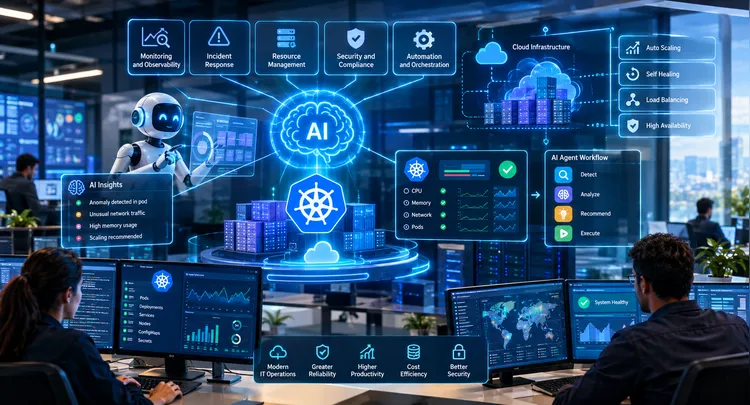
Kubernetes has become a foundation for modern cloud infrastructure, and artificial intelligence is now changing how teams operate it. Instead of relying entirely on engineers to monitor workloads and respond to every incident, organizations are exploring AI systems that can observe infrastructure, identify problems and recommend or perform operational actions.
The shift is becoming more important as AI workloads themselves increasingly run on Kubernetes. According to the Cloud Native Computing Foundation, 82 percent of container users now run Kubernetes in production, while 66 percent of organizations hosting generative AI use Kubernetes for some or all of their inference workloads.
As a result, AI agents are becoming part of a broader effort to make cloud operations more responsive and automated.
AI Agents Can Monitor Complex Environments
Modern Kubernetes environments can contain thousands of containers, services, databases, APIs and infrastructure components. Monitoring all of these systems manually can create a significant workload for platform and operations teams.
AI agents can examine telemetry from applications and infrastructure to identify unusual behavior. They can compare current conditions with historical patterns and help engineers understand whether an issue represents a temporary fluctuation or a larger reliability problem.
Furthermore, AI systems can connect information from logs, metrics and application events. This creates a more complete picture of what is happening inside a cloud environment.
Incident Response Could Become Faster
When a production service fails, every minute can matter. Engineers may need to identify the affected workload, examine recent changes, review logs and determine the safest recovery action.
AI agents can assist with these steps by analyzing available information and suggesting possible causes. More advanced systems can also execute approved actions under defined controls.
Kubernetes itself is adapting to the needs of long running autonomous agents. Its Agent Sandbox project is exploring infrastructure for agents that need persistent identity, secure execution environments and the ability to pause and resume their work.
Consequently, cloud operations could move toward systems where AI helps investigate incidents continuously rather than waiting for an engineer to begin the process.
Resource Management Is Becoming More Intelligent
Resource allocation is another area where intelligent automation can create value. Kubernetes workloads can experience changing demand throughout the day, while AI applications can create particularly demanding requirements for accelerators, memory and computing capacity.
The Cloud Native Computing Foundation notes that AI workloads require teams to consider accelerator availability, scheduling, model delivery, inference latency and resource utilization alongside traditional infrastructure metrics.
AI agents could help teams interpret these signals and recommend adjustments based on workload requirements. Over time, this could support more efficient use of computing resources while helping maintain application performance.
Reliability Requires More Than Automation
Automation alone does not guarantee reliability. An automated system can make a mistake if it has incomplete information or excessive permissions.
Therefore, AI driven operations need clear boundaries. Agents should understand which resources they can inspect, which actions they can perform and when human approval is required.
A recent CNCF project focused on running agentic security systems on Kubernetes demonstrates this approach. The architecture separates specialized agents for detection, analysis, remediation and notification while retaining a human approval path for important actions.
This model shows how organizations can combine automation with human oversight.
Observability Is Becoming More Important
Traditional monitoring often focuses on CPU usage, memory consumption, network activity and application latency. However, AI workloads introduce additional measurements such as accelerator utilization, model loading time, inference latency, token throughput and scheduling delays.
CNCF guidance for AI ready Kubernetes platforms emphasizes the need to observe infrastructure, application and AI specific signals together.
This creates an important technology insight. AI agents are only as effective as the information available to them. Better observability can give intelligent systems the context needed to make more useful recommendations.
Cloud Reliability Could Become More Proactive
Traditional operations often respond after an incident begins. AI assisted operations could shift some attention toward predicting potential problems before they become outages.
For example, an agent could notice unusual resource consumption, increasing error rates or repeated deployment failures and alert an engineering team before customers experience a major disruption.
The objective is not simply faster reaction. Instead, organizations can use AI to identify patterns that human teams may overlook when dealing with large and constantly changing environments.
AI Agents Also Need Reliable Infrastructure
There is an interesting connection between AI and Kubernetes reliability. While AI agents can help operate cloud infrastructure, those same agents require reliable infrastructure to function effectively.
The CNCF released Dapr Agents version 1.0 in 2026 with capabilities for durable workflows, failure recovery, persistent state, secure communication and observability. The project is designed to help organizations run reliable AI agents in production environments, including Kubernetes.
This means the infrastructure supporting intelligent systems must itself provide strong reliability, security and recovery mechanisms.
Security Will Become Central to AI Operations
Giving an AI agent access to production infrastructure introduces new security considerations. An agent that can inspect resources may have access to sensitive information. An agent that can modify workloads could potentially cause significant operational problems if its permissions are not carefully controlled.
Identity management, access policies, audit trails and isolated execution environments will therefore become increasingly important.
Kubernetes and the broader cloud native ecosystem are developing tools and standards that support secure agent workloads. The CNCF Kubernetes AI Conformance Program has also expanded validation to include agentic workloads and infrastructure requirements for complex AI systems.
Workforce Skills Are Changing
The growth of intelligent cloud operations does not eliminate the need for engineers. Instead, it changes what engineers need to know.
Platform teams may spend less time performing repetitive monitoring tasks and more time designing reliable systems, reviewing automated decisions and managing complex incidents.
This connects with HR trends and insights because organizations will need professionals who understand Kubernetes, cloud architecture, observability, security and AI systems. Continuous learning will become increasingly important as infrastructure automation evolves.
Business Teams Can Benefit From Better Reliability
Cloud reliability affects more than IT departments. When applications remain available, customers experience fewer disruptions and business operations can continue smoothly.
Finance teams can benefit from more predictable infrastructure costs. Sales teams depend on reliable customer systems and communication platforms. Marketing teams need websites and digital campaigns to remain available during important launches.
Therefore, developments in Kubernetes operations connect with finance industry updates, sales strategies and research and marketing trends analysis. Infrastructure reliability has become a business concern rather than a purely technical measurement.
Valuable Insights for Businesses
AI agents are moving Kubernetes operations toward a more proactive model where intelligent systems can monitor environments, investigate incidents, understand resource requirements and support remediation.
However, businesses should introduce this capability carefully. The strongest approach is to begin with well defined operational tasks, provide agents with limited permissions and maintain human approval for sensitive actions.
Organizations should also invest in observability because intelligent automation depends on reliable operational data. Furthermore, teams need clear governance covering security, access, monitoring and accountability.
Kubernetes is already a major foundation for cloud native applications and AI workloads. As intelligent systems become more capable, the next stage will involve combining Kubernetes automation with AI reasoning while keeping reliability and human oversight at the center. For more technology insights and IT industry news, connect with InfoProWeekly for practical coverage of cloud computing, AI and infrastructure innovation.
Stay informed about HR trends and insights, finance industry updates, sales strategies and research and marketing trends analysis shaping modern business technology.