The story of when a computer outsmarted a human master is one of the most iconic chapters in the history of artificial intelligence. This milestone changed how the world viewed computers—not merely as calculators, but as entities capable of deep strategic thinking and decision-making. While computers had been steadily improving for decades, the moment they surpassed a human expert in a complex task signaled a new era in technological evolution.
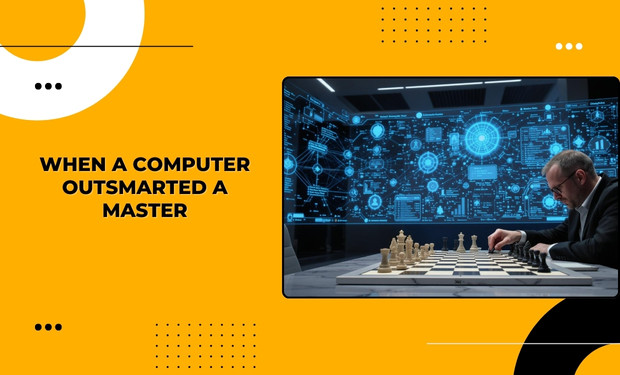
One of the most famous examples of when a computer outsmarted a champion occurred on May 11, 1997, during a historic chess match between IBM’s Deep Blue and reigning world chess champion Garry Kasparov. Deep Blue was a specialized chess-playing computer designed to analyze and evaluate millions of potential moves far faster than any human player could. Over a series of games, the machine’s processing speed, computation power, and strategic algorithms enabled it to consistently challenge and ultimately defeat Kasparov. This was the first time a computer had beaten a world chess champion in a multi-game match, a moment that stunned the world and marked a pivotal achievement in computing history.
Chess had long been considered a pinnacle of intellectual challenge, combining simple rules with almost infinite strategic possibilities. For decades, computer scientists had pushed the boundaries of machine computation and game theory, striving to build systems that could successfully compete with the best human minds. Early computing efforts focused on brute-force calculation and exhaustive search methods evaluating every possible move and its consequences. By the time Deep Blue faced Kasparov, it could assess hundreds of millions of positions per second and look many moves ahead, a capability no human could match.
The moment when a computer outsmarted a human master wasn’t an overnight success. Deep Blue evolved from years of research, trial and error, and iterative improvements in both hardware and software. The project began with ambitious ideas about automating strategic reasoning and grew into one of the most sophisticated research machines of its time. Researchers built Deep Blue with parallel processing capabilities, enabling multiple processors to work simultaneously on different branches of the decision tree. This designed advantage gave Deep Blue the raw processing strength required to challenge world-class players.
Kasparov himself won the first match against Deep Blue in 1996, demonstrating that humans still held an edge. But the rematch in 1997 showed how rapidly computer intelligence could evolve. The games ended with a mix of wins, draws, and losses, culminating in Deep Blue’s decisive victory in the final matchup. Once the machine secured the historic win, debate erupted over the nature of the competition. Some questioned whether the machine had human assistance or programming quirks. Regardless of conjecture, the achievement stood: the computer had won.
The impact of the event when a computer outsmarted a master extended far beyond the chessboard. It symbolized not only a triumph in computational power and machine strategy but also highlighted the growing role that advanced algorithms and artificial intelligence would play in the future. Chess is a game of strategy that requires foresight, memory, and complex decision-making. Machines mastering this discipline hinted at broader possibilities for AI across industries, from logistics and medicine to finance and operations optimization.
Since that historic moment, computer systems have continued to advance at an astonishing pace. Modern artificial intelligence systems no longer rely solely on brute-force computation but incorporate machine learning, heuristic analysis, and neural networks. These advancements have enabled AI to achieve success in other complex games well beyond chess.
For example, AlphaGo, an AI developed by DeepMind, famously defeated top human players in the ancient board game Go a game whose complexity vastly exceeds that of chess due to its almost unfathomable number of possible positions. AI used reinforcement learning and pattern recognition rather than brute-force search strategies to dominate the game. The sequence of matches demonstrated that when a computer outsmarted a professional player in Go, AI had reached new levels of strategic reasoning, learning from experience and improving with each game.
Instances like this show how computers have moved from performing repetitive tasks to mastering strategic thinking that was once the exclusive domain of human experts. Researchers and developers continue to refine algorithms that mimic aspects of human cognition, including learning from past decisions, predicting opponent moves, and adapting strategies in real time. Today’s AI systems are used not only in games but also in complex real-world applications such as medical diagnosis, autonomous vehicles, financial forecasting, and language translation systems.
The implications of events like when a computer outsmarted a master are significant for business and technology leaders. Companies are now investing heavily in AI research to leverage insights that machines can derive from huge data sets. The shift from traditional programming to machine learning and deep learning allows computers to identify patterns, make predictions, and even create new solutions a dramatic evolution from the early days of rule-based computing.
In practical terms, when a computer outsmarted human experts in strategic games, it paved the way for machines to support and augment human decision-making in areas once thought impervious to automation. AI can help diagnose diseases with higher accuracy than some human specialists, optimize supply chains that span multiple continents, and personalize customer experiences in real time by understanding patterns in behavior.
The narrative of AI evolution and when computers matched or exceeded human performance in intellectual tasks reshaped research priorities, funding, and public perception. It encouraged a wave of innovation in artificial intelligence that now extends to natural language processing, robotics, and cognitive computing. Businesses are integrating AI capabilities to harness insights and automate processes that improve efficiency, reduce costs, and enhance competitive advantage.
As algorithms become more sophisticated and hardware continues to grow in power, the boundary between human and machine intelligence becomes increasingly collaborative rather than purely competitive. Today, AI systems are built not to replace human expertise but to extend it acting as powerful partners that can analyze vast amounts of information, identify trends at scale, and help humans make better-informed decisions faster.
For readers who want to explore more insights on AI breakthroughs, technological evolution, and how machine intelligence continues to shape industries, visit Infoproweekly