Stop Talking to AI, Let Them Talk to Each Other: The A2A Protocol
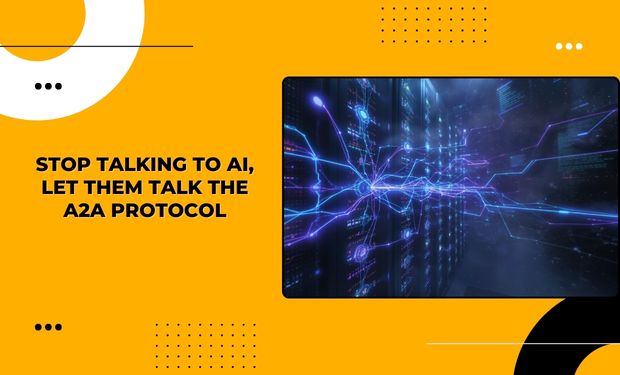
The future of artificial intelligence is shifting from isolated AI assistants that respond to human prompts toward autonomous systems that communicate directly with each other. This evolution is embodied in the emerging standard called the A2A protocol, or Agent-to-Agent communication. In essence, A2A is designed to let AI agents talk to each other, creating interoperability and collaboration across systems built on different frameworks and platforms.
This new paradigm heralds a significant transformation in how developers, enterprises, and even everyday users can leverage AI — not just as a tool that answers questions, but as a network of intelligent agents capable of sharing tasks, delegating work, negotiating context, and coordinating complex workflows.
What the A2A Protocol Actually Is
At its core, the A2A protocol is a standardized communication layer that allows AI agents to interact securely and seamlessly with one another. Traditionally, AI agents operated in isolation: one agent couldn’t easily “talk” to another unless custom integration code was written. The A2A protocol changes that by introducing:
- A common language agents can use to exchange messages
- A secure handshake and identity system so agents can trust each other
- A structure for task delegation, context sharing, and artifact transfer
- Standards based on HTTP(S), JSON-RPC, and streaming mechanisms like Server-Sent Events (SSE)
These features make it possible for one AI agent to discover what other agents can do, ask them to perform specific tasks, and receive results — all without human intervention in the communication process. In this way, A2A tackles the long-standing problem of fragmented agent ecosystems.
Why A2A Matters for AI Collaboration
Imagine a digital ecosystem where a travel-planning AI can independently contact a flight-booking agent, hotel-reservation agent, budgeting agent, and language translation agent — all in real time — to fulfill a user’s request. Without a shared protocol, each of those integrations would require custom coding and significant engineering effort. With A2A, they can discover and communicate fluidly, reducing friction and overhead.
This move toward autonomous agent collaboration represents a major shift in AI system design. It means:
- AI agents no longer function as isolated responders but as participants in a broader ecosystem.
- Developers can mix and match agents from different platforms or vendors.
- Organizations can scale complex AI workflows without reinventing integration layers.
By enabling A2A communication between agents, AI systems become far more versatile, responsive, and capable of handling multifaceted tasks that were once too complex for a single model or isolated agent to manage.
How A2A Works at a Technical Level
The A2A protocol introduces a system of Agent Cards, task objects, messaging standards, and lifecycle rules that enable meaningful interaction among autonomous systems. Here are the key technical pieces:
Agent Cards
Each agent publishes an Agent Card, which includes structured metadata about the agent’s identity, capabilities, network endpoints, and authentication mechanisms. When another agent needs to find a capable partner, it queries the Agent Card to assess whether it’s a good match for the task at hand.
Tasks and Artifacts
Tasks — units of work — are exchanged between agents using a format that supports not just text, but also artifacts like files, generated content, and structured data. The agents negotiate task outputs and monitor progress through status updates.
Secure Messaging
Communication flows over standard web protocols like HTTP(S) and JSON-RPC, with optional streaming support for real-time data exchange and long-running operations. Authentication schemes align with existing web standards, ensuring secure, enterprise-ready communication.
This combination allows agents to互operate like autonomous digital workers in a shared ecosystem rather than isolated AI entities tied to specific tasks or proprietary systems.
A2A vs Traditional AI Interaction
Many AI systems today are built around a simple human-to-AI interaction model — you ask, the AI answers. This model is powerful for direct responses but limited in collaborative scope. A2A flips this model by enabling AI-to-AI communication, where agents discuss, negotiate, and complete complex tasks without a human having to mediate each step.
This evolution is analogous to how the modern internet moved from static pages to dynamic, interconnected services. In the same way that HTTP enabled the World Wide Web to flourish, A2A might be the communication standard that enables the agentic web: a network of intelligent systems working together.
Real-World Applications of A2A
Once AI agents can communicate directly through A2A, a wide range of practical applications becomes feasible. A few examples include:
1. Enhanced Customer Support
Cross-functional AI support agents can coordinate to answer questions, troubleshoot issues, and escalate complex cases without human routing.
2. Enterprise Workflows
Finance, IT, HR, and operations agents can share tasks and context automatically, streamlining processes like compliance checks or supply chain decisioning.
3. Smart Automation
In industries like healthcare or logistics, AI agents can coordinate complex multi-agent workflows — such as diagnostic agents handing off to treatment planning agents.
4. Integrated Data Systems
Agents are no longer limited by platform silos; they can request and share structured results, making systems more interoperable and data-driven.
In each of these scenarios, A2A lets AI agents collaborate on tasks, leveraging specialized strengths instead of duplicating effort.
Challenges and Considerations
While A2A offers transformative potential, it also introduces challenges that engineers and organizations must address:
- Security and Privacy: AI agents exchanging context and artifacts could expose sensitive information if not properly secured. Robust authentication and encryption mechanisms are crucial.
- Governance and Orchestration: As agent networks grow, tracking interactions, managing conflicts, and monitoring workflows require governance frameworks beyond basic protocol support.
- Scalability: Direct agent-to-agent communications may work seamlessly at small scale but need careful orchestration for enterprise environments to avoid performance bottlenecks.
These considerations are active areas of research and development within the A2A community and broader AI standards groups.
The Broader AI Ecosystem Impact
As A2A drives direct communication between AI systems, it is rapidly becoming a cornerstone of agentic AI — where autonomous systems can self-organize, delegate work, and coordinate without human prompts. This evolution promises not just smarter tools, but intelligent systems that behave as part of an interconnected digital workforce.
By making AI agents interoperable by design, the A2A protocol could redefine how businesses build software, how developers compose intelligent services, and how users benefit from seamless digital assistance.
For more in-depth analysis on cutting-edge AI technology trends like A2A and multi-agent systems, visit Infoproweekly — your source for future-ready tech insights.