
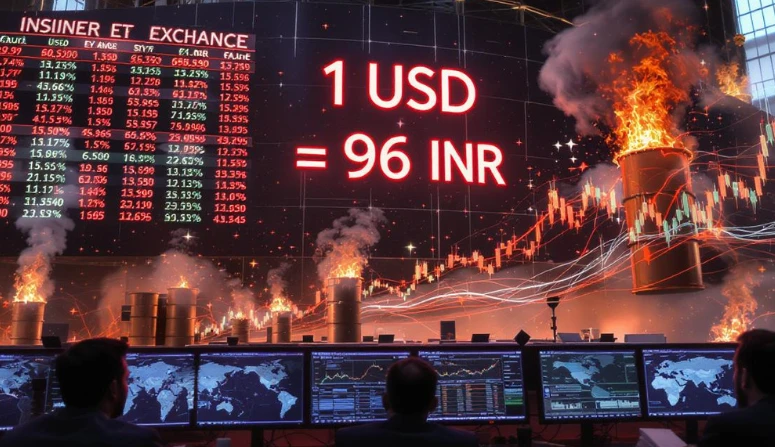
The Indian currency market is facing renewed pressure as the rupee moves dangerously close to the 96 per dollar mark. A sharp increase in global crude oil prices along with massive foreign institutional investor withdrawals has intensified concerns across financial markets. Analysts believe the combination of rising import costs and weakening investor sentiment is creating a difficult phase for the Indian economy.
At the same time, the development has triggered fresh discussions across the finance sector, while experts in technology insights and marketing trends analysis are closely tracking how currency volatility may reshape corporate spending and business planning. The movement of the rupee has quickly become one of the most talked about finance industry updates this month.
Oil Prices Add Fresh Pressure on the Rupee
Global oil markets have witnessed strong upward momentum due to geopolitical tensions and tightening supply conditions. Since India imports a major portion of its crude oil requirements, higher oil prices directly increase the country’s import bill. Consequently, demand for the US dollar rises, placing additional stress on the rupee.
As crude prices continue climbing, investors are becoming cautious about India’s fiscal stability and inflation outlook. Furthermore, businesses dependent on imported raw materials are expected to face higher operational costs. This situation is especially concerning for sectors connected to manufacturing, logistics, aviation, and consumer goods.
Meanwhile, the weakening rupee is also influencing IT industry news because technology firms with international exposure could see mixed effects. Export focused companies may benefit from better dollar earnings, yet firms relying on imported infrastructure or overseas software services could experience cost increases.
Foreign Investors Pull Billions from Indian Markets
Foreign institutional investors have reportedly withdrawn more than 22 billion dollars from Indian equities and debt markets in recent months. This large scale capital outflow reflects growing global uncertainty and changing investment priorities.
Investors are increasingly moving funds toward safer assets and developed markets where interest rates remain attractive. As a result, emerging economies like India are witnessing reduced foreign inflows. In addition, fears related to inflation, global growth slowdown, and energy market instability are encouraging investors to reduce exposure to riskier markets.
Consequently, the rupee nears 96 USD amid oil spike and $22B FII outflow narrative has become central to discussions among economists and policymakers. Market experts believe persistent outflows could continue putting downward pressure on the currency unless global conditions stabilize.
Impact on Inflation and Consumer Spending
A weaker rupee often leads to more expensive imports, which can eventually increase inflation across several sectors. Products such as fuel, electronics, industrial equipment, and edible oils may become costlier for businesses and consumers alike.
As inflationary pressure rises, consumer spending patterns may also change. Families could reduce discretionary purchases while businesses may delay expansion plans. Therefore, companies involved in sales strategies and research are closely monitoring changing customer behavior and market demand.
Additionally, rising prices may influence hiring patterns and workplace planning. HR trends and insights suggest that organizations may adopt more cautious recruitment strategies if economic uncertainty continues. Companies focused on operational efficiency could prioritize productivity and automation instead of aggressive workforce expansion.
Stock Markets React to Currency Weakness
Indian stock markets have shown increased volatility as investors respond to currency concerns and foreign fund exits. Banking stocks, energy companies, and import dependent industries have experienced heightened pressure during recent trading sessions.
However, export oriented sectors such as pharmaceuticals and information technology may receive temporary support from a weaker rupee. Their overseas earnings become more valuable when converted into Indian currency. Even so, broader investor sentiment remains cautious.
Moreover, marketing trends analysis indicates that businesses are adjusting communication strategies to reassure investors and consumers during uncertain economic conditions. Brands are focusing more on trust, value, and financial resilience in their messaging.
What the Reserve Bank of India Could Do Next
The Reserve Bank of India is expected to remain active in managing currency volatility. The central bank may intervene in foreign exchange markets to prevent excessive fluctuations and maintain investor confidence.
Additionally, policymakers could continue monitoring inflation trends and global financial developments before making further monetary policy decisions. Economists believe maintaining stability will require a careful balance between supporting growth and controlling inflationary risks.
Although India still maintains strong long term economic fundamentals, the current environment presents several short term challenges. Therefore, market participants are watching closely for signals from both domestic policymakers and global economic trends.
Businesses Prepare for a Volatile Economic Environment
The rupee nears 96 USD amid oil spike and $22B FII outflow situation is pushing businesses to rethink financial strategies. Companies with global operations are increasing focus on currency risk management and cost optimization.
Likewise, firms involved in technology insights are exploring automation and digital transformation to improve efficiency during uncertain market conditions. Organizations are also strengthening financial forecasting models to prepare for continued volatility.
Across industries, leaders are emphasizing adaptability and strategic planning. Businesses that respond quickly to changing economic realities may be better positioned to manage risks while identifying new growth opportunities.
Insights for Investors and Business Leaders
Currency volatility often creates uncertainty, yet it also reveals important market opportunities. Investors should pay close attention to global oil movements, foreign investment trends, and central bank actions because these factors could shape market direction in the coming months.
At the same time, businesses can benefit from strengthening financial discipline, improving operational efficiency, and diversifying revenue streams. Companies that stay informed about finance industry updates, HR trends and insights, IT industry news, sales strategies and research, and marketing trends analysis are more likely to navigate economic shifts successfully.
InfoProWeekly delivers timely analysis and forward looking industry coverage designed for professionals who want deeper business intelligence and market awareness.
.