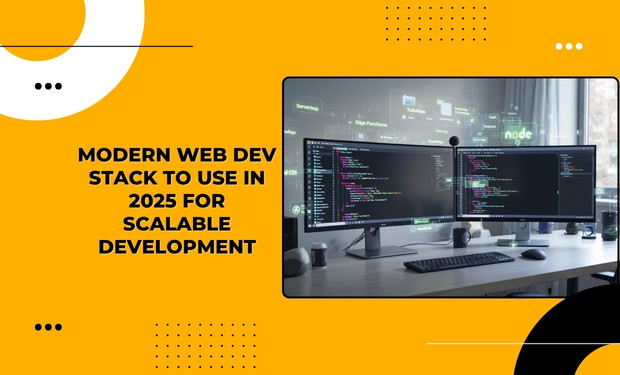
Web development has come a long way from the days of static HTML pages and jQuery-driven interactivity. As digital demands increase and user expectations evolve, developers need a Dev Stack that’s not just modern, but future-ready. In 2025, building scalable, secure, and high-performance web applications requires a carefully selected combination of frontend, backend, infrastructure, and DevOps technologies.
The modern Dev Stack is no longer limited to a few popular frameworks it encompasses ecosystems that support microservices, AI integration, real-time data streaming, enhanced developer experience, and more. Businesses, startups, and developers are prioritizing productivity, performance, and seamless deployment pipelines.
Let’s explore the cutting-edge web dev stack you should be using in 2025 to stay ahead of the curve.
Frontend Frameworks for the Future
- React + Next.js 14 for Hybrid Rendering
React continues to dominate the frontend space in 2025, thanks to its robust ecosystem and large community. However, React by itself is no longer sufficient for enterprise-grade development. Enter Next.js 14, the full-featured framework built on React, offering server-side rendering (SSR), static site generation (SSG), API routing, and built-in internationalization.
With the release of the App Router in Next.js 14, developers can now take full advantage of streaming, partial rendering, and dynamic layouts. These features improve time-to-interactive metrics and enhance user experience dramatically. The frontend layer of your Dev Stack in 2025 must prioritize performance and SEO Next.js delivers both.
- Tailwind CSS for Utility-First Styling
In 2025, Tailwind CSS has cemented its place as the go-to CSS framework. Its utility-first approach allows developers to build complex, responsive UIs without ever leaving their HTML. With tools like Headless UI and Tailwind’s Just-in-Time (JIT) compiler, styling becomes both performant and developer-friendly.
In a modern Dev Stack, Tailwind CSS accelerates design implementation and ensures consistency across large codebases. Paired with design systems like Figma, it creates a smooth collaboration between designers and developers.
Backend Development: Scalable and API-First
- Node.js + TypeScript for Full-Stack Flexibility
Node.js remains a core part of the Dev Stack due to its asynchronous, event-driven nature. Combined with TypeScript, it enables strongly typed, maintainable server-side applications that align well with modern frontend tooling.
In 2025, frameworks like NestJS and Fastify are popular for building modular, testable backend APIs. NestJS, in particular, offers a clean architecture for building microservices and GraphQL APIs, while Fastify focuses on blazing-fast performance with low overhead.
TypeScript support is no longer optional modern backends are expected to be type-safe, developer-friendly, and optimized for large teams.
- Edge Functions and Serverless APIs
The backend landscape is also shifting toward edge computing. Platforms like Vercel and Cloudflare Workers are enabling developers to deploy serverless APIs closer to the user. This means faster response times and globally distributed performance.
Edge functions have become essential in the Dev Stack because they scale automatically and reduce backend infrastructure costs. They’re perfect for authentication, A/B testing, personalization, and other latency-sensitive operations.
Database Technologies for Modern Apps
- PostgreSQL with Edge-Friendly Extensions
In 2025, PostgreSQL remains the preferred SQL database, and its capabilities have been supercharged with modern extensions like pgvector for AI embeddings and PostGIS for geospatial data. PostgreSQL now powers high-availability, horizontally scalable databases using tools like Supabase and Neon.
Supabase is increasingly popular in the Dev Stack for its Firebase-like experience, complete with instant APIs, real-time subscriptions, authentication, and serverless functions all powered by PostgreSQL.
- Redis and Edge Caching
Real-time experiences are vital in 2025, and Redis continues to be the go-to in-memory store for caching, pub/sub messaging, and session management. Integrating Redis with tools like Upstash (serverless Redis) ensures that even your caching layers can benefit from edge distribution.
Combining Redis with your backend increases speed, reduces load on your primary database, and improves overall user experience a must for a modern Dev Stack.
DevOps, CI/CD, and Developer Experience
- GitHub Actions + TurboRepo for CI/CD
Automated deployments are non-negotiable in 2025. GitHub Actions has become the standard CI/CD solution for modern Dev Stack pipelines. It integrates deeply with Git workflows, supports parallel jobs, and connects easily with deployment platforms like Vercel, Netlify, and AWS.
When working with monorepos, TurboRepo enhances the developer experience by speeding up builds and reducing redundancy. It supports build caching and incremental compilation, making it perfect for teams building across multiple packages or apps.
- Docker, Deno, and Edge Containers
Containerization continues to be important, especially for backend services, background jobs, and complex deployments. Docker remains relevant, but newer runtimes like Deno and Bun are gaining traction for lighter, faster setups.
Edge containerization is also emerging, enabling developers to deploy isolated environments to edge locations via providers like Fly.io, Vercel, and Railway. These technologies are shaping the future-ready Dev Stack.
APIs, Headless CMS, and Data Layer
- GraphQL and tRPC for Type-Safe APIs
GraphQL is widely adopted in 2025 for its efficient data-fetching capabilities and developer-friendly schema structure. Tools like Apollo Server and Hasura provide instant GraphQL APIs over databases, reducing the need for boilerplate backend code.
However, tRPC has gained popularity in the full-stack TypeScript ecosystem. It eliminates the need for generating API clients by inferring types directly between frontend and backend. This leads to zero overhead, end-to-end type safety, and faster development cycles.
Your 2025 Dev Stack should leverage either GraphQL or tRPC depending on the project complexity, scalability needs, and team preferences.
- Headless CMS and Unified Content APIs
In a content-heavy application, a headless CMS is a must. Platforms like Sanity, Strapi, and Contentful provide content modeling flexibility and REST/GraphQL APIs to fetch data wherever needed.
These CMS tools integrate seamlessly with modern frontend frameworks and are easily managed by non-developer stakeholders. For multi-channel content distribution, a headless CMS brings unparalleled agility to your Dev Stack.
Monitoring, Observability, and Security
- Logging and Metrics with OpenTelemetry
Monitoring in 2025 goes beyond error tracking. With OpenTelemetry, developers gain a standardized way to collect logs, metrics, and traces across applications. Tools like Grafana, Prometheus, and Honeycomb provide detailed observability into application performance and user behavior.
These insights are critical for optimizing load times, reducing downtime, and improving backend efficiency in any production-grade Dev Stack.
- Security and Authentication with NextAuth.js & OAuth 2.0
Security remains a top priority. Authentication solutions like NextAuth.js make it easy to integrate social logins, email/password, and JWT-based sessions. For enterprise needs, OAuth 2.0 and OpenID Connect standards ensure scalable identity management.
For edge environments, using short-lived tokens, session-based auth, and region-aware validations enhances the robustness of the Dev Stack while maintaining UX performance.
Want More Insights on Developer Tools and Tech Stacks?Discover expert analysis, industry trends, and future-focused content at Infoproweekly.