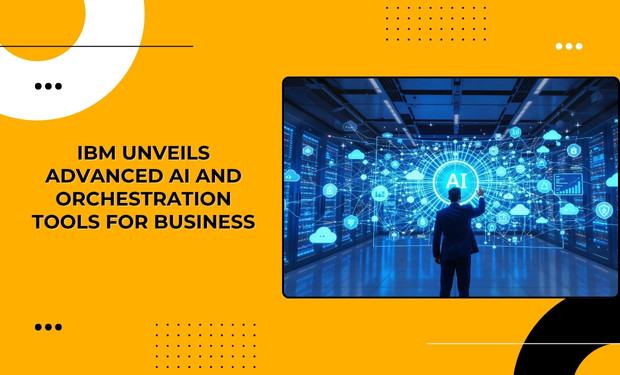
IBM has once again demonstrated its leadership in enterprise technology with the unveiling of a new suite of AI and orchestration tools designed to help organisations streamline operations, scale automation, and bridge the gap between experimentation and real-world implementation.
As artificial intelligence continues to evolve, businesses across industries are striving to integrate smarter, faster, and more adaptive systems into their workflows. IBM’s latest initiative aims to meet that demand by offering tools that allow enterprises to operationalize AI seamlessly across hybrid and multi-cloud environments.
The Growing Importance of AI and Orchestration Tools
In today’s digital economy, companies are inundated with complex data, multiple cloud environments, and decentralised workflows. Managing all of this efficiently requires more than just automation it demands intelligent orchestration.
AI and orchestration tools are now at the heart of enterprise transformation. These technologies don’t just automate repetitive tasks; they create an interconnected ecosystem where AI models, data pipelines, and IT operations work together autonomously.
For example, orchestration tools powered by AI can automatically detect issues, reroute processes, and balance workloads across systems all without human intervention. This capability is what IBM’s latest launch is all about: giving organizations the power to make smarter decisions in real time while reducing operational complexity.
What Makes IBM’s New Suite Stand Out
IBM’s new line of AI and orchestration tools focuses on end-to-end integration, scalability, and security. Built with enterprise-grade performance in mind, the platform allows businesses to deploy AI models faster while maintaining transparency and compliance.
Key features of IBM’s offering include:
- Unified Workflow Management – A central platform that coordinates AI models, data workflows, and automation tools across different departments and cloud systems.
- Agentic AI Capabilities – Intelligent “agents” that can autonomously manage specific tasks, such as monitoring system health, optimizing workloads, or resolving errors.
- Low-Code Deployment Frameworks – Tools that let business users implement AI-driven automation without needing deep coding expertise.
- Enhanced Governance and Security – Built-in safeguards that ensure responsible AI usage and protect sensitive enterprise data from misuse or exposure.
Together, these capabilities mark a significant step toward a future where AI is not an isolated tool but a foundational layer of enterprise operations.
Bridging the Gap Between Experimentation and Execution
For years, many organizations have struggled to move from AI experimentation to full-scale deployment. While proof-of-concept models often demonstrate value, integrating them into existing business systems remains a challenge.
IBM’s AI and orchestration tools are designed to solve this problem. By automating integration and providing pre-built connectors for major enterprise platforms, IBM enables companies to bridge the “last mile” of AI adoption moving from testing to production.
This approach also reduces time-to-value, allowing organizations to see tangible returns on their AI investments much faster than before.
AI Orchestration in Hybrid and Multi-Cloud Environments
In today’s interconnected world, most enterprises rely on a mix of public clouds, private data centers, and on-premises systems. Managing such hybrid setups requires sophisticated orchestration that can adapt to changing environments.
IBM’s new suite of AI and orchestration tools is built precisely for this scenario. It provides dynamic workload management that automatically distributes computing resources where they’re needed most.
For example, if one data center experiences high demand, the orchestration engine can instantly reroute workloads to another server, maintaining performance and uptime. This makes enterprise operations more resilient and cost-efficient a key advantage in competitive markets.
Empowering Businesses with Agentic AI
One of the most intriguing aspects of IBM’s new initiative is the integration of agentic AI, or AI systems capable of autonomous decision-making within defined parameters. These intelligent agents can manage IT processes, monitor data pipelines, and even execute remediation strategies when they detect anomalies.
Imagine a financial institution where AI agents oversee transaction processing systems. When they detect unusual activity or delays, they can automatically initiate corrective actions or alert security teams. This kind of automation doesn’t just increase efficiency it enhances trust and reliability in AI-driven systems.
Driving Digital Transformation Across Industries
The potential applications of AI and orchestration tools are vast. From healthcare to manufacturing and retail, every industry stands to benefit from streamlined operations and enhanced data intelligence.
- Healthcare: AI orchestration can integrate patient data, optimize scheduling, and even assist in predictive diagnostics.
- Finance: Automated systems can process thousands of transactions simultaneously, flagging anomalies in real time.
- Manufacturing: Smart orchestration enables predictive maintenance, minimizing downtime and maximizing productivity.
- Retail: Customer insights, inventory management, and personalized marketing can all be driven by orchestrated AI systems.
With IBM’s new platform, these industries can go beyond basic automation and enter a new era of cognitive orchestration where AI not only executes tasks but continuously improves them.
The Role of Data in Effective Orchestration
Data remains the backbone of AI orchestration. Without structured, accurate, and accessible data, even the most advanced AI models cannot perform effectively. IBM’s suite addresses this by integrating powerful data management tools that prepare, cleanse, and enrich data automatically.
This ensures that AI systems always operate on reliable information, leading to better predictions, improved analytics, and more meaningful outcomes.
Additionally, IBM’s data orchestration frameworks are designed to handle compliance with global data protection laws ensuring that organizations can scale AI responsibly and securely.
A Strategic Step in IBM’s AI Roadmap
IBM’s launch of these AI and orchestration tools is part of its broader strategy to help enterprises accelerate digital transformation. The company has invested heavily in hybrid cloud, automation, and AI governance technologies over the past decade.
By combining these strengths into a unified offering, IBM positions itself as a leader in the race to make enterprise AI practical, safe, and scalable.
Arvind Krishna, IBM’s CEO, has repeatedly emphasized that AI should be an “everyday capability” within organizations, not just a research project. This launch embodies that vision by giving companies the tools to build AI-driven processes that are transparent, accountable, and measurable.
Why Orchestration Will Define the Future of AI
The real power of AI lies not just in individual algorithms or models but in how they work together within a coordinated system. That’s where orchestration comes in.
AI and orchestration tools represent the next stage of intelligent automation one where systems communicate, adapt, and self-optimise continuously. In the coming years, enterprises that successfully integrate AI orchestration into their workflows will likely outperform competitors in efficiency, innovation, and cost management.
IBM’s latest tools are an important milestone on that journey, offering a scalable blueprint for how businesses can evolve from automation to true intelligence.
Explore More AI Innovations
To stay updated on how AI and orchestration tools are transforming industries worldwide, visit Infoproweekly for the latest insights, trends, and analysis from the world of technology and digital transformation.