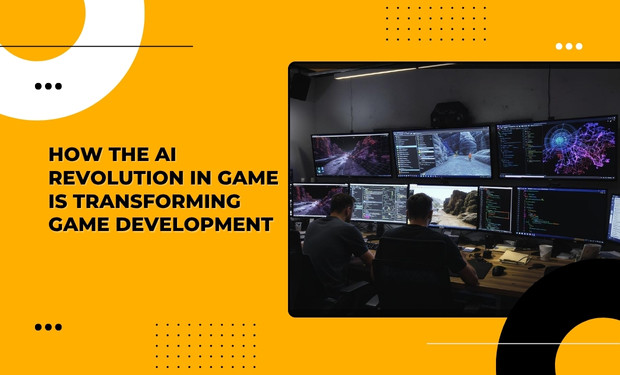
The gaming industry is undergoing a profound transformation driven by the AI revolution in games, with generative AI technologies leading the charge. From indie developers to AAA studios, the implementation of AI-generated assets, dialogue systems, and immersive storytelling is changing how games are created, played, and experienced.
Generative AI is no longer just a futuristic concept it’s actively redefining the creative process behind game development. Tools powered by machine learning are now capable of designing characters, crafting environments, composing soundtracks, and even scripting branching narratives, saving time while enhancing originality. In many ways, the AI revolution in games is as impactful as the arrival of 3D graphics or online multiplayer once was.
Game Development Enters a New Era
Traditionally, developing a video game required massive teams, long timelines, and intricate coordination between departments. Artists created assets from scratch, designers mapped out game worlds, and writers crafted dialogue line by line. Now, with the AI revolution in games, developers are increasingly automating these labor-intensive tasks using generative models trained on vast datasets.
For instance, platforms like Unity and Unreal Engine are integrating AI features that generate 3D models, textures, and lighting setups based on simple inputs or text prompts. This dramatically reduces development time while maintaining visual quality. Game creators can rapidly prototype levels, characters, and worlds without starting from a blank canvas.
The shift is particularly beneficial for small studios and indie developers, who previously struggled with limited resources. With AI handling much of the groundwork, creativity becomes the central focus allowing storytellers and designers to bring unique visions to life without being hindered by technical constraints.
AI-Driven Storytelling and Dynamic Dialogue
One of the most exciting applications of the AI revolution in games is its impact on narrative design. Generative AI models like GPT are enabling developers to create dynamic, adaptive storylines that respond to player choices in real time. This goes beyond traditional branching narratives it opens the door to fully reactive worlds where NPCs (non-player characters) generate unique conversations, backstories, and emotional responses.
This technology is already being explored in RPGs and open-world games, where character interactions can evolve with the player’s journey. AI-driven storytelling fosters deeper immersion by making the world feel more alive, responsive, and personalized. Instead of pre-recorded dialogue trees, players engage with intelligent characters that remember past actions and respond accordingly.
Moreover, AI is also being used to localize dialogue into multiple languages in real time, breaking down global barriers and ensuring that gamers worldwide can enjoy culturally adapted experiences. This level of responsiveness and scale would be nearly impossible to achieve through traditional methods alone.
Revolutionizing Game Art and Animation
Art creation has always been one of the most resource-intensive aspects of game development. With the AI revolution in games, artists are now leveraging AI to accelerate visual production without compromising creativity. Generative tools can create concept art, textures, and animations based on simple sketches or text descriptions.
Programs like Midjourney, DALL·E, and Adobe Firefly allow developers to iterate rapidly on visual ideas, enabling faster asset creation and visual exploration. In character design, AI helps generate multiple variations of models with different features, costumes, and expressions empowering artists to experiment and refine concepts in real time.
AI-assisted animation tools are also making it easier to bring characters to life. Motion capture, once expensive and time-consuming, is now being enhanced by AI that can simulate human-like movement based on basic input. This makes animations smoother, more realistic, and less dependent on large-scale production setups.
AI-Powered Procedural Content Generation
Procedural generation isn’t new to gaming, but the AI revolution in games has supercharged its potential. Generative AI takes procedural content to new levels, enabling vast, intricate game worlds to be created with minimal manual input. Terrain, foliage, architecture, and even missions can now be dynamically generated to suit different gameplay scenarios or user preferences.
AI-generated environments are helping build massive open worlds that adapt to the player’s behavior. For example, terrain can shift, quests can evolve, and cities can grow based on real-time decisions. This not only boosts replay ability but also ensures every playthrough feels unique.
Games like No Man’s Sky pioneered procedural content at scale, but the new wave of generative AI makes it far more intuitive and responsive. Developers can now define high-level rules and let AI handle the details, creating living, breathing virtual ecosystems that react to in-game events.
Personalized Gameplay Experiences
With the help of machine learning models, the AI revolution in games is also bringing hyper-personalization to gameplay. AI systems can analyze player behavior like choices, playstyle, skill level, and progression rate and adjust the game accordingly. Whether it’s adapting difficulty levels or recommending gear, the game becomes tailored to individual users.
This type of personalization is already being used in mobile games and MMOs (massively multiplayer online games), where engagement and retention are critical. AI ensures players remain challenged without becoming frustrated or bored, increasing satisfaction and extending playtime.
Moreover, personalized tutorials powered by AI can teach players at their own pace. Novices receive extra help and tips, while advanced players face increased complexity and fewer interruptions, creating a seamless onboarding process.
Ethics, Creativity, and the Human Touch
As the AI revolution in games progresses, it also raises important questions about ethics, authorship, and creative control. While generative AI can produce impressive results, it still relies on data inputs that are often scraped from existing works raising concerns about intellectual property and originality.
There’s also the risk of over-reliance on AI, potentially diluting the human element that makes games emotionally impactful and artistically rich. Industry leaders emphasize the importance of keeping humans in the loop using AI as a creative assistant, not a replacement.
Game developers must navigate these challenges responsibly. Transparency about AI use, clear crediting of creators, and adherence to ethical guidelines are essential to maintaining trust and artistic integrity in game development.
Expanding Opportunities for Modding and Community Content
Another exciting byproduct of the AI revolution in games is how it empowers the modding community. AI tools are making it easier for gamers to create and share their own content, from characters and missions to voiceovers and animations.
This democratization of content creation means more user-generated content (UGC) can flourish, extending a game’s lifespan and enriching its community. Studios are increasingly encouraging modding by integrating AI creation tools directly into their engines or toolkits.
This grassroots content development not only fosters creativity but can also lead to breakthrough ideas and indie successes some of today’s most successful franchises, like Dota or Counter-Strike, began as mods.
The Future of the AI Revolution in Games
The influence of the AI revolution in games is only just beginning. As generative models grow more sophisticated, their integration into every facet of game design will become the new standard. We’re entering a phase where games are no longer just built they’re co-created in real time, adapting to the player, the platform, and the cultural context.
Gamers will benefit from deeper immersion, smarter interactions, and more diverse storytelling, while developers gain the freedom to innovate without being constrained by technical limitations. It’s a new creative frontier where imagination meets artificial intelligence to redefine what games can be.
For more insights on how technology is reshaping entertainment, gaming, and digital innovation, visit InfoProWeekly.