Fast-Charging Quantum Battery Built Inside a Quantum Computer
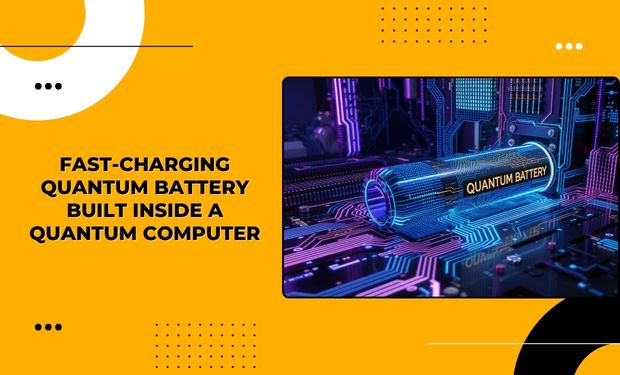
Quantum technologies continue to push the boundaries of science and engineering, and one of the most intriguing recent breakthroughs is the fast-charging quantum battery built inside a quantum computer. This development combines the principles of quantum physics, advanced energy storage, and cutting-edge computing to create a device that charges much faster than traditional batteries while operating in a quantum computing environment. By leveraging superconducting qubits and the unique properties of quantum systems, researchers have shown a pathway toward integrating energy storage directly within quantum processors — a step that could redefine how future quantum technologies are powered and optimized.
What Is a Quantum Battery?
A quantum battery is not simply a smaller or more powerful version of a conventional battery — it operates based on the laws of quantum mechanics rather than classical electrochemical reactions. Traditional batteries store energy by facilitating electron flow through chemical changes, but quantum batteries use quantum states and interactions among qubits to store and transfer energy.
Instead of relying on chemical reactions, a quantum battery stores energy by manipulating the energy levels of qubits, which are the fundamental information units in quantum computing. Qubits can exist in a superposition of states, meaning they can simultaneously occupy more than one energy level. This unique property creates opportunities for enhanced charging protocols that do not exist in classical systems.
Growing Need for Integrated Energy Storage in Quantum Computing
Quantum computers are rapidly advancing in capability, promising to solve problems beyond the reach of classical processors. However, these machines are notoriously demanding in terms of infrastructure. They require ultra-low temperatures — often near absolute zero — to maintain qubit coherence, and they rely on complex control systems to manage operations.
One often-overlooked challenge is how to efficiently power these systems, especially as qubit counts grow and quantum processors scale toward practical applications. Integrating energy storage directly into quantum computers could reduce dependence on external power systems and offer a more seamless way to manage energy flow. This is where the fast-charging quantum battery concept comes into play.
Building a Fast-Charging Quantum Battery Inside a Quantum Computer
Researchers at institutions such as the Hefei National Laboratory in China recently demonstrated a quantum battery constructed inside a quantum computer using superconducting qubits. In this setup, scientists used 12 qubits made of tiny superconducting circuits, each of which could be controlled using microwave pulses and quantum interactions.
Here’s how their approach differs from conventional batteries:
- Quantum State-Based Energy Storage: Each qubit serves as a tiny cell that can store a defined quantum of energy by transitioning between ground and excited states, a fundamentally different process from moving electrons through chemical reactions.
- Controlled Interactions: By controlling how qubits interact with each other through nearest-neighbor coupling, researchers could experiment with multiple charging protocols. One protocol mimicked classical charging — with no quantum coupling — while the other deliberately used the interactions between qubits to enhance energy transfer.
- Increased Power Output: The team observed that when quantum interactions were used during charging, the quantum battery delivered more power and charged more quickly on average compared with the non-interacting charging method.
This experiment suggests that quantum batteries can potentially achieve greater charging efficiency when integrated within a quantum computing system, especially by utilizing operations inherent to the hardware itself.
Why Integrating Quantum Batteries Inside Quantum Computers Matters
The idea of embedding a quantum battery within a quantum computer presents several exciting prospects for the future of energy and computing technologies:
1. Improved Energy Efficiency
Quantum computers require precise energy control to maintain qubit coherence. By integrating a quantum battery into the system, it may be possible to optimize energy delivery and reduce waste, which is crucial for expanding quantum systems beyond laboratory settings.
2. Reduced External Overhead
Instead of relying solely on large external infrastructure to deliver power, on-chip quantum batteries could act as internal energy buffers, helping to smooth the energy demands of complex computing tasks and reduce the burden on peripheral power systems.
3. Enhanced Scalability
As quantum computing scales from a few dozen qubits to hundreds or thousands, energy management becomes more critical. Integrating scalable quantum batteries might help support larger arrays of qubits while maintaining system performance and stability.
4. New Charging Protocols
Quantum batteries are not limited to classical charging methods. Complex collective processes — such as entanglement and superabsorption — can be engineered to create faster charging protocols, potentially exceeding the performance of conventional technologies.
Science Behind Fast Charging in Quantum Batteries
The very essence of quantum physics allows for unique charging advantages:
- Superposition and Entanglement: These quantum effects can enable energy transfer protocols where the charging speed improves with the number of qubits — a phenomenon sometimes referred to as superextensive charging.
- Collective Dynamics: By using interactions among qubits, quantum batteries can theoretically exploit cooperative mechanisms that lead to higher average power output than would be possible if each qubit operated independently.
This fundamentally distinguishes quantum batteries from classical batteries, which scale linearly with capacity and are bound by classical physics constraints.
Challenges and Future Research Directions
Despite these advances, several challenges remain before quantum batteries become mainstream:
- Practical Utility: While the recent experiment shows a significant step toward integrating a quantum battery with quantum computing hardware, translating the observed benefits into practical devices usable outside research labs remains complex.
- Noise and Control: Quantum systems are sensitive to environmental noise and require precise control techniques. Ensuring that a quantum battery can function reliably in such conditions is a continuing challenge.
- Scalability and Stability: Ongoing theoretical work suggests that building larger, more stable quantum batteries will require careful engineering to maintain coherence and optimize energy transfer.
However, this initial demonstration is a promising sign that quantum batteries could play a crucial role in the future energy architecture of quantum computers and other quantum devices.
Exploring the science of quantum batteries not only pushes the envelope of what’s possible in quantum computing but also opens up broader avenues for next-generation energy storage technologies rooted in the principles of quantum mechanics.
Dive Deeper into Quantum Tech
If you’re fascinated by how quantum innovations like fast-charging quantum batteries are shaping tomorrow’s technologies, explore more cutting-edge insights and trends at Infoproweekly — your destination for the latest in quantum advancements and tech breakthroughs.