
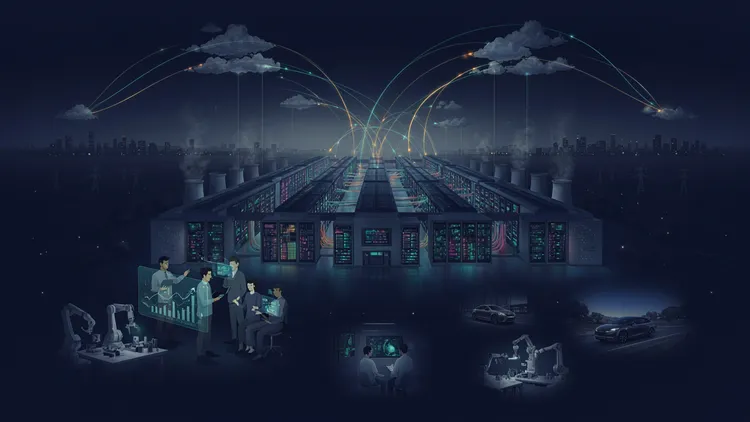
AI Infrastructure Faces a Massive Revenue Challenge
The artificial intelligence boom is entering a more demanding stage. Companies are spending enormous amounts on data centers, chips, networking equipment and electricity to support increasingly powerful AI systems. Now, a new Bain and Company analysis suggests that the industry could need about $6 trillion in annual revenue by 2031 to justify the scale of investment being made in AI infrastructure.
That figure is not a prediction that the industry will definitely reach $6 trillion. Instead, Bain describes it as the level of annual revenue needed to support the projected infrastructure spending. The distinction matters because current AI services may not generate enough revenue on their own.
Consequently, the next phase of AI growth could depend on creating entirely new applications and business models.
Why the $6 Trillion Figure Matters
Bain estimates that AI infrastructure investment could reach around $1.5 trillion each year by 2031. If capital expenditure represents roughly one quarter of industry revenue, the broader AI economy would need about $6 trillion in annual revenue to support that level of spending.
Existing consumer and enterprise AI applications could generate between $1.2 trillion and $1.8 trillion, according to the report. That leaves a potential gap of about $4.2 trillion that would need to come from newer applications and markets.
Therefore, the central question is changing. It is no longer only about building larger AI systems. The industry also needs to discover where those systems can create enough economic value to support their infrastructure.
Data Centers Are Driving Enormous Investment
Data centers sit at the heart of the current AI expansion. Advanced models require large amounts of computing power, memory, storage and networking capacity. They also require substantial electricity and sophisticated cooling systems.
The investment is already moving beyond traditional cloud infrastructure. Companies are developing dedicated AI facilities and expanding access to specialised computing resources.
Recent developments illustrate the scale. Anthropic has disclosed plans involving more than $518 billion in infrastructure commitments over the next decade, including agreements involving major cloud and semiconductor partners. Reuters reported that about 80 percent of those commitments are non cancellable or require payment regardless of usage.
This illustrates why AI infrastructure is becoming an important part of finance industry updates. Large technology projects increasingly involve long term contracts, debt, private capital and complex risk management.
Current AI Services May Not Be Enough
Consumer subscriptions and enterprise software are already generating significant AI revenue. Businesses are using AI for coding, customer service, marketing, sales research and IT operations.
However, Bain estimates these existing applications could account for only a portion of the revenue required to support the projected infrastructure investment.
That gap creates pressure for the industry to find additional sources of value.
For example, AI could become deeply integrated into physical industries rather than remaining primarily a software technology. Manufacturing, transportation, healthcare, energy and scientific research could all become important areas of expansion.
Autonomous Machines Could Create New Markets
One potential source of new revenue is autonomous technology. Self driving vehicles, industrial automation, drones and intelligent machines could use AI to perform tasks that currently require significant human involvement.
Bain identifies autonomous machines and industrial automation among the areas that could help create the additional economic value needed to support the expanding infrastructure.
This shift could also change HR trends and insights. Companies adopting physical AI may need workers who understand robotics, software, maintenance, data systems and automated operations.
At the same time, traditional roles may evolve as people supervise intelligent machines instead of performing every task manually.
Robotics Could Become a Major AI Business
Robotics represents another potentially large opportunity. AI models are becoming better at understanding environments, processing visual information and making decisions based on changing conditions.
Combining these capabilities with physical machines could create new applications across factories, warehouses, healthcare facilities and other environments.
Such developments could have a wider impact than conventional AI software. A successful robotics market would generate demand for hardware, sensors, software, cloud services, connectivity and maintenance.
In turn, this could expand opportunities across technology insights and IT industry news as AI becomes increasingly connected with physical infrastructure.
AI Could Transform Scientific Research
Another potential source of value is scientific discovery. Bain highlights areas such as drug discovery, mental health and energy generation as examples of new products and applications that could emerge from increasingly abundant AI capabilities.
Drug discovery is particularly interesting because AI can analyse large amounts of scientific information and help researchers identify potential candidates more efficiently.
Likewise, energy systems could benefit from AI based forecasting, optimisation and automation. These applications could create value that goes far beyond today’s consumer chatbots.
Advertising Could Become More Connected to AI
Advertising is another area that could contribute to future AI revenue. AI systems are increasingly involved in search, recommendations, content creation and customer discovery.
Bain identifies AI integrated advertising as one possible source of additional revenue as AI systems become more deeply connected with consumer behaviour and digital discovery.
This could influence marketing trends analysis significantly. Businesses may increasingly need to optimise their products and content for AI driven discovery rather than relying only on traditional search and social platforms.
Sales strategies and research could also change as AI systems become more involved in identifying prospects, understanding customer needs and recommending products.
Power and Infrastructure Are Becoming Strategic
The AI expansion cannot happen without electricity. Data centers require reliable power, while advanced computing facilities also need cooling, networking and physical space.
Recent projects have already encountered power and construction challenges. Reuters reported that delays in securing power affected the Oracle and Blue Owl Jupiter data center project in New Mexico. The incident highlights the practical difficulties involved in rapidly expanding AI infrastructure.
Therefore, AI infrastructure is increasingly connected with energy policy, construction, utilities and industrial investment.
Businesses Need to Focus on AI Value
The enormous infrastructure spending creates an important lesson for businesses. Adopting AI simply because competitors are doing so may not be enough.
Companies need to identify specific problems where AI can improve revenue, reduce costs, increase productivity or create new products.
That means technology teams will need to work more closely with finance, sales, marketing and operations. Clear measurement will become increasingly important as companies determine whether AI investments are producing meaningful business outcomes.
Valuable Insights for Businesses
The $6 trillion figure highlights the scale of the economic challenge surrounding the AI infrastructure boom. Existing applications can generate substantial revenue, but Bain’s analysis suggests that much more value may need to come from new markets and technologies.
Businesses should therefore look beyond chatbots and productivity tools. Robotics, autonomous systems, scientific discovery, energy technology, advertising and industrial automation could become important parts of the next AI economy.
For technology leaders, the key opportunity is to connect AI investment with measurable business value. For investors and finance teams, infrastructure commitments deserve careful attention to demand, power availability and long term revenue potential.
The next stage of artificial intelligence may ultimately depend less on how much computing power the world can build and more on how effectively that computing power can create new economic activity.
Follow InfoProWeekly for technology insights, IT industry news and practical analysis of the business opportunities emerging from artificial intelligence. Reach out to InfoProWeekly to explore the technology trends, market developments and strategies shaping the next generation of digital business.