
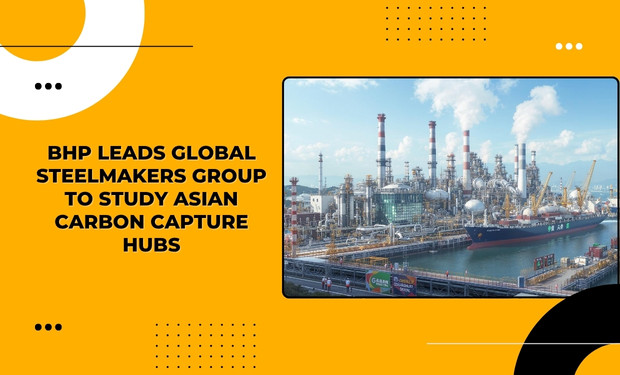
The global steel industry is facing one of its biggest challenges yet: cutting emissions while meeting growing demand. This week, a major step forward was announced as BHP took the lead in forming a coalition of steelmakers from across the globe to investigate the feasibility of Asian carbon capture hubs. These hubs could become a cornerstone in the push for large-scale decarbonization, especially in regions where steel production is critical to economic growth but also a major source of carbon emissions.
The initiative highlights a growing shift in the steel sector where industry competitors are now becoming collaborators in the fight against climate change. By joining forces, the steelmakers aim to fast-track technological and infrastructural advancements that could reshape how steel is produced and processed in Asia.
The Urgency Behind the Initiative
Steel production accounts for roughly 7–9% of global CO₂ emissions, making it one of the most carbon-intensive industries. Asian countries, particularly China, Japan, South Korea, and India, dominate global steel output, which means decarbonizing production in this region is critical to meeting international climate goals.
The challenge lies in the fact that steel manufacturing processes are difficult to decarbonize due to their reliance on high-temperature furnaces and fossil fuels. While renewable energy can partially power operations, the chemical reactions in steelmaking still produce unavoidable emissions.
Carbon capture, utilization, and storage (CCUS) technology has emerged as one of the most promising solutions for steelmakers. The concept involves capturing carbon dioxide directly from industrial plants and either storing it underground or repurposing it for other industrial uses.
Why BHP Is Taking the Lead
BHP, one of the world’s largest mining and resource companies, has long been a key supplier of iron ore to the steel sector. This places the company in a unique position to influence industry-wide practices. By spearheading the carbon capture hub study, BHP is not only aligning with its sustainability commitments but also ensuring that its core customers the steelmakers have a viable path to decarbonization.
For BHP, this is more than just environmental responsibility. It’s about safeguarding the future of the steel industry. If steelmakers can’t adapt to stricter emission regulations and growing investor demands for sustainability, their long-term viability could be at risk.
The Role of Carbon Capture Hubs in Asia
Unlike single-plant CCUS projects, carbon capture hubs are designed to serve multiple industrial facilities at once. The idea is to centralize carbon capture infrastructure, making it more cost-effective and easier to scale.
In Asia, where industrial zones often house clusters of steelmakers alongside cement, chemical, and power plants, hub-based solutions could significantly reduce the per-unit cost of carbon capture. The stored carbon could then be transported via pipelines to geological storage sites or used in secondary industries such as synthetic fuel production.
Global Steelmakers Come Together
BHP’s coalition isn’t limited to a few regional players it includes some of the largest and most influential steelmakers worldwide. These companies are setting aside competitive differences to collaborate on feasibility studies, regulatory engagement, and investment planning.
The involvement of global steel leaders ensures that the hub designs will be applicable across different markets and operational conditions. This also sends a strong signal to policymakers and investors that the industry is serious about tackling its carbon footprint.
Financial and Policy Backing
While the coalition is industry-led, it is expected that government support will be essential for the success of these carbon capture hubs. Policymakers in several Asian nations are already signaling interest in funding pilot projects, offering tax incentives, and streamlining permitting processes for CCUS infrastructure.
The cost of carbon capture is still high often exceeding $50 per ton of CO₂ but with the economies of scale provided by hubs, the coalition believes they can drive costs down significantly. Additionally, international climate finance initiatives may step in to provide grants or low-interest loans to make early-stage projects viable.
Potential Impact on the Steel Supply Chain
The success of these carbon capture hubs could ripple throughout the global steel supply chain. For raw material suppliers like BHP, it could mean long-term demand stability as steelmakers retain competitiveness in a low-carbon economy.
For downstream industries such as automotive, construction, and manufacturing lower-carbon steel could become a valuable selling point, especially as end consumers grow more conscious of the environmental impact of their purchases.
This also opens up new market opportunities for certified “green steel,” which could command premium prices in certain regions. If the hubs deliver on their promise, the steel sector might transform from being one of the largest emitters to a leader in industrial decarbonization.
Challenges That Still Need Addressing
Despite the optimism, there are significant challenges to overcome. First is the technical hurdle of integrating carbon capture into existing steel plants without disrupting operations. Second is the need for secure and long-term storage solutions that prevent carbon leakage.
Furthermore, the regulatory landscape across Asian nations is highly fragmented. What works in Japan may not be applicable in India or Indonesia. Harmonizing standards and building cross-border cooperation will be vital to ensure the hubs can operate efficiently.
Finally, the question of who pays for the infrastructure remains. While steelmakers and companies like BHP are willing to invest, public funding or blended finance models will likely be necessary to make the hubs financially feasible at scale.
Why This Matters for the Future of Steelmaking
If the coalition succeeds, it could serve as a blueprint for other heavy industries facing similar decarbonization challenges. Cement producers, petrochemical companies, and even large-scale energy generators could adopt the hub model, accelerating emission reductions across multiple sectors.
Moreover, the collaboration between steelmakers in this initiative reflects a broader trend in the global economy one where industries recognize that climate change is not just an environmental issue but a business survival issue.
The carbon capture hubs in Asia could very well be the turning point that defines the steel industry’s role in a sustainable future. By embracing cooperation and technological innovation, steelmakers are showing that it’s possible to be both competitive and climate-conscious in the modern marketplace.
Take your knowledge further and stay informed on the latest sustainability, steel industry, and innovation trends by visiting Infoproweekly. Get in-depth analysis, expert insights, and real-time updates to keep you ahead in the ever-evolving industrial landscape.