Anthropic’s AI Push Raises Analyst Concerns Over Indian IT Services Revenues
The global technology landscape is undergoing a seismic shift, driven by rapid advancements in artificial intelligence. One of the most talked-about developments is Anthropic’s AI push, which has triggered heightened concern among analysts over the potential impact on Indian IT services revenues. As AI tools gain traction and automate complex tasks, traditional business models that underpin Indian IT companies are facing scrutiny, sparking widespread debate about the future of the sector. In this comprehensive blog, we’ll explore the context and implications of Anthropic’s AI push concerns, what analysts are warning about, and what this could mean for Indian IT firms in the coming years.
The Rise of AI and Its Impact on IT Services
Anthropic, a U.S.-based artificial intelligence startup, has been at the forefront of developing innovative AI tools aimed at automating a wide array of business processes. These advancements have accelerated in recent months, and the Anthropic AI push has been seen as a catalyst for structural changes within the IT industry. Analysts argue that as AI systems become more capable of handling tasks traditionally performed by human professionals, key revenue streams for IT services companies could gradually erode.
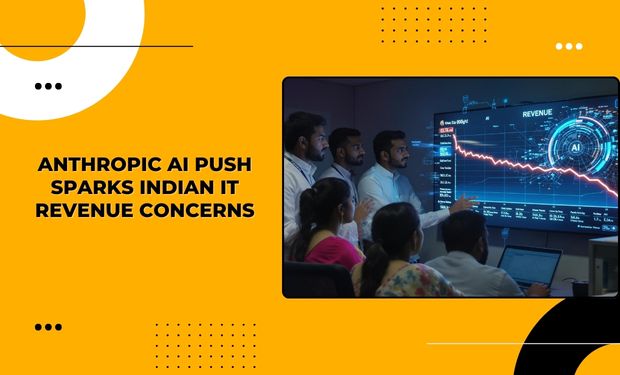
Indian IT firms have historically relied on application services—labor-intensive work involving custom software development, system integration, and ongoing maintenance contracts—as a major revenue source. With application services accounting for a substantial proportion of total revenues, there is growing concern that Anthropic’s AI push could compress project timelines, reduce demand for manual hours, and ultimately shrink high-margin service lines.
Analyst Concerns: Revenue Erosion and Valuation Pressure
Financial analysts have expressed reservations about how quickly AI technologies, including those championed by Anthropic, could reshape the IT services field. A key point of concern is the possibility that automation could replace or significantly diminish demand for routine coding, testing, and analytics tasks that have long been the bread and butter of Indian IT companies. Jefferies, a prominent investment firm, explicitly warned that Anthropic’s AI push could erode application service revenues, potentially weighing on growth prospects and valuations.
According to projections, application services account for anywhere between 40% to 70% of revenue for Indian IT firms. This significant exposure has made investors nervous, particularly as AI-driven automation tools promise faster delivery and lower costs compared to traditional human-led services. As a result, when news of enhanced AI tools from Anthropic and its peer Palantir hit the markets, Indian IT stocks experienced notable sell-offs, marking one of the worst daily drops for the sector in years.
Market Reaction: Sell-Off and Investor Sentiment
The immediate market response to the Anthropic AI push was swift. Shares of India’s major software exporters fell sharply, with the Indian IT index dropping significantly amid fears of AI-induced disruption. Investors reacted to the notion that AI could make traditional outsourcing and labor-intensive services less relevant, leading to broad sell-offs across the industry.
Foreign institutional investors also responded by offloading Indian IT stocks, with figures showing record outflows as skepticism grew about the sector’s near-term growth prospects. Compounding these concerns were other macroeconomic factors such as weak global tech spending, delayed client decision-making, and ongoing pricing pressures—all of which have already been weighing on the industry.
However, it’s important to note that not all analysts believe the reaction is fully justified. Some financial experts argue that the sell-off may be overblown and that the market has exaggerated the potential negative impact of AI. These analysts posit that while AI will certainly change how services are delivered, it’s unlikely to replace all layers of enterprise software or human expertise immediately.
Indian IT Firms: Exposure and Strategic Challenges
Different Indian tech companies vary in their exposure to the potential risks posed by Anthropic’s AI push. Firms such as Tata Consultancy Services (TCS), Tech Mahindra, and LTIMindtree are more heavily dependent on application services, which makes them potentially more vulnerable to AI’s disruptive effects. In contrast, companies like HCL Tech have somewhat lower exposure and may be better positioned to withstand some of the pressures associated with AI adoption.
The varying degrees of risk exposure underscore the importance of strategic diversification. Indian IT firms are increasingly investing in AI research, talent re-skilling, and partnerships with global technology providers to strengthen their competitive edge. By incorporating AI solutions into their service portfolios, these companies aim to evolve from traditional outsourcing models to more advanced, AI-augmented service offerings.
The Broader Implications for India’s IT Sector
The debate surrounding Anthropic’s AI push highlights a larger conversation about the future of work and revenue models in the digital age. Indian IT companies have long thrived on a labor-based billing model, leveraging a large workforce to deliver customized services to global clients. But with AI technologies maturing rapidly, some of the foundational assumptions of this model are being challenged.
One potential outcome of this shift is the creation of new service lines that focus more on AI integration, data science, and outcome-based pricing structures. Rather than competing purely on cost and manpower, Indian IT firms may increasingly specialize in deploying and managing advanced AI solutions for clients. This could enable them to capture value in new areas such as predictive analytics, AI-driven customer experience platforms, and automated business process management.
Another trend emerging from the current landscape is the increasing emphasis on re-skilling and up-skilling IT talent. As routine coding and testing tasks become increasingly automated, the demand for professionals with expertise in AI, machine learning, and advanced analytics is expected to rise. This presents both a challenge and an opportunity: Indian IT firms must find ways to retrain their workforce to remain relevant in a fast-evolving technological ecosystem.
Why Adaptation Is Critical
It’s clear that Anthropic’s AI push has sent ripples across the Indian IT industry. While short-term market reactions have focused on revenue risks and valuation pressure, the long-term story is about adaptation and innovation. Indian IT services companies that embrace AI as a complementary tool rather than a threat may unlock new avenues for growth and competitiveness.
By integrating AI into core service offerings, firms can enhance operational efficiency, deliver higher-value insights to clients, and differentiate themselves in a crowded global market. This transformation won’t happen overnight, but it sets the stage for a new era in IT services—one where human expertise and AI capabilities combine to drive business outcomes.
If you are monitoring industry trends or involved in the business of technology services, understanding the nuances of Anthropic’s AI push and its implications for the Indian IT sector is essential. Stay informed and explore how the evolving AI landscape could reshape the future of IT services and revenue models.
Want to stay ahead with the latest in tech and business insights? Visit Infoproweekly for expert analysis and cutting-edge updates.