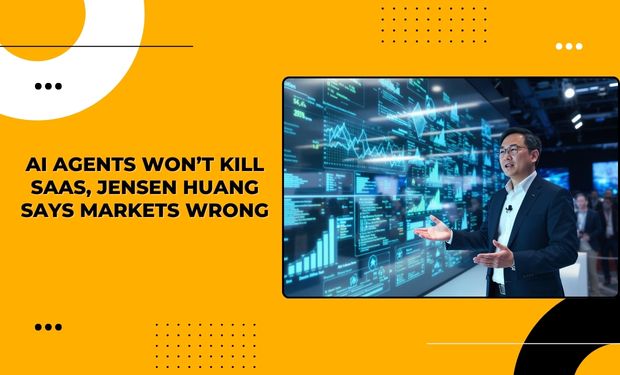
‘Markets got it wrong’: Jensen Huang Reveals Why AI Agents Will Not Kill SaaS Companies
In recent tech headlines, the fear that AI agents will kill SaaS companies has rippled through markets, sparking intense debates among investors, executives, and engineers. However, Nvidia CEO Jensen Huang has publicly pushed back against the idea that artificial intelligence poses an existential threat to traditional software-as-a-service (SaaS) providers. His perspective challenges a prevailing narrative and offers a fresh lens on how AI agents and SaaS might evolve together — not in opposition.
The Fear of a ‘SaaSpocalypse’
The term “SaaSpocalypse” has been tossed around recently to describe the potential downfall of SaaS companies due to the rise of AI agents, sophisticated software systems capable of executing complex tasks autonomously. With AI advancements accelerating, some analysts and investors began to speculate that these agents could make traditional enterprise software obsolete. This fear triggered volatility in software stock valuations globally, including significant selloffs in major IT and SaaS stocks.
Amid this backdrop, many began to wonder: Are AI agents poised to replace SaaS tools entirely? For some investors, the answer seemed to be “yes” — hence the sharp market reactions and industry headlines questioning long-term sustainability of SaaS companies.
Jensen Huang: Markets Misread the AI Impact
But in a candid interview with CNBC, Jensen Huang — a central figure in the AI revolution as CEO of Nvidia — offered a counter-argument that could reshape how we think about AI and enterprise software. His core message: “Markets got it wrong.”
Huang doesn’t believe AI agents will replace SaaS companies. Instead, he asserts that AI agents will use existing software tools as part of their workflows. According to him, these tools — created by SaaS companies — aren’t going away. They will remain essential infrastructure that AI uses to get work done effectively.
Rather than seeing AI agents killing SaaS, Huang sees a future where AI enhances SaaS platforms by leveraging their capabilities in new and powerful ways.
AI Agents as Tool Users, Not Replacers
One of Huang’s fundamental points is that AI agents won’t render SaaS tools obsolete; they’ll act as “intelligent users” of those platforms. In other words, these agents won’t recreate the tools — they will operate through them.
Huang explains that established enterprise software — think tools like ServiceNow, SAP, Cadence, or Synopsys — exists for very good reasons. They solve real business challenges, manage critical data, and handle complex workflows that enterprises depend on. AI agents won’t suddenly eliminate that value. Instead, they’ll make these tools more powerful by using them to automate tasks, streamline processes, and boost productivity.
To illustrate this point, Huang referenced ubiquitous tools like internet browsers and Microsoft Excel — tools that have remained relevant for decades because they solve fundamental problems. In a world with advanced AI, Huang argues, why rewrite Excel when AI can use it intelligently on your behalf?
Why SaaS Still Matters in an AI-Driven World
Huang’s perspective reveals a deeper truth: software and AI are complementary — not adversaries. AI agents need SaaS platforms to function efficiently and translate intelligence into actionable outcomes. In technical terms, a SaaS platform becomes a system of record — a place that stores data reliably — while AI agents become interpreters and executors of tasks on behalf of humans.
This distinction is crucial. SaaS isn’t just software sitting in the cloud — it’s the backbone of enterprise workflows, with structured processes, security protocols, upgrade cycles, integrations, and governance baked into them. AI agents will need these capabilities to operate in real-world organizational environments, which makes SaaS platforms indispensable in the AI era.
Productivity Gains, Not Obsolescence
Another important angle of Huang’s argument is that AI agents aren’t here to take over the jobs of existing enterprise software engineers or products — they are here to augment productivity. According to Huang, companies that integrate AI agents within their SaaS frameworks will unlock new levels of performance without dismantling the existing technology stack.
Rather than displacing software developers or replacing entire platforms, AI may shift how software is built and maintained. Developers might code at a higher level of abstraction, enabling faster iteration and innovation without sacrificing foundational systems. In Huang’s words, “We’re going to need lots and lots of software engineers, but they won’t have to code like they used to.”
This paints a picture where the rise of AI agents triggers a pivot in software creation processes — not software eradication. Enhanced collaboration between AI agents and existing tools could usher in a new era of automation and scale.
Investor Sentiment vs. Technological Fundamentals
Despite Huang’s optimism, financial markets have been cautious. The selloff in software stock indexes reflects growing skepticism among investors about the value of legacy enterprise software in an AI-driven landscape. Such sentiment, amplified by headlines and fear narratives, doesn’t necessarily reflect the underlying utility of SaaS systems themselves.
By saying “markets got it wrong”, Huang challenges the assumption that AI’s evolution must come at the expense of SaaS companies. He believes this narrative misunderstands how modern enterprise IT actually operates and how AI technologies are integrated. Rather than replacing them, AI agents will ride on the backbone of SaaS ecosystems — making them more central to enterprise architectures than ever.
This viewpoint suggests that the real opportunity may lie in AI-augmented SaaS, where platforms evolve to incorporate intelligent agents, creating more efficient, adaptive, and powerful enterprise solutions.
What This Means for the Future of SaaS
Huang’s message offers a reassuring perspective for SaaS vendors, developers, and enterprises wrestling with the narrative of AI disruption. By reframing AI agents as enhancers of software tools rather than destroyers, he positions SaaS not just as surviving — but potentially thriving — in the AI age.
AI agents could improve areas such as workflow automation, predictive analytics, customer engagement, and internal collaboration, all through existing SaaS platforms. This evolution could even expand SaaS markets and redefine how companies measure value, shifting focus from user licenses to effective AI-driven outcomes.
The future of enterprise software may not be a world where AI agents kill SaaS. Instead, it could be one where AI and SaaS evolve together, forming an integrated ecosystem that pushes business efficiency to new heights.
For more expert insights on AI, enterprise tech trends, and emerging software narratives, explore Infoproweekly — your destination for tech intelligence and industry viewpoints.