The world of marketing is undergoing a revolutionary shift with the rise of agentic AI a new class of intelligent systems capable of acting autonomously, learning continuously, and making high-impact decisions without waiting for human prompts. Unlike traditional AI tools that rely on static inputs and pre-defined scripts, agentic AI behaves more like a strategic partner. It initiates tasks, analyzes data in real time, and dynamically adapts to changing customer behavior.
This emerging breakthrough is redefining how marketing teams operate, marking the beginning of a new era in customer experience, personalization, and performance-driven strategy.
What Is Agentic AI?
Agentic AI refers to systems that can sense their environment, reason about what action to take, and autonomously execute tasks to achieve specific goals. In marketing, these agents evaluate customer behavior, assess campaign data, generate messaging, allocate budgets, and optimize performance all without manual intervention.
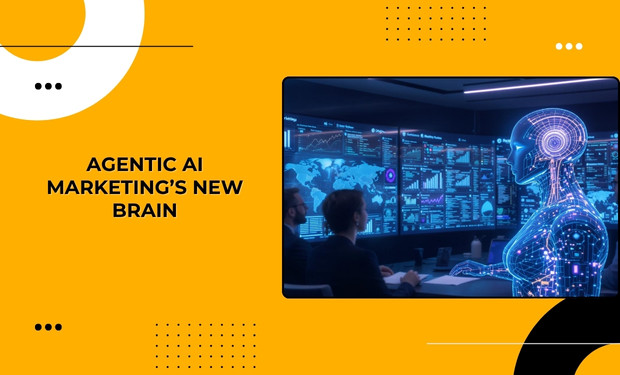
Traditional automation follows rigid rules. Agentic AI goes beyond that. It analyzes vast amounts of data, predicts the best actions, tests real-time scenarios, and adjusts strategies instantly. As a result, it behaves like a self-thinking ecosystem marketing’s new brain.
How Agentic AI Differs from Traditional AI Tools
Standard AI in marketing helps generate content, automate emails, or segment audiences, but it needs prompts and continuous human direction. Agentic AI changes the equation entirely:
1. It Thinks Before It Acts
Agentic AI processes customer behavior, market signals, and performance metrics to decide the best course of action before executing anything.
2. It Acts Independently
Instead of waiting for human instructions, it automatically launches campaigns, refines audience segments, adjusts creative, or reallocates budgets.
3. It Learns Continuously
Agentic systems run ongoing feedback loops. They learn from each customer touchpoint, refine predictions, and optimize the journey in real time.
4. It Coordinates Multi-Step Workflows
From idea to execution, agentic AI can run complex workflow chains like campaign ideation, content generation, testing, and optimization end-to-end.
Why Agentic AI Is Being Called Marketing’s New Brain
With autonomy, intelligence, and memory, agentic AI acts like a marketing strategist capable of performing high-level tasks that normally require entire teams. Here’s why it’s earning the title “marketing’s new brain”:
1. Real-Time Decision Making
Marketing teams traditionally analyze performance weekly or monthly. Agentic AI analyzes performance every second.
If engagement drops, it switches messaging.
If conversions spike, it increases budget.
If customers change behavior, it updates segmentation instantly.
This level of responsiveness fundamentally transforms how brands stay relevant and competitive.
2. Hyper-Personalization at Scale
Agentic AI can track every customer action across channels website, social media, email, and more. It builds evolving customer profiles and tailors’ content, recommendations, and timing for each individual.
This means brands can deliver personalization once possible only with large teams and massive budgets.
3. Autonomous Campaign Optimization
Agentic AI doesn’t just launch a campaign it monitors it, tests variations, and improves it nonstop.
It can:
- Run thousands of micro-experiments
- Test different creatives automatically
- Identify which messages work best
- Allocate budget based on live performance
The result? Campaigns that keep improving themselves without manual tweaks.
4. Huge Savings in Time and Effort
Marketers spend countless hours generating reports, building segments, writing content, and optimizing campaigns. Agentic AI automates these tasks, enabling teams to focus on creativity, branding, and strategy.
This shift transforms marketing roles from “task executors” to “strategic supervisors.”
5. Strategic Insights You Can’t See Manually
Agentic AI continuously identifies hidden patterns and opportunities. It can:
- Predict customer churn
- Forecast lifetime value
- Spot emerging trends
- Discover new audience clusters
- Recommend strategies and experiments
This intelligence empowers marketing teams to make smarter decisions grounded in data, not guesses.
Real-World Use Cases of Agentic AI in Marketing
Agentic AI is already reshaping major marketing functions. Here’s how brands are using it:
1. Autonomous Campaign Management
Agentic AI agents can independently run campaigns across email, SMS, ads, and social media. They:
- Create audience segments
- Craft content
- Launch campaigns
- Monitor results
- Optimize in real time
This replaces manual scheduling, campaign tweaks, and continuous oversight.
2. Conversational Customer Engagement
Agentic chatbots provide human-like assistance by understanding intent, emotion, and context. They resolve issues, recommend products, and guide customers instantly enhancing brand experience.
3. Predictive Analytics for Smarter Targeting
Agentic AI predicts:
- When a customer will buy
- When they might churn
- What they might want next
- How likely they are to convert
Marketers can then send the right message at the right moment.
4. Intelligent Content Generation
Agentic AI doesn’t just write content it tests multiple versions, optimizes messaging, and adapts tone based on audience behavior.
It can generate:
- Email copy
- Ad creatives
- Social posts
- Landing page content
- Product descriptions
Then refine them dynamically to improve performance.
5. Self-Optimizing Customer Journeys
Agentic systems design and adjust customer journeys automatically. If a customer doesn’t respond to email, the agent may switch to push notifications or SMS. If they show high engagement, the agent may introduce personalized offers.
This ensures every customer receives the right experience at the right time.
What an Agentic AI Works Behind the Scenes
Agentic AI relies on several core components:
1. Sensing Layer (Data Intake)
It collects customer data, campaign metrics, browsing behavior, and interactions from all channels.
2. Reasoning Engine
This is the AI’s brain. It evaluates options, predicts outcomes, and decides the best actions to take.
3. Action Execution Layer
The system carries out decisions launching campaigns, modifying bids, generating content, adjusting segments, or updating journeys.
4. Memory System
Agentic AI stores previous interactions, results, and learnings to continually refine its behavior.
5. Feedback Loops
Every decision becomes data. This feedback improves the system’s intelligence over time.
Benefits of Agentic AI for Modern Marketing Teams
- Execute campaigns faster and more efficiently
- Achieve personalization at unprecedented scale
- Increase ROI through intelligent optimization
- Reduce manual workload and repetitive tasks
- Improve customer experience through timely and relevant interactions
- Build smarter strategies using real-time insights
Agentic AI turns data into decisions and decisions into action instantly.
Challenges and Risks Marketers Should Understand
While agentic AI offers immense potential, it also requires careful handling.
1. Data Dependency
If data quality is poor, the agent will make poor decisions.
2. Need for Strong Controls
Brands must set clear goals, guardrails, and boundaries.
3. Transparency Issues
Some decisions may be difficult to interpret without proper visibility tools.
4. Initial Technical Complexity
Implementing agentic AI requires integration, training, and organizational alignment.
5. Shifting Skill Requirements
Marketers must evolve from execution tasks to strategic supervision, creativity, and oversight.
The Future of Agentic AI in Marketing
Agentic AI is still in its early stages, but the future is clear: marketing will become increasingly automated, personalized, and intelligent. We will see:
- Multi-agent ecosystems working as automated marketing teams
- Fully personalized omnichannel experiences
- Real-time creative ideation and optimization
- Predictive marketing strategies powered by continuous learning
- Hybrid workflows where humans guide strategy and AI execute flawlessly
Agentic AI is not just a tool it is becoming the operational brain of future marketing.
Want to stay ahead in the world of AI, digital transformation, and marketing innovation?
Explore more insightful content at Infoproweekly .