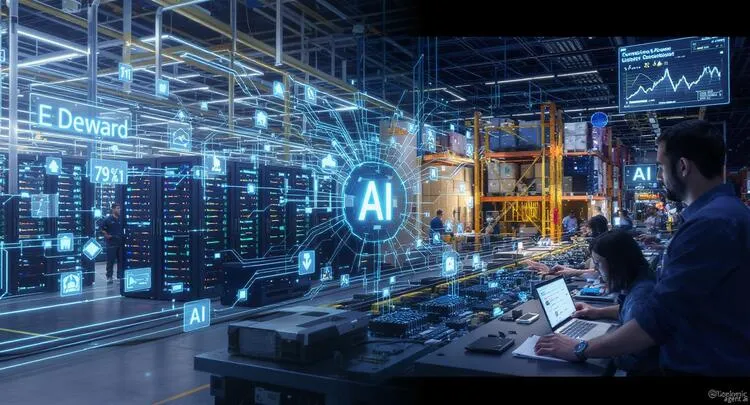
Artificial intelligence is reshaping the technology hardware market, and Lenovo is benefiting from growing demand for devices and infrastructure designed to support AI workloads. The company has reported record revenue as customers continue investing in computing products while the industry faces higher costs and supply challenges.
The development highlights how artificial intelligence is creating opportunities across the hardware ecosystem. Businesses are upgrading computers, servers, data center infrastructure, and other systems to handle increasingly demanding AI applications.
At the same time, manufacturers are navigating an environment where components and production costs can place pressure on margins.
AI Demand Is Changing Hardware Spending
AI adoption is creating new requirements for computing infrastructure. Organizations that once focused primarily on conventional productivity systems are increasingly considering devices capable of supporting AI applications locally or through connected infrastructure.
This shift is particularly significant for enterprise customers. AI workloads can require powerful processors, advanced graphics capabilities, larger memory capacity, and specialized acceleration technologies.
Consequently, hardware spending is being influenced by the broader AI investment cycle. Technology insights and IT industry news increasingly point toward a market where AI capability is becoming an important consideration when businesses plan technology upgrades.
Record Revenue Reflects Strong Market Demand
Lenovo’s revenue performance demonstrates that demand for technology hardware remains resilient despite economic and supply related pressures.
The company operates across multiple parts of the technology market, giving it exposure to consumer devices, enterprise computing, infrastructure, and services. This diversification can provide additional opportunities when demand changes between individual product categories.
Furthermore, businesses continue to prioritize technology investments that support productivity and digital transformation. AI is strengthening that trend by creating new reasons to upgrade aging infrastructure.
Rising Prices Create New Challenges
Strong demand does not eliminate pressure on manufacturers. Higher component costs, logistics expenses, and changing supply conditions can affect pricing throughout the hardware industry.
Price increases can create difficult decisions for both manufacturers and customers. Companies must protect profitability while maintaining competitive pricing, while customers need to determine whether new hardware delivers enough value to justify higher spending.
For Lenovo and its competitors, managing this balance will remain important as AI demand continues to develop.
Supply Constraints Remain a Key Risk
AI infrastructure requires a complex collection of components, and shortages in one part of the supply chain can affect production schedules and product availability.
Demand for advanced processors and other specialized components has increased as companies expand AI infrastructure. This can place additional pressure on global manufacturing and supply networks.
Therefore, supply chain management is becoming an increasingly important competitive advantage. Companies with strong supplier relationships and flexible production strategies may be better positioned to respond when demand changes quickly.
Enterprise AI Is Creating New Opportunities
Large organizations are among the most important drivers of AI hardware demand. Businesses are investing in AI to improve analytics, automate workflows, develop applications, and process increasing volumes of data.
These investments extend beyond individual computers. Data centers and enterprise infrastructure need to support the growing computational requirements associated with AI.
Finance industry updates increasingly reflect the scale of technology investment taking place across businesses. Organizations are treating AI infrastructure as a strategic investment rather than simply another IT expense.
AI PCs Could Transform the Device Market
Artificial intelligence is also influencing personal computing. AI capable PCs are becoming an important part of the hardware conversation as manufacturers look for new reasons for customers to upgrade.
Local AI processing could allow certain applications to perform tasks more efficiently while potentially improving privacy and responsiveness. For consumers and businesses, however, the value of these capabilities will depend on whether they solve practical problems.
This means hardware manufacturers will need to demonstrate meaningful benefits rather than relying solely on AI branding.
The Workforce Impact of AI Hardware
The expansion of AI infrastructure also has implications for employees. HR trends and insights increasingly focus on the skills organizations need to operate AI enabled environments.
As businesses adopt more advanced computing systems, employees may require training in data analysis, AI applications, cybersecurity, and digital workflows. Technology investment therefore needs to be accompanied by workforce development.
Companies that upgrade infrastructure without preparing employees may struggle to capture the full value of their investment.
What It Means for Other Industries
The impact of AI hardware demand extends across the wider business ecosystem. Sales strategies and research increasingly depend on analytics platforms and intelligent customer systems, while Marketing trends analysis is becoming more data driven.
As these functions adopt AI, demand for reliable computing infrastructure can continue to increase. This creates opportunities not only for hardware manufacturers but also for cloud providers, software companies, component suppliers, and technology service businesses.
The Next Phase of AI Hardware Growth
The current environment suggests that AI could remain an important driver of technology spending. However, growth will depend on more than demand alone.
Manufacturers must manage component availability, pricing, energy requirements, product innovation, and changing customer expectations. At the same time, businesses need to evaluate whether AI investments produce measurable improvements in productivity and revenue.
The strongest opportunities may therefore emerge where hardware, software, and business strategy work together.
Practical Insights for Technology Leaders
Lenovo’s record revenue demonstrates how AI demand can create significant opportunities for technology companies even when the broader supply environment remains challenging.
For business leaders, the lesson is to evaluate AI investments based on practical outcomes rather than technology trends alone. Organizations should consider infrastructure requirements, employee capabilities, operating costs, security, and long term scalability before expanding their AI footprint.
For technology professionals, the accelerating demand also signals continued opportunities across AI infrastructure, enterprise computing, cybersecurity, and digital transformation.
For more Technology insights and IT industry news, connect with InfoProWeekly for practical analysis of the technologies shaping modern business.
Stay informed with InfoProWeekly for the latest perspectives on AI, hardware, business technology, Finance industry updates, and emerging market trends.