
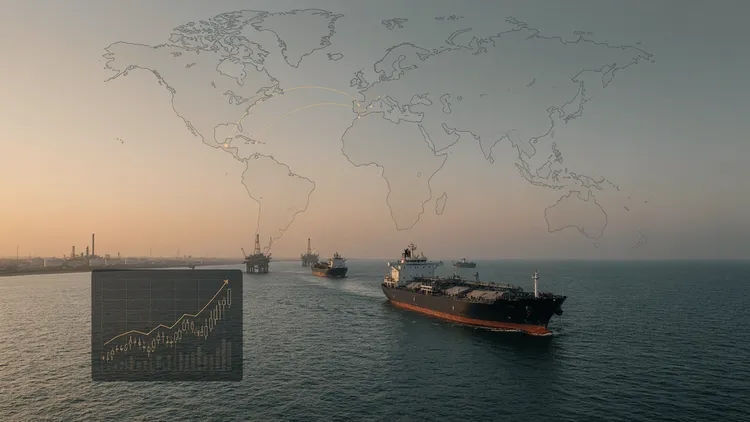
Oil Forecasts Move Higher as Gulf Supply Remains Disrupted
Global oil markets are entering another period of uncertainty as prolonged disruption across the Gulf continues to affect crude exports and shipping routes. Consequently, analysts have raised their expectations for oil prices in 2026 as concerns about supply availability outweigh worries about slower demand growth.
A September Reuters survey of 30 economists and analysts found that Brent crude is expected to average $89.05 per barrel in 2026, while US crude is forecast to average $83.90 per barrel. The range of Brent estimates extends from $77.27 to $97.60, showing how widely market expectations differ.
The latest 2026 oil price forecasts reflect the view that disruptions around the Strait of Hormuz could take longer to resolve than previously expected.
Why the Gulf Remains Central to Oil Prices
The Gulf remains critical to global energy markets because large volumes of crude and refined products move through the region. When shipping routes become restricted, producers and traders must rely on alternative transportation methods, which can increase costs and reduce the amount of oil reaching international markets.
The Strait of Hormuz is particularly important because disruptions there can affect both physical supply and market expectations. Although some shipments have resumed through alternative routes and other workarounds, analysts continue to monitor whether those arrangements can remain effective.
The US Energy Information Administration reported that Brent crude averaged $91 per barrel in August, up from $84 in July. It also expects global oil inventories to continue falling during the second half of 2026 because of ongoing supply disruptions.
Therefore, even when some physical flows recover, the market can remain sensitive to any additional disruption.
Analysts Are Reassessing Their Expectations
Several major financial institutions have already revised their outlooks. HSBC increased its 2026 Brent forecast to $90 per barrel from $80 previously and raised its 2027 forecast to $85 from $65.
Similarly, DBS raised its 2026 Brent forecast range to between $85 and $90 per barrel after renewed tensions affected traffic through the Strait of Hormuz.
These changes demonstrate how quickly commodity expectations can shift when supply conditions change. However, forecasts remain estimates rather than guarantees. A significant improvement in shipping conditions or a broader diplomatic agreement could reduce the supply risk premium and put downward pressure on prices.
Inventories Are Becoming More Important
Oil inventories are another important factor behind the latest market outlook. When supply disruptions persist, countries and companies can rely on stored crude for a period of time. However, continued inventory withdrawals reduce that buffer.
The EIA expects global inventories to decline through the fourth quarter of 2026 before supply conditions gradually improve. It estimates that production shut ins in the region will remain substantial during the period.
As a result, inventory levels have become an important indicator for investors and energy companies. If stocks continue falling while disruptions remain unresolved, prices could face additional upward pressure.
Demand Concerns Still Matter
Supply is currently receiving considerable attention, but demand remains an important part of the equation.
A weaker global economy could reduce fuel consumption and limit how far oil prices rise. China, the United States, India, and other major energy consuming economies will therefore remain important to the outlook.
At the same time, high energy prices can themselves affect economic activity. More expensive fuel raises transportation and manufacturing costs, while businesses may pass those increases on to customers.
Consequently, oil markets are closely connected with broader Finance industry updates because changes in energy costs can influence inflation, interest rates, currencies, and corporate earnings.
Higher Oil Prices Could Affect Businesses Worldwide
The impact of higher crude prices extends well beyond energy companies. Airlines, logistics providers, manufacturers, chemical producers, transportation companies, and other fuel intensive businesses can face increased operating costs.
For consumers, higher energy costs can also reduce disposable income. Therefore, companies may need to reassess budgets, pricing strategies, and cost management plans if elevated oil prices persist.
Marketing teams may also need to reconsider campaign spending when customers become more cautious. This creates a connection with Marketing trends analysis, while sales organizations may need to adapt their approaches as customers face changing operating costs.
India Could Face Additional Energy Pressure
India is particularly sensitive to global crude prices because it imports a large share of the oil it consumes. Consequently, sustained increases in international crude prices can create pressure across the economy.
Higher crude costs can influence the rupee, inflation expectations, transportation expenses, and corporate margins. Recent Reuters reporting noted that elevated crude prices and global market pressures have contributed to weakness in the Indian rupee during September.
However, the effect on consumers does not always move immediately with international crude prices because domestic fuel pricing, government policy, inventories, and currency movements can influence the final impact.
Technology Is Changing How Energy Markets Respond
Technology is also becoming increasingly important in energy market analysis. Advanced data systems can help traders, producers, governments, and financial institutions monitor shipping activity, inventory changes, production levels, and market sentiment.
Artificial intelligence can further assist with analyzing large datasets and identifying changing patterns. Consequently, Technology insights and IT industry news are becoming increasingly relevant to commodity markets.
Energy companies are also investing in digital systems that can improve operational visibility and supply chain planning. These technologies cannot eliminate geopolitical risk, but they can help businesses respond more quickly when market conditions change.
What Businesses Should Watch Next
The direction of oil prices will depend on several interconnected factors. The restoration of Gulf exports, shipping conditions around major maritime routes, global inventories, production recovery, economic growth, and diplomatic developments will all influence the market.
Therefore, businesses should avoid relying on a single oil price assumption when planning budgets. Scenario planning can provide greater flexibility by considering both sustained high prices and a faster normalization of supply.
Companies exposed to fuel costs can also monitor energy expenses more frequently rather than treating them as a fixed annual assumption. Meanwhile, finance teams can evaluate how different oil price environments could affect margins and cash flow.
Practical Insights for the Energy Market
The latest 2026 oil price forecasts highlight an important lesson about commodity markets. Supply disruptions can influence prices even when underlying demand expectations are relatively uncertain.
Businesses should therefore focus on resilience rather than relying exclusively on a single forecast. Monitoring inventories, transportation conditions, currency movements, and energy costs can provide a more complete view of potential risks.
For investors and business leaders, the key issue is not simply whether oil reaches a particular price. Instead, understanding how long supply disruptions persist and how quickly global markets can rebuild inventories may provide more useful information for planning.
Stay Informed With InfoProWeekly Follow the latest Finance industry updates and global business developments with practical analysis from InfoProWeekly.
Visit InfoProWeekly for timely insights across finance, technology, marketing, IT, HR, and sales.