
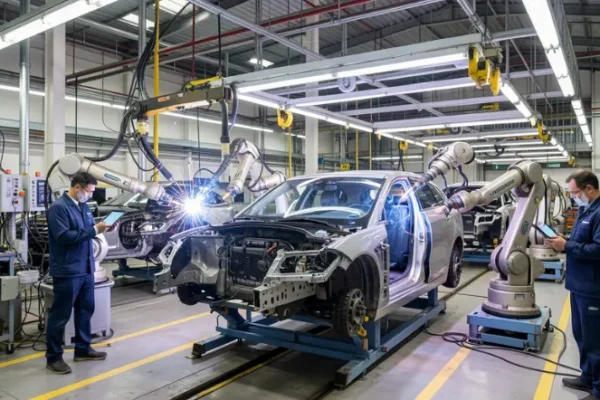
The announcement of the JLR Manufacturing Plant Launched by Tata Motors in Ranipet marks a defining moment in India evolving automotive landscape. Tata Motors has steadily strengthened its global presence and this new facility reflects both ambition and long term industrial vision. Located in Tamil Nadu Ranipet industrial corridor the plant represents a strategic investment designed to elevate production capabilities while reinforcing India role in premium vehicle manufacturing.
This development arrives at a time when global automakers are reassessing supply chains and regional production hubs. Consequently India has emerged as a preferred destination due to infrastructure readiness policy support and skilled workforce availability. The Ranipet facility therefore stands not only as an expansion project but also as a signal of confidence in India manufacturing future.
Strategic Importance of the Ranipet Location
Ranipet has grown into one of South India most promising industrial zones. Its proximity to Chennai ports logistics corridors and supplier ecosystems creates operational advantages that few regions can match. Because of this connectivity Tata Motors can streamline exports while maintaining cost efficiency in domestic distribution.
Moreover Tamil Nadu has consistently attracted automotive investments due to its stable policy environment. The decision behind the JLR Manufacturing Plant Launched by Tata Motors in Ranipet reflects careful evaluation of logistics supplier density and workforce specialization. As a result the facility is expected to integrate seamlessly with existing automotive clusters across the state.
Investment Scale and Infrastructure Vision
The scale of investment behind the JLR Manufacturing Plant Launched by Tata Motors in Ranipet underscores its long horizon objectives. With a commitment of approximately nine thousand crore rupees the company is building a future ready production ecosystem rather than a conventional assembly unit.
Advanced robotics digital manufacturing systems and precision engineering lines are expected to define the plant operational backbone. In addition smart factory frameworks will support predictive maintenance energy optimization and real time production monitoring. These technology insights highlight how next generation automotive plants are blending manufacturing with intelligent automation.
Employment Generation and Workforce Development
Large scale manufacturing projects inevitably shape regional employment patterns and this initiative is no exception. The JLR Manufacturing Plant Launched by Tata Motors in Ranipet is projected to generate substantial direct and indirect job opportunities across technical and non technical domains.
Beyond factory floor roles the plant will stimulate HR trends and insights related to workforce reskilling apprenticeship programs and cross functional training. Automotive manufacturing increasingly demands hybrid skill sets that combine mechanical expertise with digital fluency. Therefore workforce development programs linked to this project are expected to influence hiring models across the broader industry.
Strengthening India Premium Auto Manufacturing Position
Jaguar Land Rover represents one of the most recognized luxury automotive brands globally. Localized manufacturing through the JLR Manufacturing Plant Launched by Tata Motors in Ranipet strengthens India credibility in premium vehicle production.
Domestic manufacturing reduces import dependence improves pricing agility and enhances supply responsiveness. Furthermore it allows Tata Motors to customize production for regional market preferences. From finance industry updates perspective localized production can optimize cost structures currency exposure and long term margin stability.
Supply Chain and Vendor Ecosystem Impact
Whenever a high value automotive plant becomes operational supplier networks expand alongside it. Component manufacturers logistics providers and engineering partners typically scale operations to align with production demand.
The JLR Manufacturing Plant Launched by Tata Motors in Ranipet is expected to energize the surrounding vendor ecosystem. This ripple effect will influence sales strategies and research among auto component firms seeking long term supply contracts. In parallel marketing trends analysis within the automotive sector may increasingly highlight India as a luxury manufacturing destination.
Technology Integration and Smart Manufacturing Evolution
Modern automotive plants are built around data driven manufacturing principles. The Ranipet facility is expected to leverage artificial intelligence enabled quality checks automated assembly validation and digital twin simulations.
Such technology insights reveal how manufacturing is transitioning from labor intensive models to precision led intelligent systems. Real time analytics will allow production leaders to anticipate defects optimize throughput and reduce downtime. Consequently the plant will likely serve as a benchmark for smart automotive manufacturing across emerging markets.
Regional Economic and Industrial Growth Multiplier
Industrial megaprojects often reshape regional economies through infrastructure upgrades housing demand and service sector expansion. The JLR Manufacturing Plant Launched by Tata Motors in Ranipet is positioned to become a growth catalyst for the wider Ranipet and Vellore belt.
Ancillary industries warehousing providers and mobility services are expected to expand in response. IT industry news observers also anticipate rising demand for industrial software cybersecurity systems and plant digitization services supporting the facility operations.
Global Strategy and Export Potential
Tata Motors global strategy increasingly balances domestic production with international demand. By strengthening manufacturing depth in India the company can serve multiple export markets more efficiently.
The JLR Manufacturing Plant Launched by Tata Motors in Ranipet may therefore evolve into a critical export base for select vehicle lines. Trade route accessibility through southern ports enhances shipment timelines while maintaining cost competitiveness in global luxury segments.
Industry Wide Competitive Signaling
Large investments by established automakers often trigger competitive responses. Industry peers closely monitor expansion moves that reshape production economics or supply advantages.
The presence of the JLR Manufacturing Plant Launched by Tata Motors in Ranipet could encourage rival manufacturers to accelerate their India investment strategies. This competitive signaling may further elevate India standing within global automotive manufacturing hierarchies.
Insights for Industry Leaders and Market Watchers
For business leaders this development offers more than manufacturing news. It reflects how localization technology adoption and workforce transformation are converging within modern industrial strategy. Organizations across sectors can study how integrated supply ecosystems reduce operational risk while enhancing scalability.
Equally important is the lesson in long term capital commitment. Strategic infrastructure investments aligned with digital manufacturing capabilities often create durable competitive advantages that extend beyond immediate production gains.
Connect with InfoProWeekly
Stay ahead with trusted industry intelligence and in depth business narratives that decode global transformation. Reach out to InfoProWeekly to explore collaborative insights partnerships and future ready market research.
Source : thehindu.com