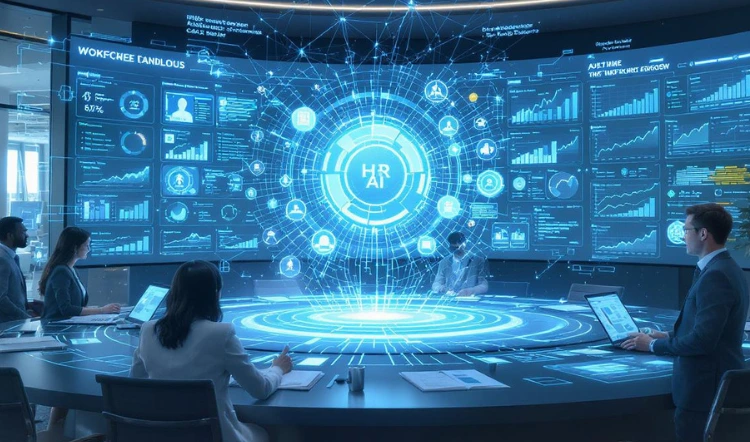

Artificial intelligence is transforming industries across the Middle East and North Africa at a remarkable pace. Governments are investing heavily in digital infrastructure while businesses accelerate automation, analytics, and intelligent systems. As a result, human resources teams are facing new responsibilities. Understanding the Key HR Priorities for AI in MENA Workplaces has become essential for organizations that want to stay competitive while protecting workforce stability.
Moreover, companies are realizing that technology adoption alone does not guarantee success. Instead, people strategies must evolve alongside innovation. Consequently, HR leaders are guiding cultural change, workforce reskilling, and responsible AI adoption while supporting long term growth.
AI reshaping talent strategies across the MENA region
One of the most important Key HR Priorities for AI in MENA Workplaces involves rethinking talent acquisition and workforce planning. AI technologies are redefining the skills required across industries such as finance, technology, marketing, and operations.
As automation expands, many routine tasks are handled by intelligent systems. However, this shift does not eliminate the need for people. Instead, it increases the value of creativity, problem solving, and strategic thinking. Therefore, HR teams are focusing on hiring professionals who can collaborate with AI tools.
At the same time, companies closely monitor technology insights and IT industry news to anticipate future skill demands. This awareness helps HR teams design recruitment strategies that align with emerging workforce needs. Furthermore, many organizations in the region now consider digital literacy a core skill for modern roles.
Reskilling and continuous learning for an AI driven workforce
Another major workforce priority involves employee reskilling. Many companies are discovering that the fastest way to adapt to AI driven change is by investing in the development of their current workforce.
Consequently, training programs focused on data literacy, automation tools, and AI assisted decision making are becoming more common. In addition, organizations are adopting learning platforms that allow employees to update their skills continuously.
HR leaders are also studying global HR trends and insights to design programs that support adaptability. Employees who understand both business strategy and emerging technology often become valuable bridges between leadership teams and technical specialists.
As digital transformation expands across industries, this learning culture helps employees remain confident rather than fearful of technological change. Moreover, it strengthens long term engagement.
Ethical AI adoption and responsible workplace policies
AI offers enormous potential, yet it also introduces concerns related to fairness, transparency, and employee privacy. Because of this, responsible governance has become central to the Key HR Priorities for AI in MENA Workplaces.
Organizations are working closely with HR leaders to develop policies that guide the ethical use of AI in recruitment, performance reviews, and workforce analytics. Clear policies help employees understand how workplace data is collected and used. As a result, trust within organizations improves.
Furthermore, HR teams collaborate with leadership to ensure AI driven decisions always include human oversight. This balanced approach protects employees while allowing companies to benefit from innovation.
Meanwhile, discussions about ethical technology frequently appear in technology insights and IT industry news, which helps HR professionals stay informed about global best practices.
AI driven decision making across business functions
Another important workforce trend involves using AI insights to support broader business strategy. Data analytics platforms now allow HR teams to identify patterns in engagement, productivity, and talent performance.
This insight helps organizations connect workforce planning with growth goals such as digital transformation or market expansion. For example, finance industry updates often highlight how banks and fintech firms use predictive analytics to forecast talent needs.
Similarly, marketing departments rely heavily on AI powered data for campaign planning. This shift aligns with ongoing marketing trends analysis that shows the growing influence of data driven personalization.
In addition, sales teams are benefiting from automation tools and predictive forecasting models. As a result, HR leaders are studying sales strategies and research to understand how skill requirements continue to evolve.
Through this collaboration across departments, HR becomes a strategic partner in business innovation.
Building a workplace culture that supports AI collaboration
Technology adoption succeeds only when company culture supports change. For this reason, cultural transformation remains one of the most important Key HR Priorities for AI in MENA Workplaces.
Employees often feel uncertain when automation enters the workplace. However, organizations that communicate openly about technological change tend to experience smoother transitions. Therefore, HR teams focus on leadership training, transparent communication, and strong engagement initiatives.
Companies are also encouraging collaboration between technical experts and non technical teams. This approach ensures that AI enhances human abilities instead of replacing them.
Gradually, this shift is helping organizations see artificial intelligence as a partner that improves creativity and productivity.
Practical insights for HR leaders navigating AI adoption
Organizations across the region are learning that successful AI adoption depends on human strategy. The Key HR Priorities for AI in MENA Workplaces highlight the need to align technology investment with workforce development, ethical policies, and cultural readiness.
HR professionals who follow technology insights, HR trends and insights, and IT industry news are better prepared to anticipate future workforce demands. Likewise, attention to finance industry updates, marketing trends analysis, and sales strategies and research provides valuable context for business transformation.
Companies that place equal importance on people and technology will create stronger and more adaptable workplaces. When employees receive the right training and support, AI becomes a powerful driver of growth.
Connect with InfoProWeekly to explore deeper industry intelligence and expert perspectives on digital transformation and workforce strategy.